Paper II — Q5
(a) A DC motor has an armature resistance of 0·5 Ω and Kφ of 3 Vs. The motor is driven by a single-phase thyristorized full…
A DC motor has an armature resistance of 0·5 Ω and Kφ of 3 Vs. The motor is driven by a single-phase thyristorized full converter. The input to the converter is an AC source of 230 V, 50 Hz. The motor is used as a prime mover of a forklift. In the upward direction, the mechanical load is 69 Nm and the triggering angle is α = 15°. In the downward direction, the load torque is 180 Nm. Calculate the triggering angle required to keep the downward speed equal in magnitude to upward speed. Assume continuous motor current for all operation. Also calculate the triggering angle to keep the motor at holding position while it was moving upward. 12 marks
The primary side of an ideal transformer (having 400 turns in primary winding and 720 turns in secondary winding) is excited by a 1000 V, 50 Hz AC source. The secondary of the transformer is connected to a resistive load of 80 kW. There is one tapping in secondary winding at 480 turns and this tapping is supplying a pure inductive load of 100 kVA. Determine the primary current and its power factor. 12 marks
Obtain an expression for the total average power of a sinusoidal AM wave v_c = V_c sin ω_c t v_m = V_m sin ω_m t
An AM transmitter broadcasts a carrier power of 100 kW. Determine the radiated power at the amplitude modulation index of 0·8. 12 marks
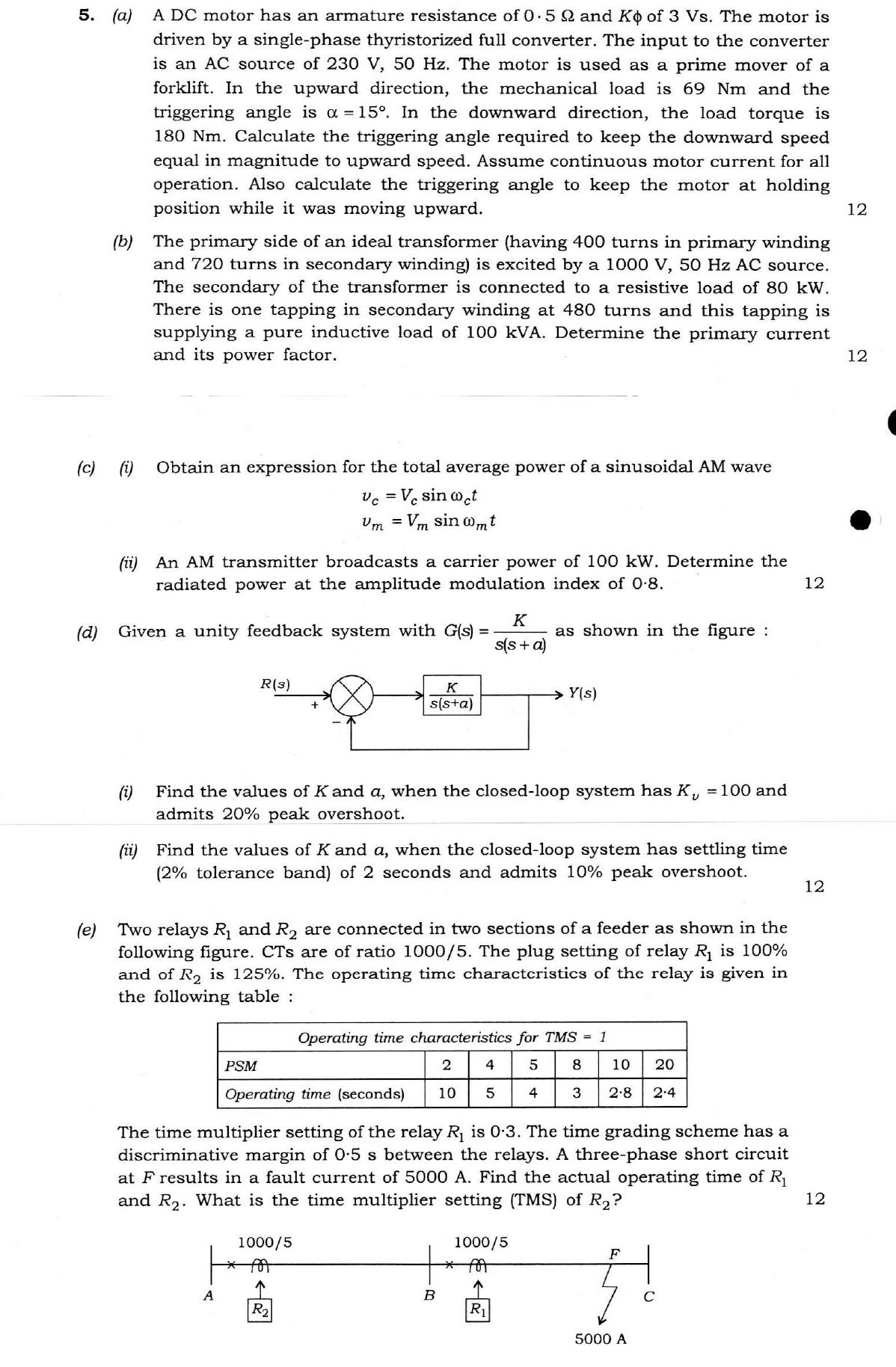
Given a unity feedback system with G(s) = K/s(s+a) as shown in the figure :
Find the values of K and a, when the closed-loop system has K_v = 100 and admits 20% peak overshoot.
Find the values of K and a, when the closed-loop system has settling time (2% tolerance band) of 2 seconds and admits 10% peak overshoot. 12 marks
Two relays R_1 and R_2 are connected in two sections of a feeder as shown in the following figure. CTs are of ratio 1000/5. The plug setting of relay R_1 is 100% and of R_2 is 125%. The operating time characteristics of the relay is given in the following table :
Operating time characteristics for TMS = 1 PSM | 2 | 4 | 5 | 8 | 10 | 20 Operating time (seconds) | 10 | 5 | 4 | 3 | 2·8 | 2·4
The time multiplier setting of the relay R_1 is 0·3. The time grading scheme has a discriminative margin of 0·5 s between the relays. A three-phase short circuit at F results in a fault current of 5000 A. Find the actual operating time of R_1 and R_2. What is the time multiplier setting (TMS) of R_2? 12 marks
The figure this question refers to, in words
The question paper is a scan and the diagram did not survive as text. This is the figure as read from the original page — every component, value and label — so the question can be worked from the text below.
(d) A block diagram of a closed-loop unity negative feedback control system. An input R(s) enters a summing point with a positive sign (+). The output of the summing point feeds into a forward path block with transfer function K / [s(s + a)]. The output of this block is Y(s). A feedback signal branches directly from Y(s) and connects back to the summing point with a negative sign (-).
(e) Table: Operating time characteristics for TMS = 1 PSM: 2 | 4 | 5 | 8 | 10 | 20 Operating time (seconds): 10 | 5 | 4 | 3 | 2.8 | 2.4
Diagram: A single-line diagram of a feeder showing three vertical busbars labeled A, B, and C from left to right.
- Between busbar A and busbar B, the line contains a circuit breaker (marked with an 'x') followed by a CT labeled '1000/5', connected to relay 'R2'.
- Between busbar B and busbar C, the line contains a circuit breaker (marked with an 'x') followed by a CT labeled '1000/5', connected to relay 'R1'.
- Beyond the CT for R1, before busbar C, a fault is indicated at point 'F' with a lightning arrow pointing downwards to '5000 A'.
Model answer
Written by UPSC Answer Check against this question's marking rubric, to the expected length. UPSC does not publish answers for Mains — this is one way to score well, not an official key.
(a) For a single-phase fully controlled converter with continuous current, the average output voltage is Vdc = (2Vm/π) cos α, where Vm = √2 × 230 = 325.27 V. Thus Vmax = 2Vm/π = 2 × 325.27/π = 207.07 V.
Upward motion: Vdc = 207.07 cos 15° = 207.07 × 0.96593 = 200.0 V. Motor torque T = Kφ Ia, so Ia = 69/3 = 23 A. Back emf: Eb = Vdc − IaRa = 200 − 23 × 0.5 = 188.5 V. Speed: ωup = Eb/Kφ = 188.5/3 = 62.83 rad/s.
Downward motion at same speed magnitude: The back emf reverses, so Eb,down = −188.5 V. The downward load torque assists motion; the motor must brake, so it develops +180 Nm torque. Ia,down = 180/3 = 60 A. Required converter voltage: Vdc,down = Eb,down + IaRa = −188.5 + 60 × 0.5 = −158.5 V. Hence cos αd = −158.5/207.07 = −0.7654. So αd = arccos(−0.7654) = 139.95° ≈ 140°.
Holding position while moving upward: At holding, speed = 0, so Eb = 0. Load torque is 69 Nm, hence Ia = 23 A. Vdc = IaRa = 23 × 0.5 = 11.5 V. cos αh = 11.5/207.07 = 0.05554. So αh = arccos(0.05554) = 86.82°.
Final answers: downward α = 139.95°, holding α = 86.82°.
(b) Primary turns N1 = 400, full secondary N2 = 720, tapping N3 = 480. V1 = 1000 V. Full secondary voltage: V2 = 1000 × 720/400 = 1800 V. Tapping voltage: V3 = 1000 × 480/400 = 1200 V.
Resistive load current: I2 = 80,000/1800 = 44.44 A, in phase with V2.
Inductive load current: I3 = 100,000/1200 = 83.33 A, lagging by 90°, so phasor I3 = −j83.33 A.
Reflecting secondary currents to primary: I1 = (N2 I2 + N3 I3)/N1 = [720 × 44.44 + 480 × (−j83.33)]/400 = [32000 − j40000]/400 = 80 − j100 A.
Magnitude: |I1| = √(80² + 100²) = √16400 = 128.06 A. Power factor = cos φ = 80/128.06 = 0.6247 lagging.
Final answers: primary current = 128.06 A, power factor = 0.6247 lagging.
(c)(i) AM wave: v = (Vc + Vm sin ωm t) sin ωc t = Vc(1 + m sin ωm t) sin ωc t, where m = Vm/Vc.
For resistive load R, instantaneous power p = v²/R. Averaging over an RF cycle and over the modulating cycle: average sin²ωc t = 1/2, average sin ωm t = 0, average sin²ωm t = 1/2.
Thus Ptotal = Vc²/(2R) × (1 + m²/2) = Pc(1 + m²/2), where Pc = Vc²/(2R).
Equivalently, Ptotal = Vc²/(2R) + Vm²/(4R). The total sideband power is m²Pc/2.
(c)(ii) Pc = 100 kW, m = 0.8. Ptotal = 100 × (1 + 0.8²/2) = 100 × (1 + 0.32) = 132 kW.
Final answer: radiated power = 132 kW.
(d)(i) For unity feedback, closed-loop characteristic equation: 1 + G(s) = 0 1 + K/[s(s+a)] = 0 s² + a s + K = 0.
Compare with s² + 2ζωn s + ωn² = 0: a = 2ζωn, K = ωn². Velocity error constant: Kv = lim s→0 sG(s) = K/a.
Given Kv = 100, K/a = 100 ⇒ K = 100a.
Peak overshoot 20%: Mp = e^(−πζ/√(1−ζ²)) = 0.20. Solving gives ζ ≈ 0.456.
Using K = 100a and a = 2ζωn, K = ωn²: a = 400ζ², K = 40000ζ². ζ² ≈ 0.2079. Therefore a ≈ 83.16 s⁻¹, K ≈ 8316 s⁻².
Final answers: K ≈ 8.32 × 10³, a ≈ 83.16 s⁻¹.
(d)(ii) For 2% settling time: ts = 4/(ζωn) = 2 s ⇒ ζωn = 2.
Peak overshoot 10%: Mp = e^(−πζ/√(1−ζ²)) = 0.10. Solving gives ζ ≈ 0.591.
Then a = 2ζωn = 2 × 2 = 4 s⁻¹. ωn = 2/ζ = 2/0.591 ≈ 3.383 rad/s. K = ωn² ≈ 11.45 s⁻².
Final answers: K ≈ 11.45, a = 4 s⁻¹.
(e) CT ratio = 1000/5, so secondary current for 5000 A fault: Ict = 5000/(1000/5) = 5000/200 = 25 A.
Assume relay rated current = 5 A.
For R1: Plug setting = 100% ⇒ pickup = 1.00 × 5 = 5 A. PSM = 25/5 = 5. From table, for PSM = 5, operating time at TMS = 1 is 4 s. TMS1 = 0.3. Actual time of R1: t1 = 4 × 0.3 = 1.2 s.
For R2: Plug setting = 125% ⇒ pickup = 1.25 × 5 = 6.25 A. PSM = 25/6.25 = 4. From table, for PSM = 4, operating time at TMS = 1 is 5 s.
Grading margin = 0.5 s. Since R2 is upstream backup, t2 = t1 + 0.5 = 1.2 + 0.5 = 1.7 s.
Therefore TMS of R2: TMS2 = t2/5 = 1.7/5 = 0.34.
Final answers: actual operating time of R1 = 1.2 s, actual operating time of R2 = 1.7 s, TMS of R2 = 0.34.
What "Solve" is asking you to do
Choose the method, then carry it through to a final answer. Identifying what kind of problem this is and why that method applies is the first thing marked; a correct figure arrived at invisibly earns almost nothing.
Structure that answers it
Given data and what is required → method chosen, with the reason it applies → set-up (equation, circuit, free body, trial balance) → working, step by step → answer with units and any condition of validity
Where marks are lost
Doing the middle steps mentally and writing only the result. In mathematics papers, a further loss comes from giving a decimal where the exact value in surds or fractions was wanted, or from skipping the justification a part explicitly asks for.
How this answer will be evaluated
Approach
(a) calculate: given > formula > substitution > result with units > interpretation | (b) calculate: given > formula > substitution > result with units > interpretation | (c(i)) derive: given > assumptions > stepwise derivation > result > check | (c(ii)) calculate: given > formula > substitution > result with units > interpretation | (d(i)) calculate: given > formula > substitution > result with units > interpretation | (d(ii)) calculate: given > formula > substitution > result with units > interpretation | (e) calculate: given > formula > substitution > result with units > interpretation Full marks: Complete method with correct calculations, clear assumptions, and proper units throughout.
Key points expected
- Calculate upward speed from given torque and alpha
- Apply back-EMF equation for downward motoring/braking
- Solve for alpha_downward for equal speed magnitude
- Calculate alpha for holding position (zero speed)
- Calculate secondary voltages for 720T and 480T taps
- Determine secondary currents for resistive and inductive loads
- Refer secondary currents to primary side
- Calculate total primary current and power factor
Evaluation rubric
Each sub-part is marked on its own, against the marks and word limit printed on the paper.
- (a) Determine triggering angles for downward speed and holding position. 12 marks
calculate— given → formula → substitution → result with units → interpretation
Must cover
- Calculate upward speed from given torque and alpha
- Apply back-EMF equation for downward motoring/braking
- Solve for alpha_downward for equal speed magnitude
- Calculate alpha for holding position (zero speed)
Loses marks
- Ignoring back-EMF in voltage balance
- Sign errors in torque or speed direction
- Using half-wave converter formula
Earns more
- Correct use of full converter voltage equation
- Explicit assumption of continuous current
- Clear distinction between motoring and braking modes
Extra mark
- Sketch of converter voltage waveform
- Verification of current continuity condition
- (b) Determine primary current magnitude and power factor. 12 marks
calculate— given → formula → substitution → result with units → interpretation
Must cover
- Calculate secondary voltages for 720T and 480T taps
- Determine secondary currents for resistive and inductive loads
- Refer secondary currents to primary side
- Calculate total primary current and power factor
Loses marks
- Arithmetic addition of currents instead of phasor
- Incorrect turns ratio application
- Ignoring phase difference between loads
Earns more
- Correct application of transformer turns ratio
- Proper phasor addition of currents
- Clear separation of real and reactive components
Extra mark
- Phasor diagram showing current components
- Verification of power balance
- (c(i)) Obtain expression for total average power of AM wave.
derive— given → assumptions → stepwise derivation → result → check
Must cover
- Write AM wave equation with modulation index
- Expand squared term for power calculation
- Integrate over period to find average power
- Express result in terms of carrier power and m
Loses marks
- Missing integration step
- Incorrect expansion of squared term
- Confusing peak and RMS values
Earns more
- Clear definition of modulation index m
- Step-by-step integration shown
- Final expression P = Pc(1 + m²/2)
Extra mark
- Spectral power distribution explanation
- Graph of power vs modulation index
- (c(ii)) Determine radiated power at modulation index 0.8.
calculate— given → formula → substitution → result with units → interpretation
Must cover
- Use derived power expression from part (i)
- Substitute Pc = 100 kW and m = 0.8
- Calculate total radiated power
- State result with units
Loses marks
- Using wrong power formula
- Arithmetic errors in calculation
- Missing units in final answer
Earns more
- Correct substitution of values
- Clear arithmetic steps
- Final answer 132 kW
Extra mark
- Breakdown of carrier and sideband power
- Percentage increase calculation
- (d(i)) Find K and a for Kv=100 and 20% overshoot.
calculate— given → formula → substitution → result with units → interpretation
Must cover
- Determine closed-loop transfer function
- Apply Kv = K/a = 100 condition
- Use overshoot formula to find damping ratio
- Solve for K and a using characteristic equation
Loses marks
- Incorrect Kv formula application
- Wrong overshoot-damping relation
- Algebraic errors in solving equations
Earns more
- Correct closed-loop TF derivation
- Proper use of overshoot-damping relation
- Systematic solution of equations
Extra mark
- Root locus sketch
- Verification of stability
- (d(ii)) Find K and a for Ts=2s and 10% overshoot.
calculate— given → formula → substitution → result with units → interpretation
Must cover
- Use settling time formula Ts = 4/ζωn
- Apply overshoot formula for 10% overshoot
- Relate ζ and ωn to K and a
- Solve simultaneous equations for K and a
Loses marks
- Wrong settling time formula
- Incorrect damping ratio from overshoot
- Algebraic errors in solution
Earns more
- Correct settling time formula application
- Proper damping ratio calculation
- Systematic solution of equations
Extra mark
- Step response sketch
- Comparison with part (i) results
- (e) Find operating times of R1, R2 and TMS of R2. 12 marks
calculate— given → formula → substitution → result with units → interpretation
Must cover
- Calculate PSM for both relays from fault current
- Determine operating time of R1 using TMS=0.3
- Apply 0.5s discriminative margin for R2
- Calculate TMS of R2 from required operating time
Loses marks
- Incorrect PSM calculation
- Ignoring CT ratio in current calculation
- Wrong application of time margin
Earns more
- Correct PSM calculation using CT ratio
- Proper use of operating time table
- Clear application of time grading
Extra mark
- Time-current characteristic sketch
- Verification of coordination
Practice this exact question
Write your answer and it is marked point by point against the model answer above — what you covered, what you missed, what you got wrong.
Evaluate my answer →More from Electrical Engineering 2022 Paper II
- Q2 (a) A single-phase full bridge inverter is used to produce a 50 Hz voltage across a serie…
- Q3 (a) For the circuit shown below, calculate the output voltage : R₁ = 1 kΩ R₂ = 2 kΩ R₃ =…
- Q4 (a) (i) What do you mean by grading of cables? What are the methods of grading? (ii) Deri…
- Q5 (a) A DC motor has an armature resistance of 0·5 Ω and Kφ of 3 Vs. The motor is driven by…
- Q6 (a) A 20 kW, 500 V DC shunt motor (having 90% full-load efficiency) has 40% armature copp…
- Q7 (a) A full-controlled full-wave bridge AC/DC converter is fed from a single-phase, 230 V,…
- Q8 (a) A signal is given by x[t] = cos(28πt) + 2cos(40πt) + 3cos(70πt) This signal is sample…