Paper II — Q4
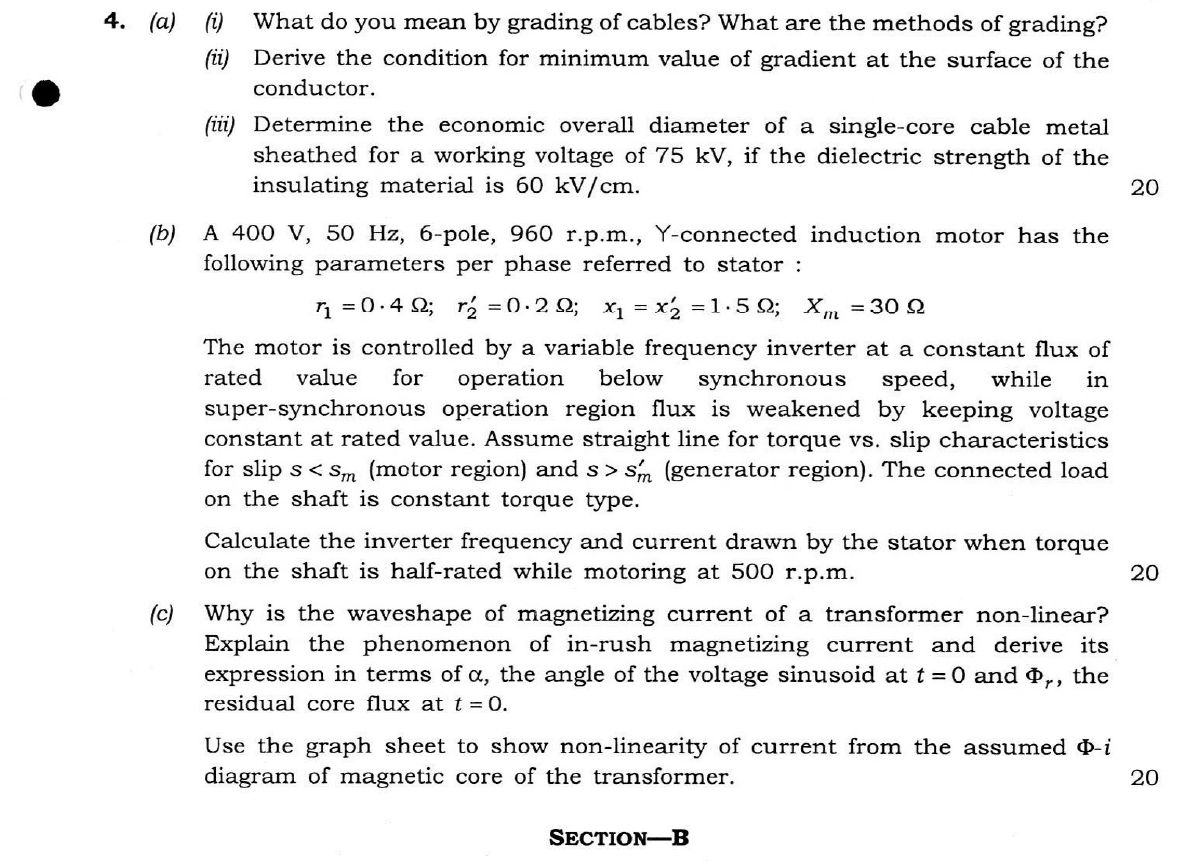
(a) (i) What do you mean by grading of cables? What are the methods of grading? (ii) Derive the condition for minimum value of…
What do you mean by grading of cables? What are the methods of grading?
Derive the condition for minimum value of gradient at the surface of the conductor.
Determine the economic overall diameter of a single-core cable metal sheathed for a working voltage of 75 kV, if the dielectric strength of the insulating material is 60 kV/cm.
A 400 V, 50 Hz, 6-pole, 960 r.p.m., Y-connected induction motor has the following parameters per phase referred to stator : r₁ = 0·4 Ω; r₂' = 0·2 Ω; x₁ = x₂' = 1·5 Ω; Xₘ = 30 Ω
The motor is controlled by a variable frequency inverter at a constant flux of rated value for operation below synchronous speed, while in super-synchronous operation region flux is weakened by keeping voltage constant at rated value. Assume straight line for torque vs. slip characteristics for slip s < sₘ (motor region) and s > sₘ' (generator region). The connected load on the shaft is constant torque type.
Calculate the inverter frequency and current drawn by the stator when torque on the shaft is half-rated while motoring at 500 r.p.m.
Why is the waveshape of magnetizing current of a transformer non-linear? Explain the phenomenon of in-rush magnetizing current and derive its expression in terms of α, the angle of the voltage sinusoid at t = 0 and Φᵣ, the residual core flux at t = 0.
Use the graph sheet to show non-linearity of current from the assumed Φ-i diagram of magnetic core of the transformer.
Model answer
Written by UPSC Answer Check against this question's marking rubric, to the expected length. UPSC does not publish answers for Mains — this is one way to score well, not an official key.
(a)(i) Grading of cables means controlling the dielectric stress in the insulation so that the maximum electric stress at the conductor surface is reduced and the insulation is used economically. The main methods are:
- Capacitance grading: two or more dielectric layers of different permittivities are used concentrically.
- Intersheath grading: one or more metallic intersheaths are placed at suitable potentials inside the dielectric, each layer being designed for the same maximum stress.
(a)(ii) Let conductor radius = r, sheath radius = R, and voltage between conductor and sheath = V. For a single-core cable, electric stress at radius x is g(x) = V/(x ln(R/r)). At the conductor surface, x = r: gₘₐₓ = V/(r ln(R/r)). For fixed R and V, minimise gₘₐₓ by maximising y = r ln(R/r). dy/dr = ln(R/r) - 1. Set dy/dr = 0: ln(R/r) = 1, so R/r = e. Since d²y/dr² = -1/r < 0, this gives the minimum surface gradient. Thus the condition is R = e r.
(a)(iii) For economic design, the surface gradient equals the dielectric strength gₛ. Using R = e r, V = gₛ r ln(R/r) = gₛ r. Given V = 75 kV and gₛ = 60 kV/cm, r = 75/60 = 1.25 cm. R = e r = 2.71828 × 1.25 = 3.3979 cm. Overall diameter = 2R = 6.7957 cm. Overall diameter ≈ 6.80 cm.
(b) At 50 Hz, synchronous speed: Nₛ = 120f/p = 120 × 50/6 = 1000 rpm. Rated slip: s_N = (1000 - 960)/1000 = 0.04. Rated slip frequency: fₛ_N = s_N f = 0.04 × 50 = 2 Hz. For constant flux below base speed, torque is proportional to slip frequency. Hence for half-rated torque, fₛ = 1 Hz. At N = 500 rpm motoring, Nₛ' = N + (120/p)fₛ = 500 + (120/6) × 1 = 520 rpm. Inverter frequency: f' = Nₛ' p/120 = 520 × 6/120 = 26 Hz. Inverter frequency = 26 Hz.
Slip at this point: s = (520 - 500)/520 = 0.0384615. Rated phase voltage = 400/√3 = 230.94 V. At constant flux, V' = 230.94 × (26/50) = 120.09 V. Reactances at 26 Hz: x₁ = x₂' = 1.5 × 26/50 = 0.78 Ω, Xₘ = 30 × 26/50 = 15.6 Ω. Rotor branch: r₂'/s = 0.2/0.0384615 = 5.2 Ω. Using the per-phase equivalent circuit, Z₂ = 5.2 + j0.78 Ω, Zₘ = j15.6 Ω. Parallel combination: Zₚ = (j15.6)(5.2 + j0.78)/(j15.6 + 5.2 + j0.78) = 4.285 + j2.103 Ω. Total impedance: Z = 0.4 + j0.78 + 4.285 + j2.103 = 4.685 + j2.883 Ω. |Z| = √(4.685² + 2.883²) = 5.501 Ω. Stator current: I₁ = V'/|Z| = 120.09/5.501 = 21.83 A. Stator current ≈ 21.8 A (line = phase).
(c) The magnetizing current waveshape is non-linear because the core B-H or Φ-i relation is non-linear. For a sinusoidal voltage, flux is almost sinusoidal, but the current required to produce that flux is not linear in flux; saturation makes the current peaked and rich in odd harmonics, especially third harmonic.
In-rush magnetizing current occurs when a transformer is switched on with residual core flux Φᵣ. Let the applied voltage be v(t) = Vₘ sin(ωt + α). By Faraday’s law, Vₘ sin(ωt + α) = N dΦ/dt. Integrating from t = 0, with Φ(0) = Φᵣ: Φ(t) = Φᵣ + (Vₘ/(Nω))[cos α - cos(ωt + α)]. Let Φₘ = Vₘ/(Nω). Then Φ(t) = Φᵣ + Φₘ cos α - Φₘ cos(ωt + α). The term Φᵣ + Φₘ cos α is a dc offset. The worst case occurs at α = 0, giving Φₘₐₓ = Φᵣ + 2Φₘ. This drives the core deep into saturation, producing a large unidirectional magnetizing current pulse that decays with the primary time constant. The current is iₘ(t) = f[Φ(t)] = f[Φᵣ + Φₘ(cos α - cos(ωt + α))], where f denotes the non-linear Φ-i characteristic.
Graph description: plot Φ on the y-axis and i on the x-axis. The curve is almost linear up to the knee and then bends sharply, showing saturation. When the flux waveform with dc offset is projected onto this curve, the resulting current is non-sinusoidal with narrow, high peaks.
What "Solve" is asking you to do
Choose the method, then carry it through to a final answer. Identifying what kind of problem this is and why that method applies is the first thing marked; a correct figure arrived at invisibly earns almost nothing.
Structure that answers it
Given data and what is required → method chosen, with the reason it applies → set-up (equation, circuit, free body, trial balance) → working, step by step → answer with units and any condition of validity
Where marks are lost
Doing the middle steps mentally and writing only the result. In mathematics papers, a further loss comes from giving a decimal where the exact value in surds or fractions was wanted, or from skipping the justification a part explicitly asks for.
How this answer will be evaluated
Approach
(a(i)) describe: define > structure or process in order > labelled diagram > significance | (a(ii)) derive: given > assumptions > stepwise derivation > result > check | (a(iii)) calculate: given > formula > substitution > result with units > interpretation | (b) calculate: given > formula > substitution > result with units > interpretation | (c) explain: definition/context > points in order > small example > short close Full marks: All parts answered with correct derivations, calculations, and clear explanations.
Key points expected
- Define grading as uniform stress distribution
- List methods (e.g., concentric layers)
- Explain the purpose of grading
- Start with the general stress formula
- Differentiate with respect to radius
- Set derivative to zero for minimum
- State the final condition (ratio of radii)
- Identify given values (V, dielectric strength)
Evaluation rubric
Each sub-part is marked on its own, against the marks and word limit printed on the paper.
- (a(i)) Definition of cable grading and its methods.
describe— define → structure or process in order → labelled diagram → significance
Must cover
- Define grading as uniform stress distribution
- List methods (e.g., concentric layers)
- Explain the purpose of grading
Loses marks
- Confusing grading with insulation thickness
- Missing the definition
Earns more
- Mention specific dielectric constants
- Reference to stress reduction
Extra mark
- Diagram of concentric layers
- (a(ii)) Derivation of the condition for minimum surface gradient.
derive— given → assumptions → stepwise derivation → result → check
Must cover
- Start with the general stress formula
- Differentiate with respect to radius
- Set derivative to zero for minimum
- State the final condition (ratio of radii)
Loses marks
- Skipping the differentiation step
- Incorrect final condition
Earns more
- Clear step-by-step algebra
- Correct use of calculus notation
Extra mark
- Physical interpretation of the result
- (a(iii)) Calculation of the economic overall diameter of the cable.
calculate— given → formula → substitution → result with units → interpretation
Must cover
- Identify given values (V, dielectric strength)
- Apply the economic diameter formula
- Substitute values correctly
- Provide final answer with units
Loses marks
- Using wrong formula
- Unit errors
Earns more
- Clear substitution steps
- Correct unit conversion
Extra mark
- Mentioning the economic ratio
- (b) Calculation of inverter frequency and stator current for half-rated torque. 20 marks
calculate— given → formula → substitution → result with units → interpretation
Must cover
- Determine slip and synchronous speed
- Calculate inverter frequency from speed
- Use equivalent circuit for current
- Apply constant flux condition
Loses marks
- Ignoring the constant flux condition
- Incorrect slip calculation
Earns more
- Correct use of per-unit or referred values
- Clear torque-slip relationship
Extra mark
- Phasor diagram of the motor
- (c) Explanation of non-linear magnetizing current and in-rush phenomenon. 20 marks
explain— definition/context → points in order → small example → short close
Must cover
- Explain non-linearity due to core saturation
- Define in-rush magnetizing current
- Derive expression involving alpha and residual flux
- Show non-linearity on a graph
Loses marks
- Missing the derivation
- Not explaining the role of residual flux
Earns more
- Clear explanation of saturation
- Correct derivation of the expression
Extra mark
- Graph of B-H curve
- Mention of practical implications
Practice this exact question
Write your answer and it is marked point by point against the model answer above — what you covered, what you missed, what you got wrong.
Evaluate my answer →More from Electrical Engineering 2022 Paper II
- Q1 (a) A single-phase AC voltage controller is feeding a resistive load of 26·45 Ω from an A…
- Q2 (a) A single-phase full bridge inverter is used to produce a 50 Hz voltage across a serie…
- Q3 (a) For the circuit shown below, calculate the output voltage : R₁ = 1 kΩ R₂ = 2 kΩ R₃ =…
- Q4 (a) (i) What do you mean by grading of cables? What are the methods of grading? (ii) Deri…
- Q5 (a) A DC motor has an armature resistance of 0·5 Ω and Kφ of 3 Vs. The motor is driven by…
- Q6 (a) A 20 kW, 500 V DC shunt motor (having 90% full-load efficiency) has 40% armature copp…
- Q7 (a) A full-controlled full-wave bridge AC/DC converter is fed from a single-phase, 230 V,…