Paper II — Q3
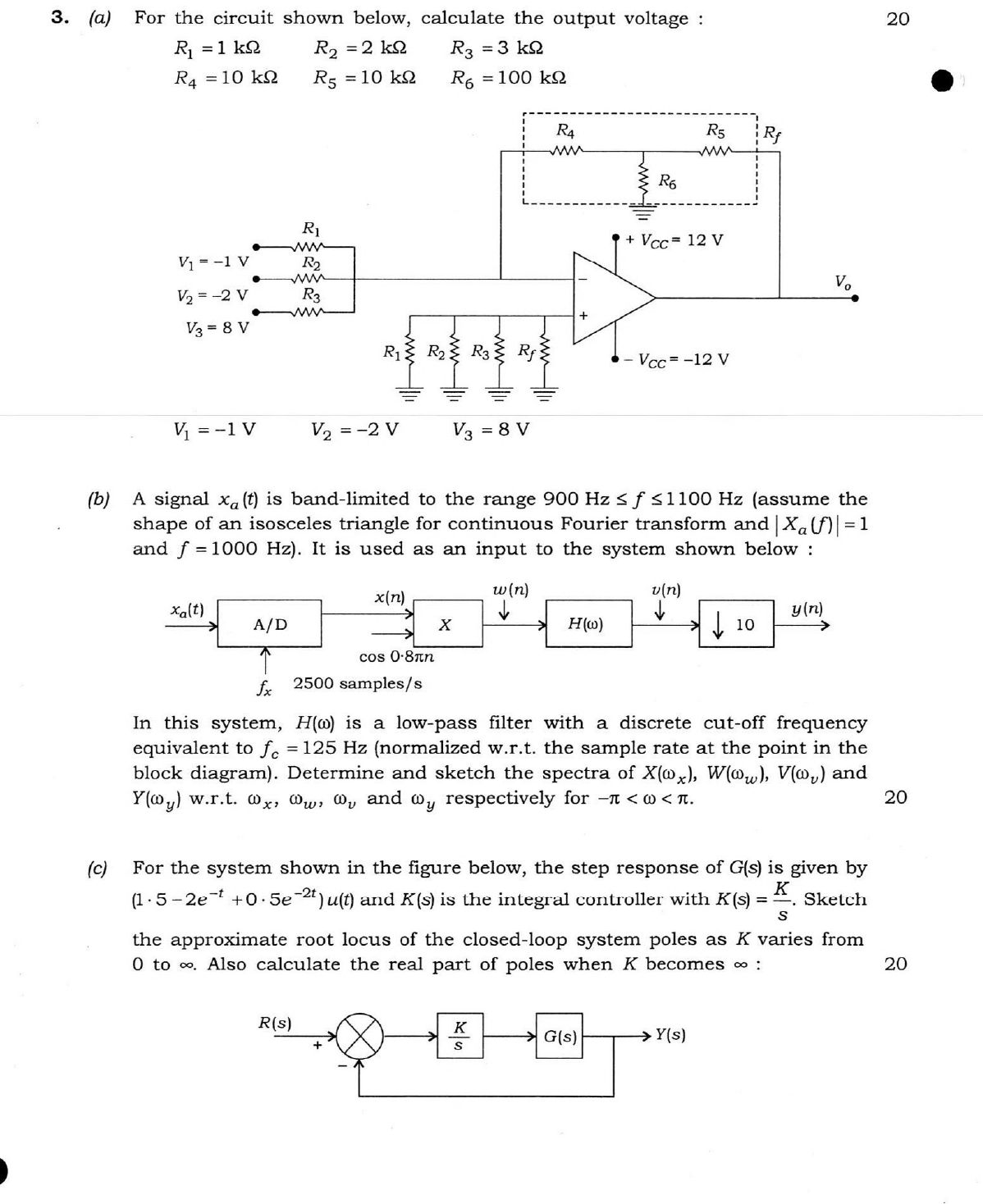
(a) For the circuit shown below, calculate the output voltage : R₁ = 1 kΩ R₂ = 2 kΩ R₃ = 3 kΩ R₄ = 10 kΩ R₅ = 10 kΩ R₆…
For the circuit shown below, calculate the output voltage : R₁ = 1 kΩ R₂ = 2 kΩ R₃ = 3 kΩ R₄ = 10 kΩ R₅ = 10 kΩ R₆ = 100 kΩ
V₁ = -1 V V₂ = -2 V V₃ = 8 V
A signal xₐ(t) is band-limited to the range 900 Hz ≤ f ≤ 1100 Hz (assume the shape of an isosceles triangle for continuous Fourier transform and |Xₐ(f)| = 1 and f = 1000 Hz). It is used as an input to the system shown below :
In this system, H(ω) is a low-pass filter with a discrete cut-off frequency equivalent to f꜀ = 125 Hz (normalized w.r.t. the sample rate at the point in the block diagram). Determine and sketch the spectra of X(ωₓ), W(ωᵥ), V(ωᵥ) and Y(ωᵧ) w.r.t. ωₓ, ωᵥ, ωᵥ and ωᵧ respectively for -π < ω < π.
For the system shown in the figure below, the step response of G(s) is given by (1·5 - 2e⁻ᵗ + 0·5e⁻²ᵗ)u(t) and K(s) is the integral controller with K(s) = K/s. Sketch the approximate root locus of the closed-loop system poles as K varies from 0 to ∞. Also calculate the real part of poles when K becomes ∞ :
The figure this question refers to, in words
The question paper is a scan and the diagram did not survive as text. This is the figure as read from the original page — every component, value and label — so the question can be worked from the text below.
(a) An operational amplifier circuit. The op-amp is powered by +Vcc = 12 V and -Vcc = -12 V. The non-inverting input (+) is connected to ground through a network of four resistors R1, R2, R3, and Rf, all connected in parallel between the input pin and ground. The inverting input (-) is connected to a summing junction. Three input voltages are connected to this junction through resistors: V1 = -1 V through R1 = 1 kOhm, V2 = -2 V through R2 = 2 kOhm, and V3 = 8 V through R3 = 3 kOhm. The feedback network connects the output Vo to the inverting input. This network consists of resistor R4 = 10 kOhm in series with resistor R5 = 10 kOhm, with resistor R6 = 100 kOhm connected from the junction between R4 and R5 to ground. The output is labeled Vo.
(b) A block diagram of a signal processing system. The input is xa(t). It enters an A/D converter block, which has a sampling rate fx = 2500 samples/s. The output of the A/D converter is x(n). This signal enters a block labeled 'X'. A second input to block 'X' is a cosine signal cos(0.8*pi*n). The output of block 'X' is w(n). This signal enters a filter block labeled H(omega). The output of the filter is v(n). This signal enters a downsampling block labeled with a down arrow and the number 10. The final output is y(n).
(c) A closed-loop control system block diagram. The input is R(s). It enters a summing junction with a positive sign. The output of the summing junction enters a block labeled K/s. The output of the K/s block enters a block labeled G(s). The output of G(s) is Y(s). A feedback path takes the signal from Y(s) and feeds it back to the summing junction with a negative sign.
What "Solve" is asking you to do
Choose the method, then carry it through to a final answer. Identifying what kind of problem this is and why that method applies is the first thing marked; a correct figure arrived at invisibly earns almost nothing.
Structure that answers it
Given data and what is required → method chosen, with the reason it applies → set-up (equation, circuit, free body, trial balance) → working, step by step → answer with units and any condition of validity
Where marks are lost
Doing the middle steps mentally and writing only the result. In mathematics papers, a further loss comes from giving a decimal where the exact value in surds or fractions was wanted, or from skipping the justification a part explicitly asks for.
How this answer will be evaluated
Approach
(a) calculate: given > formula > substitution > result with units > interpretation | (b) describe: define > structure or process in order > labelled diagram > significance | (c) describe: define > structure or process in order > labelled diagram > significance Full marks: Complete working with correct results and clear diagrams
Key points expected
- Apply superposition or nodal analysis at inverting node
- Calculate equivalent feedback resistance Rf
- Substitute given values for R1-R6 and V1-V3
- State final result with units
- Sketch X(ωx) showing band-limited triangle shape
- Sketch W(ωw) showing modulation by cos(0.8πn)
- Sketch V(ωv) showing low-pass filtering effect
- Sketch Y(ωy) showing decimation by 10
Evaluation rubric
Each sub-part is marked on its own, against the marks and word limit printed on the paper.
- (a) Output voltage Vo of the op-amp circuit. 20 marks
calculate— given → formula → substitution → result with units → interpretation
Must cover
- Apply superposition or nodal analysis at inverting node
- Calculate equivalent feedback resistance Rf
- Substitute given values for R1-R6 and V1-V3
- State final result with units
Loses marks
- Sign errors in voltage summation
- Incorrect calculation of parallel resistance
Earns more
- Redraw circuit with equivalent feedback network
- Explicitly state virtual ground assumption
Extra mark
- Verify result using superposition principle
- (b) Spectra of X, W, V, and Y for -π < ω < π. 20 marks
describe— define → structure or process in order → labelled diagram → significance
Must cover
- Sketch X(ωx) showing band-limited triangle shape
- Sketch W(ωw) showing modulation by cos(0.8πn)
- Sketch V(ωv) showing low-pass filtering effect
- Sketch Y(ωy) showing decimation by 10
Loses marks
- Incorrect frequency scaling after modulation
- Missing spectral components in sketches
Earns more
- Label frequency axes with correct normalized values
- Indicate amplitude scaling at each stage
Extra mark
- Show aliasing effects if present
- (c) Root locus sketch and asymptote real part. 20 marks
describe— define → structure or process in order → labelled diagram → significance
Must cover
- Derive G(s) from given step response
- Sketch root locus for K from 0 to ∞
- Calculate centroid of asymptotes
- State real part of poles as K → ∞
Loses marks
- Incorrect pole-zero placement
- Wrong asymptote calculation
Earns more
- Mark breakaway points on locus
- Indicate angle of asymptotes
Extra mark
- Calculate gain at breakaway point
Model answer coming soon
Every evaluation on this site is marked against a verified model answer. This question's answer is still being written; evaluation opens the moment it lands.
More from Electrical Engineering 2022 Paper II
- Q1 (a) A single-phase AC voltage controller is feeding a resistive load of 26·45 Ω from an A…
- Q2 (a) A single-phase full bridge inverter is used to produce a 50 Hz voltage across a serie…
- Q3 (a) For the circuit shown below, calculate the output voltage : R₁ = 1 kΩ R₂ = 2 kΩ R₃ =…
- Q4 (a) (i) What do you mean by grading of cables? What are the methods of grading? (ii) Deri…
- Q5 (a) A DC motor has an armature resistance of 0·5 Ω and Kφ of 3 Vs. The motor is driven by…
- Q6 (a) A 20 kW, 500 V DC shunt motor (having 90% full-load efficiency) has 40% armature copp…