Paper II — Q6
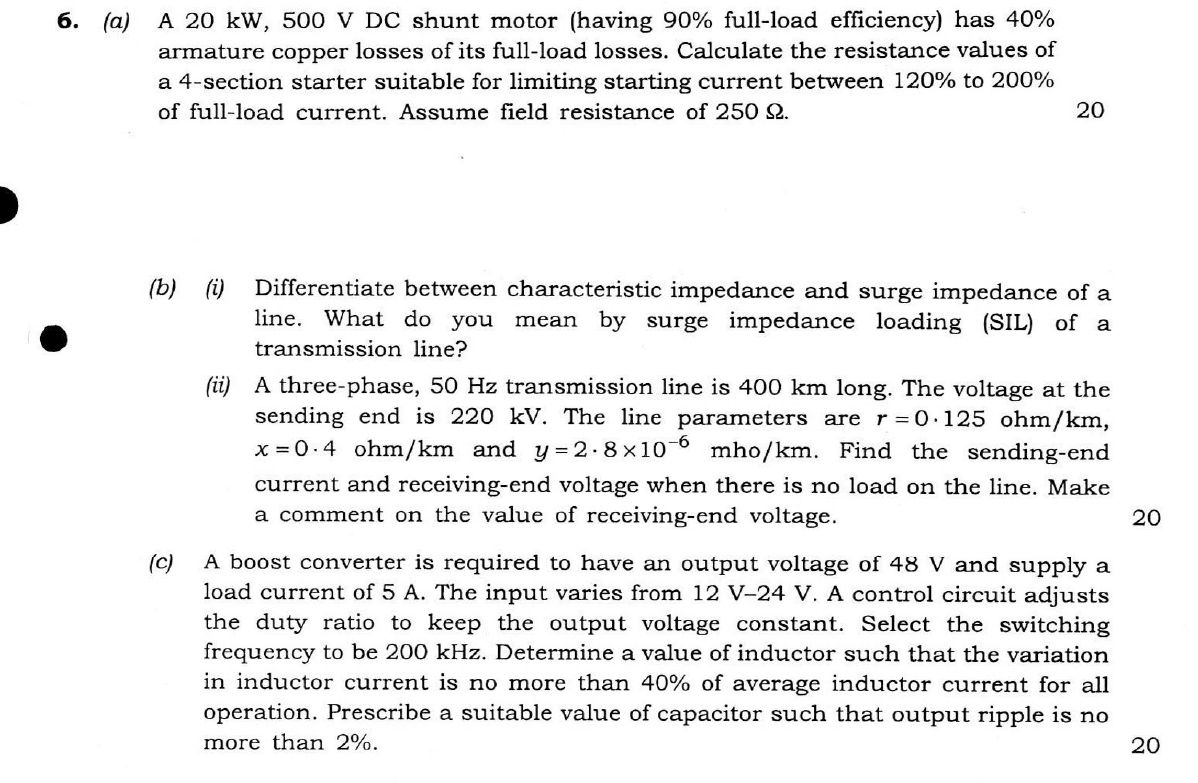
(a) A 20 kW, 500 V DC shunt motor (having 90% full-load efficiency) has 40% armature copper losses of its full-load losses…
A 20 kW, 500 V DC shunt motor (having 90% full-load efficiency) has 40% armature copper losses of its full-load losses. Calculate the resistance values of a 4-section starter suitable for limiting starting current between 120% to 200% of full-load current. Assume field resistance of 250 Ω. 20 marks
Differentiate between characteristic impedance and surge impedance of a line. What do you mean by surge impedance loading (SIL) of a transmission line?
A three-phase, 50 Hz transmission line is 400 km long. The voltage at the sending end is 220 kV. The line parameters are r = 0·125 ohm/km, x = 0·4 ohm/km and y = 2·8×10⁻⁶ mho/km. Find the sending-end current and receiving-end voltage when there is no load on the line. Make a comment on the value of receiving-end voltage. 20 marks
A boost converter is required to have an output voltage of 48 V and supply a load current of 5 A. The input varies from 12 V–24 V. A control circuit adjusts the duty ratio to keep the output voltage constant. Select the switching frequency to be 200 kHz. Determine a value of inductor such that the variation in inductor current is no more than 40% of average inductor current for all operation. Prescribe a suitable value of capacitor such that output ripple is no more than 2%. 20 marks
Model answer
Written by UPSC Answer Check against this question's marking rubric, to the expected length. UPSC does not publish answers for Mains — this is one way to score well, not an official key.
(a)
- Full-load input = 20 000/0.90 = 22 222 W, so total full-load loss = 2 222 W.
- Full-load line current I_L = 22 222/500 = 44.44 A. Field current I_f = 500/250 = 2 A, hence armature current I_a = 42.44 A.
- Armature copper loss = 0.40 × 2 222 = 888.9 W, so R_a = 888.9/(42.44)² = 0.493 Ω. Field loss is 500²/250 = 1000 W; the remainder is rotational loss, but only R_a is needed for the starter.
- Apply the stated percentage limits to the full-load line current: I_max = 2.0 × 44.44 = 88.89 A, I_min = 1.2 × 44.44 = 53.33 A.
- Total circuit resistance at starting: T_0 = 500/88.89 = 5.625 Ω. External starter resistance = 5.625 - 0.493 = 5.132 Ω.
- For a specified 4-section starter, use the current ratio for the first three shorting steps: at the instant of shorting, back emf is unchanged, so the ratio of successive total resistances is I_min/I_max = 0.60. Thus T_1 = 0.60 T_0 = 3.375 Ω, T_2 = 0.60 T_1 = 2.025 Ω, T_3 = 0.60 T_2 = 1.215 Ω. The fourth section is the residual needed to reach R_a.
- R_1 = T_0 - T_1 = 2.250 Ω, R_2 = T_1 - T_2 = 1.350 Ω, R_3 = T_2 - T_3 = 0.810 Ω, R_4 = T_3 - R_a = 0.722 Ω.
Final: R_1 = 2.25 Ω, R_2 = 1.35 Ω, R_3 = 0.810 Ω, R_4 = 0.722 Ω. The 120% lower limit is used to set the first three steps; the last section is shorted at the current that keeps the final current within the 200% limit.
(b) (i)
- Characteristic impedance Z_c = √((r+jx)/(g+jb)) per phase; it is generally complex for a lossy line.
- Surge impedance Z_s is the purely resistive characteristic impedance of a lossless line: Z_s = √(L/C) = √(x/b), where b is shunt susceptance per km.
- SIL is the three-phase power delivered to a load equal to Z_s. With line-to-line voltage V_L, SIL = V_L²/Z_s, giving MW when V_L is in kV and Z_s in Ω. It gives a flat voltage profile and zero net line reactive power.
(ii)
- Per phase: z = 0.125 + j0.4 Ω/km, y = j2.8×10⁻⁶ S/km. Use exact long-line constants: γ = √(zy), Z_c = √(z/y). The line is 400 km, so exact distributed constants are used rather than a short-line approximation.
- For l = 400 km: γl = 0.0654 + j0.4283. Thus cosh γl = 0.9116 + j0.0272 = 0.9117∠1.71°.
- Z_c = 386.9∠-8.68° Ω. Also sinh γl = 0.0595 + j0.4163 = 0.4205∠82.0°, and tanh γl = 0.461∠80.3°.
- Specified sending-end phase voltage V_s = 220/√3 = 127.0 kV.
- No load: I_r = 0. Receiving-end voltage V_r = V_s/cosh γl = 139.3∠-1.71° kV phase = 241.3 kV line.
- No-load sending-end current, from I_s = (V_s/Z_c) tanh γl, is |I_s| = 127.0/386.9 × 0.461 = 0.151 kA = 151 A. Its angle is 8.68° + 80.3° = 89.0°, leading; the current is capacitive. Check with I_s = (V_r/Z_c) sinh γl gives the same magnitude.
- Comment: V_r is about 21 kV, or 9.7%, higher than the sending-end voltage. This is the Ferranti effect: capacitive charging of the no-load line raises the receiving-end voltage.
(c)
- Output power P_o = 48 × 5 = 240 W. For an ideal boost converter, D = 1 - V_in/V_o. Hence D = 0.75 at 12 V and D = 0.50 at 24 V.
- Average inductor current I_L = P_o/V_in = I_o/(1-D). Thus I_L = 20 A at 12 V and 10 A at 24 V.
- In CCM, inductor ripple is ΔI_L = V_in D/(f L). The requirement is ΔI_L ≤ 0.40 I_L. The ratio ΔI_L/I_L = V_in² D/(f L P_o) is maximum at 24 V over 12–24 V, because d/dV[V²(1-V/48)] = V(2 - V/16) > 0 there. Allowed ripple = 0.40 × 10 = 4 A.
- L ≥ V_in D/(f ΔI_L) = 24 × 0.50/(200 000 × 4) = 15 μH. Choose L = 15 μH; the next standard 18 μH is also acceptable. The inductor value is the minimum; a larger value reduces ripple and improves CCM margin. Check: at 12 V, ΔI_L = 3 A, minimum I_L = 18.5 A; at 24 V, minimum I_L = 8 A, so CCM is maintained.
- Output ripple limit = 0.02 × 48 = 0.96 V. For a boost converter, with ESR neglected and CCM, ΔV_o = I_o D/(f C). Worst case is D = 0.75.
- C ≥ I_o D/(f ΔV_o) = 5 × 0.75/(200 000 × 0.96) = 19.5 μF. Prescribe C = 22 μF low-ESR.
Final: L = 15 μH minimum (choose 18 μH), C = 22 μF. Conditions: ideal converter, CCM, capacitor ESR contribution to ripple negligible.
What "Calculate" is asking you to do
Apply the standard formula or schedule to data the question has already supplied — a table of readings, cost records, a balance sheet — and produce the number. The method is rarely in doubt; the marks sit in the named intermediate quantities, each of which has to appear as a labelled line.
Structure that answers it
Data as given → formula or standard treatment, named → substitution → each intermediate, labelled → result with units
Where marks are lost
Omitting an intermediate the marking scheme pays for separately, or rounding at an intermediate line so the final figure drifts. In commerce and accountancy, any figure in a statement that no numbered working note supports is treated as unearned.
How this answer will be evaluated
Approach
(a) calculate: given > formula > substitution > result with units > interpretation | (b(i)) compare: paired headings or table > key differences > significance > conclusion | (b(ii)) calculate: given > formula > substitution > result with units > interpretation | (c) calculate: given > formula > substitution > result with units > interpretation Full marks: Complete working with correct formulas, all calculations shown, units included, and appropriate comments on results.
Key points expected
- Calculate full-load armature current from efficiency and losses
- Determine total starter resistance for 120-200% starting current
- Apply geometric progression for 4-section resistance division
- Calculate individual section resistances R1, R2, R3, R4
- Define characteristic impedance (Zc) of a line
- Define surge impedance (Zs) of a line
- State key differences between Zc and Zs
- Define Surge Impedance Loading (SIL)
Evaluation rubric
Each sub-part is marked on its own, against the marks and word limit printed on the paper.
- (a) Resistance values of a 4-section starter for a DC shunt motor. 20 marks
calculate— given → formula → substitution → result with units → interpretation
Must cover
- Calculate full-load armature current from efficiency and losses
- Determine total starter resistance for 120-200% starting current
- Apply geometric progression for 4-section resistance division
- Calculate individual section resistances R1, R2, R3, R4
Loses marks
- Ignoring field current in total current calculation
- Using arithmetic instead of geometric progression
- Omitting units in final resistance values
Earns more
- Correct calculation of field current (500V/250Ω)
- Explicit statement of starting current range used
- Verification of current at each section transition
Extra mark
- Starter circuit diagram with section labels
- Comment on motor starting torque characteristics
- (b(i)) Differentiation between characteristic and surge impedance; definition of SIL.
compare— paired headings or table → key differences → significance → conclusion
Must cover
- Define characteristic impedance (Zc) of a line
- Define surge impedance (Zs) of a line
- State key differences between Zc and Zs
- Define Surge Impedance Loading (SIL)
Loses marks
- Treating Zc and Zs as identical
- Omitting definition of SIL
- Confusing surge impedance with characteristic impedance
Earns more
- Mention of frequency dependence of Zc
- Note that Zs is real for lossless lines
- Formula for SIL in terms of V and Zs
Extra mark
- Example of typical Zs values for transmission lines
- Mention of Ferranti effect relation to SIL
- (b(ii)) Sending-end current and receiving-end voltage for unloaded 400km line. 20 marks
calculate— given → formula → substitution → result with units → interpretation
Must cover
- Calculate total line parameters (R, X, Y) for 400km
- Apply appropriate line model (medium/long line)
- Calculate sending-end current using line equations
- Calculate receiving-end voltage at no-load
Loses marks
- Using short-line model for 400km line
- Ignoring shunt admittance in calculations
- Omitting comment on receiving-end voltage value
Earns more
- Comment on Ferranti effect (Vr > Vs)
- Use of per-unit system for calculations
- Phasor diagram showing voltage/current relationship
Extra mark
- Calculation of SIL for comparison
- Mention of reactive power flow at no-load
- (c) Inductor and capacitor values for boost converter with specified ripple. 20 marks
calculate— given → formula → substitution → result with units → interpretation
Must cover
- Calculate duty ratio for 12V and 24V input cases
- Determine inductor value for 40% current ripple
- Calculate capacitor value for 2% output voltage ripple
- Verify values work for all input voltage range
Loses marks
- Using buck converter formulas instead of boost
- Ignoring input voltage variation range
- Omitting units for L and C values
Earns more
- Use of boost converter voltage conversion formula
- Calculation of average inductor current
- Consideration of worst-case (minimum input) condition
Extra mark
- Circuit diagram of boost converter
- Waveform sketch showing inductor current ripple
Practice this exact question
Write your answer and it is marked point by point against the model answer above — what you covered, what you missed, what you got wrong.
Evaluate my answer →More from Electrical Engineering 2022 Paper II
- Q3 (a) For the circuit shown below, calculate the output voltage : R₁ = 1 kΩ R₂ = 2 kΩ R₃ =…
- Q4 (a) (i) What do you mean by grading of cables? What are the methods of grading? (ii) Deri…
- Q5 (a) A DC motor has an armature resistance of 0·5 Ω and Kφ of 3 Vs. The motor is driven by…
- Q6 (a) A 20 kW, 500 V DC shunt motor (having 90% full-load efficiency) has 40% armature copp…
- Q7 (a) A full-controlled full-wave bridge AC/DC converter is fed from a single-phase, 230 V,…
- Q8 (a) A signal is given by x[t] = cos(28πt) + 2cos(40πt) + 3cos(70πt) This signal is sample…