Paper I — Q1
(a) Find the voltage on points A and B of the given circuit : (10 marks) (b) Determine the Z-transform of x[n] = n(1/2)ⁿ⁺²…
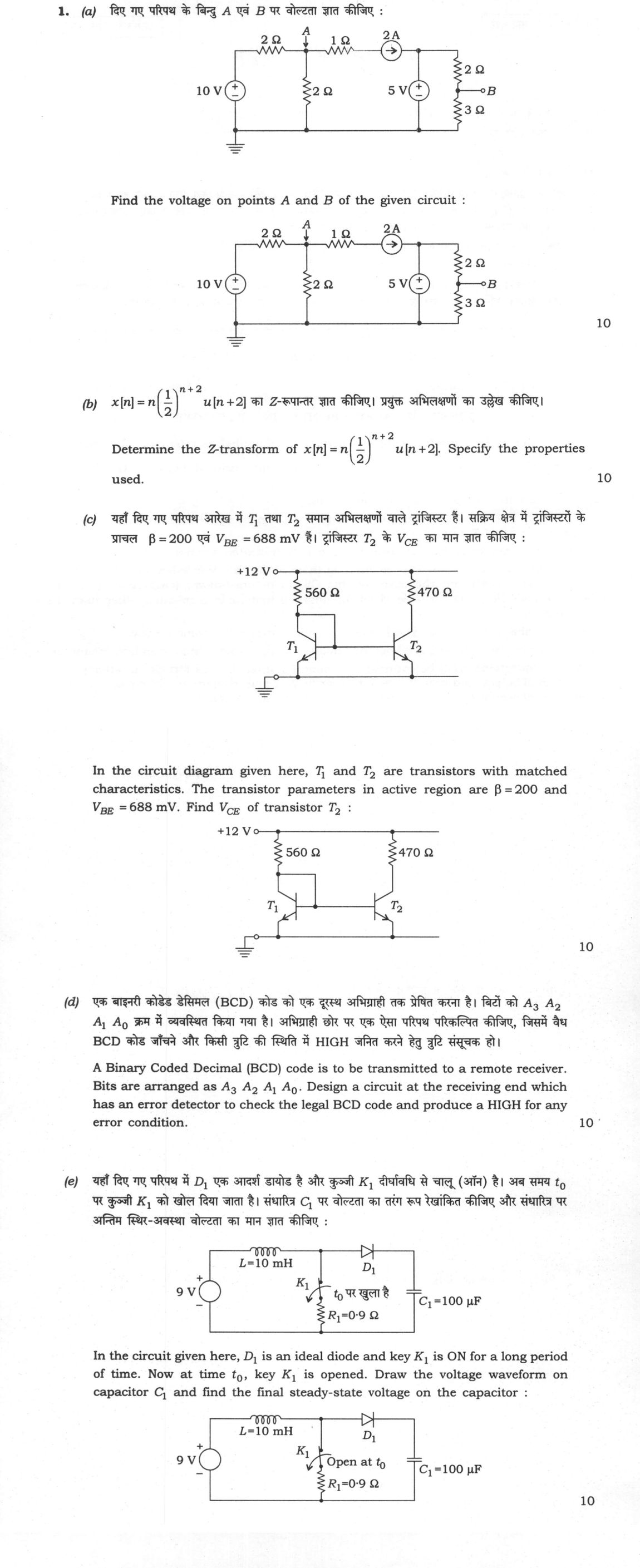
Find the voltage on points A and B of the given circuit : 10 marks
Determine the Z-transform of x[n] = n(1/2)ⁿ⁺² u[n+2]. Specify the properties used. 10 marks
In the circuit diagram given here, T₁ and T₂ are transistors with matched characteristics. The transistor parameters in active region are β = 200 and V_BE = 688 mV. Find V_CE of transistor T₂ : 10 marks
A Binary Coded Decimal (BCD) code is to be transmitted to a remote receiver. Bits are arranged as A₃ A₂ A₁ A₀. Design a circuit at the receiving end which has an error detector to check the legal BCD code and produce a HIGH for any error condition. 10 marks
In the circuit given here, D₁ is an ideal diode and key K₁ is ON for a long period of time. Now at time t₀, key K₁ is opened. Draw the voltage waveform on capacitor C₁ and find the final steady-state voltage on the capacitor : L=10 mH, 9 V, K₁ Open at t₀, R₁=0·9 Ω, D₁, C₁=100 μF 10 marks
हिंदी में प्रश्न पढ़ें
दिए गए परिपथ के बिन्दु A एवं B पर वोल्टता ज्ञात कीजिए : (10 अंक)
x[n] = n(1/2)ⁿ⁺² u[n+2] का Z-रूपान्तर ज्ञात कीजिए। प्रयुक्त अभिलक्षणों का उल्लेख कीजिए। (10 अंक)
यहाँ दिए गए परिपथ आरेख में T₁ तथा T₂ समान अभिलक्षणों वाले ट्रांजिस्टर हैं। सक्रिय क्षेत्र में ट्रांजिस्टरों के प्राचल β = 200 एवं V_BE = 688 mV हैं। ट्रांजिस्टर T₂ के V_CE का मान ज्ञात कीजिए : (10 अंक)
एक बाइनरी कोडेड डेसीमल (BCD) कोड को एक दूरस्थ अभिग्राही तक प्रेषित करना है। बिटों को A₃ A₂ A₁ A₀ क्रम में व्यवस्थित किया गया है। अभिग्राही छोर पर एक ऐसा परिपथ परिकल्पित कीजिए, जिसमें वैध BCD कोड जाँचने और किसी त्रुटि की स्थिति में HIGH जनित करने हेतु त्रुटि संसूचक हो। (10 अंक)
यहाँ दिए गए परिपथ में D₁ एक आदर्श डायोड है और कुंजी K₁ दीर्घविधि से चालु (ऑन) है। अब समय t₀ पर कुंजी K₁ को खोल दिया जाता है। संधारित्र C₁ पर वोल्टता का तरंग रूप रेखांकित कीजिए और संधारित्र पर अंतिम स्थिर-अवस्था वोल्टता का मान ज्ञात कीजिए : L=10 mH, 9 V, K₁ t₀ पर खुला है, R₁=0·9 Ω, D₁, C₁=100 μF (10 अंक)
The figure this question refers to, in words
The question paper is a scan and the diagram did not survive as text. This is the figure as read from the original page — every component, value and label — so the question can be worked from the text below.
(a) A circuit diagram with a continuous ground rail at the bottom: A 10 V DC voltage source on the far left has its negative terminal connected to ground and positive terminal connected to one terminal of a 2 ohm horizontal resistor. The other terminal of the 2 ohm resistor connects to node A. Connected to node A is a 2 ohm vertical resistor going down to ground, and a horizontal branch consisting of a 1 ohm resistor in series with a 2 A independent current source directed to the right. The output of the current source connects to a node that branches into two parallel paths to ground: one path is a 5 V DC voltage source with its positive terminal at the top and negative terminal at ground; the other path consists of a 2 ohm resistor in series with a 3 ohm resistor to ground, with node B located between the 2 ohm and 3 ohm resistors.
(c) A BJT circuit diagram: A horizontal supply rail at the top is labelled '+12 V'. Below it are two NPN bipolar junction transistors, T1 and T2. A 560 ohm resistor connects the +12 V rail to the collector of T1. Transistor T1 is diode-connected, with its collector connected directly to its base. The base of T1 is connected to the base of T2. A 470 ohm resistor connects the +12 V rail to the collector of T2. The emitters of both T1 and T2 are connected together along a common horizontal ground line, which has a ground symbol attached below the emitter of T1.
(c) A BJT current mirror circuit. A +12 V DC supply rail runs horizontally at the top. Two branches connect from the +12 V rail to ground: The first branch has a 560 ohm resistor connected between the +12 V rail and the collector of an NPN transistor T1. Transistor T1 has its collector connected directly to its base (diode-connected), and its emitter connected to ground. The base of T1 is connected to the base of a second NPN transistor T2. The second branch has a 470 ohm resistor connected between the +12 V rail and the collector of transistor T2. The emitter of T2 is connected to ground. The question asks to find V_CE of transistor T2.
(e) A circuit diagram consisting of a 9 V DC voltage source with its positive terminal at the top and negative terminal connected to a bottom common wire. An inductor with L = 10 mH is connected between the positive terminal of the 9 V source and an intermediate node. From this intermediate node, two parallel paths extend: (1) A vertical branch containing a switch K1 in series with a resistor R1 = 0.9 ohm connected down to the common wire; the switch is labelled 'Open at t_0'. (2) A horizontal branch containing an ideal diode D1 with its anode connected to the intermediate node and cathode connected to the top terminal of a capacitor C1 = 100 uF. The bottom terminal of capacitor C1 is connected to the common wire.
Model answer
Written by UPSC Answer Check against this question's marking rubric, to the expected length. UPSC does not publish answers for Mains — this is one way to score well, not an official key.
(a) Let the node at the output of the 2 A current source, where the 5 V source and the 2 Ω–3 Ω divider are connected, be C. Since an ideal 5 V source is connected between C and ground with its positive terminal at C, V_C = 5 V.
At node A, apply Kirchhoff’s current law. The 10 V source feeds A through 2 Ω, node A is loaded by 2 Ω to ground, and the current-source branch draws exactly 2 A away from A. The 1 Ω resistor in that branch does not affect this KCL because the ideal current source fixes the branch current at 2 A. Therefore, (10 − V_A)/2 = V_A/2 + 2 10 − V_A = V_A + 4 2V_A = 6 V_A = 3 V.
For node B, the 5 V source fixes node C at 5 V. The path from C to ground is 2 Ω in series with 3 Ω, with B between them. Thus a simple voltage divider gives V_B = 5 × 3/(2 + 3) = 5 × 3/5 = 3 V.
Final: V_A = 3 V, V_B = 3 V.
(b) Given x[n] = n(1/2)^(n+2) u[n+2]. Write it as x[n] = (1/4) n (1/2)^n u[n+2]. Let a = 1/2. First find the Z-transform of y[n] = a^n u[n+2]. By definition, Y(z) = Σ_n=−2^∞ a^n z^(−n) = a^(−2) z² + a^(−1) z + Σ_n=0^∞ (a z^(−1))^n. With a = 1/2, a^(−2) = 4, a^(−1) = 2, so Y(z) = 4z² + 2z + z/(z − 1/2), with ROC |z| > 1/2.
Now use the n-multiplication property, Z{n y[n]} = −z dY(z)/dz. Differentiate: dY/dz = 8z + 2 − (1/2)/(z − 1/2)².
Since x[n] = (1/4) n y[n], X(z) = (1/4)(−z) dY/dz = (1/4)(−z)[8z + 2 − (1/2)/(z − 1/2)²] = −2z² − z/2 + z/[8(z − 1/2)²].
The ROC is determined by the right-sided exponential term, ROC: |z| > 1/2, with z = ∞ excluded because of the positive powers z² and z. Final: X(z) = −2z² − z/2 + z/[8(z − 1/2)²], |z| > 1/2.
(c) T₁ and T₂ are matched, so their base currents are equal because both have the same V_BE and same emitter ground. Let I_B1 = I_B2 = I_B. Then I_C1 = I_C2 = βI_B = 200 I_B.
The 560 Ω resistor supplies the diode-connected node of T₁. Its current is I_R = (12 − V_BE)/560 = (12 − 0.688)/560 = 11.312/560 = 0.0202 A = 20.2 mA.
At the common base node, KCL gives I_R = I_C1 + I_B1 + I_B2 = 200 I_B + I_B + I_B = 202 I_B. Therefore, I_B = 20.2 mA / 202 = 0.1 mA.
Hence I_C2 = β I_B = 200 × 0.1 mA = 20 mA.
The collector voltage of T₂ is found from the 470 Ω resistor: V_C2 = 12 − I_C2 × 470 = 12 − 0.020 × 470 = 12 − 9.4 = 2.6 V.
Since emitter of T₂ is grounded, V_CE2 = V_C2 − V_E2 = 2.6 − 0 = 2.6 V. Also V_C2 = 2.6 V > V_BE = 0.688 V, so T₂ is in the active region, consistent with the assumption.
Final: V_CE of T₂ = 2.6 V.
(d) For a 4-bit BCD code A₃A₂A₁A₀, the legal codes are 0000 to 1001, i.e. decimal 0 to 9. The illegal codes are 1010 to 1111. Therefore the error output E must be HIGH for the minterms 10, 11, 12, 13, 14, 15.
Thus E = Σm(10, 11, 12, 13, 14, 15). The invalid codes are: 1010, 1011, 1100, 1101, 1110, 1111.
Minimization by grouping gives E = A₃A₂ + A₃A₁ = A₃(A₂ + A₁).
So A₀ is not used at all, because once A₃ = 1 and either A₂ = 1 or A₁ = 1, the code is already greater than 9.
Circuit design: connect A₂ and A₁ to a two-input OR gate. Let its output be O = A₂ + A₁. Then connect O and A₃ to a two-input AND gate. The AND gate output is E = A₃O = A₃(A₂ + A₁). This output is HIGH for every illegal BCD code and LOW for all legal BCD codes.
Final: E = A₃(A₂ + A₁). Use an OR gate on A₂ and A₁ followed by an AND gate with A₃.
(e) Let t₀ = 0 for convenience. Before opening K₁, the key has been ON for a long time. In DC steady state, the inductor L behaves as a short circuit. The intermediate node is therefore at 9 V, so the ideal diode D₁ charges C₁ to V_C(0−) = 9 V. The resistor branch current is i_R = 9/0.9 = 10 A. This current flows through the inductor just before opening, so i_L(0−) = 10 A.
At t = 0, K₁ opens. The 0.9 Ω branch is removed. Initially the inductor current cannot change instantly, so 10 A flows through D₁ into C₁. While D₁ conducts, the diode is ideal, hence V_M = V_C.
Apply KVL around the loop containing the 9 V source, L, D₁ and C₁: 9 − V_C = L di_L/dt. Also, i_L = C dV_C/dt. Therefore, LC d²V_C/dt² + V_C = 9.
Initial conditions: V_C(0) = 9 V, i_L(0) = 10 A, so dV_C/dt(0) = i_L(0)/C = 10/(100 × 10⁻⁶) = 100000 V/s.
The natural frequency is ω = 1/√(LC) = 1/√(10 × 10⁻³ × 100 × 10⁻⁶) = 1/√(10⁻⁶) = 1000 rad/s.
The solution is V_C(t) = 9 + A cos(1000t) + B sin(1000t). Using V_C(0) = 9 V gives A = 0. Using dV_C/dt(0) = 100000 V/s gives 1000B = 100000, so B = 100 V. Thus, while D₁ conducts, V_C(t) = 9 + 100 sin(1000t) V.
The diode current is i_L(t) = C dV_C/dt = 10 cos(1000t) A. D₁ stops conducting when i_L(t) becomes zero: cos(1000t) = 0 1000t = π/2 t = π/2000 s ≈ 1.57 ms.
At that instant, V_C = 9 + 100 sin(π/2) = 9 + 100 = 109 V. After this, D₁ is reverse-biased and blocks any reverse current. The capacitor has no discharge path, so it retains its charge.
Waveform: before t₀, V_C is steady at 9 V. At t₀, V_C rises as a quarter-sine from 9 V to 109 V over π/2000 s. After that, it remains flat at 109 V.
Final steady-state voltage on C₁ = 109 V.
What "Solve" is asking you to do
Choose the method, then carry it through to a final answer. Identifying what kind of problem this is and why that method applies is the first thing marked; a correct figure arrived at invisibly earns almost nothing.
Structure that answers it
Given data and what is required → method chosen, with the reason it applies → set-up (equation, circuit, free body, trial balance) → working, step by step → answer with units and any condition of validity
Where marks are lost
Doing the middle steps mentally and writing only the result. In mathematics papers, a further loss comes from giving a decimal where the exact value in surds or fractions was wanted, or from skipping the justification a part explicitly asks for.
How this answer will be evaluated
Approach
(a) calculate: given > formula > substitution > result with units > interpretation | (b) calculate: given > formula > substitution > result with units > interpretation | (c) calculate: given > formula > substitution > result with units > interpretation | (d) describe: define > structure or process in order > labelled diagram > significance | (e) calculate: given > formula > substitution > result with units > interpretation Full marks: Correct method, clear steps, accurate final values, and proper diagrams.
Key points expected
- Apply KCL at node A to find V_A
- Apply KVL or KCL to find V_B
- Account for 2A current source direction
- State final values with units (Volts)
- Apply time-shifting property for u[n+2]
- Apply frequency differentiation or multiplication by n
- State the ROC clearly
- List specific properties used
Evaluation rubric
Each sub-part is marked on its own, against the marks and word limit printed on the paper.
- (a) Numerical values for node voltages V_A and V_B. 10 marks
calculate— given → formula → substitution → result with units → interpretation
Must cover
- Apply KCL at node A to find V_A
- Apply KVL or KCL to find V_B
- Account for 2A current source direction
- State final values with units (Volts)
Loses marks
- Sign error in KCL equation
- Ignoring the 2A source contribution
Earns more
- Correctly identifies 5V source polarity
- Uses superposition or nodal analysis explicitly
Extra mark
- Draws simplified equivalent circuit
- (b) Z-transform expression X(z) and its Region of Convergence (ROC). 10 marks
calculate— given → formula → substitution → result with units → interpretation
Must cover
- Apply time-shifting property for u[n+2]
- Apply frequency differentiation or multiplication by n
- State the ROC clearly
- List specific properties used
Loses marks
- Incorrect ROC (e.g., missing |z| > 1/2)
- Missing the 'properties used' statement
Earns more
- Correctly handles the n+2 term expansion
- Shows intermediate algebraic steps
Extra mark
- Verifies result using direct definition
- (c) Numerical value of V_CE for transistor T2. 10 marks
calculate— given → formula → substitution → result with units → interpretation
Must cover
- Calculate base current I_B1 from 560Ω resistor
- Determine collector current I_C2 using β
- Calculate voltage drop across 470Ω resistor
- Compute V_CE2 = 12V - I_C2*R_C
Loses marks
- Using V_BE = 0.7V instead of 688mV
- Ignoring base current in voltage drop
Earns more
- Explicitly states assumption of active region
- Uses V_BE = 688mV in base loop
Extra mark
- Checks if T2 is in saturation
- (d) Logic circuit design for BCD error detection (1010-1111). 10 marks
describe— define → structure or process in order → labelled diagram → significance
Must cover
- Identify invalid BCD codes (10-15)
- Derive Boolean expression for error condition
- Simplify expression using K-map or algebra
- Draw logic gate implementation
Loses marks
- Missing logic gate diagram
- Incorrect Boolean expression for error
Earns more
- Uses K-map for minimization
- Identifies don't-care conditions if applicable
Extra mark
- Provides truth table for all 16 inputs
- (e) Capacitor voltage waveform and final steady-state value. 10 marks
calculate— given → formula → substitution → result with units → interpretation
Must cover
- Determine initial state (t < t0) with K1 closed
- Analyze circuit for t > t0 (K1 open)
- Calculate final steady-state voltage on C1
- Sketch voltage waveform vs time
Loses marks
- Assuming diode is always ON
- Missing the waveform sketch
Earns more
- Identifies diode D1 state (ON/OFF) in final state
- Calculates time constant τ = RC
Extra mark
- Calculates exact exponential decay curve
Practice this exact question
Write your answer and it is marked point by point against the model answer above — what you covered, what you missed, what you got wrong.
Evaluate my answer →More from Electrical Engineering 2024 Paper I
- Q1 (a) Find the voltage on points A and B of the given circuit : (10 marks) (b) Determine th…
- Q2 (a) Draw the circuit diagram, function table, logic symbol and switch model for a CMOS ga…
- Q3 (a) Determine the time signal that corresponds to the following bilateral Laplace transfo…
- Q4 (a) In the circuit diagram given here, load resistance R_L is to be set for maximum power…