Paper I — Q6
(a) (i) An AM signal s(t) = A_c[1 + kₐ m(t)]cos(2πf_c t) is applied to the system shown in the figure. Show that the message…
An AM signal s(t) = A_c[1 + kₐ m(t)]cos(2πf_c t) is applied to the system shown in the figure. Show that the message signal m(t) can be obtained from the square-rooter output v₃(t): Assume that |kₐ m(t)| < 1 for all t, the message signal m(t) is limited to the interval −ω ≤ f ≤ ω, and the carrier frequency f_c > 2ω. 10 marks
A narrow band FM signal is approximately given as s(t) ≈ A_c cos(2π f_c t) - β A_c sin(2π f_c t)sin(2π fₘ t) Determine the envelope of this modulated signal. Also determine the ratio of the maximum to the minimum value of this envelope. Plot this ratio versus β, with β restricted to the interval 0 ≤ β ≤ 0·4. Also determine the average power of the narrow band FM signal, expressed as a percentage of the average power of the unmodulated carrier wave. 10 marks
Explain why PWM inverters are preferred over square wave inverters. Further, draw the harmonic spectrum to highlight the differences in unipolar and bipolar PWM techniques. 10 marks
A single-phase, full-bridge inverter has DC-link voltage V_DC = 400 V, and the fundamental frequency of 50 Hz. Find the r.m.s. value of the voltages of the fundamental and next two prominent harmonics for the following cases: (1) Square wave mode (2) Voltage cancellation mode with α = 20° 10 marks
A 50 hp, 440 V, 50 Hz, star-connected, three-phase induction motor has a starting torque of 75% and maximum torque of 250% of the full-load torque. Find the following: (i) Slip at which maximum torque occurs (ii) Slip at full-load torque 10 marks
हिंदी में प्रश्न पढ़ें
एक AM संकेत s(t) = A_c[1 + kₐ m(t)]cos(2πf_c t) चित्र में प्रदर्शित तंत्र पर अनुप्रयुक्त है। दिखाइए कि संदेश संकेत m(t) को वर्गमूलक निर्गत v₃(t) से प्राप्त किया जा सकता है: मान लीजिए कि t के सभी मानों के लिए |kₐ m(t)| < 1 है, संदेश संकेत m(t) अन्तराल −ω ≤ f ≤ ω में सीमित है और वाहक आवृत्ति f_c > 2ω है। (10 अंक)
एक संकीर्ण बैंड FM संकेत लगभग निम्न द्वारा निर्धारित है: s(t) ≈ A_c cos(2π f_c t) - β A_c sin(2π f_c t)sin(2π fₘ t) इस मॉडुलित संकेत का आवरण (एनवेलप) ज्ञात कीजिए। इस आवरण के अधिकतम व न्यूनतम मान का अनुपात भी ज्ञात कीजिए। इस अनुपात का β के सापेक्ष आलेख कीजिए, जबकि β अंतराल 0 ≤ β ≤ 0·4 में सीमित है। साथ ही संकीर्ण बैंड FM संकेत की औसत शक्ति का मान, अमॉडुलित वाहक तरंग की औसत शक्ति के प्रतिशत के रूप में व्यक्त कीजिए। (10 अंक)
PWM प्रतिपथों (इन्वर्टरों) को वर्ग तरंग प्रतिपथों की अपेक्षा क्यों ज्यादा पसंद किया जाता है, व्याख्या कीजिए। एक-ध्रुवीय एवं द्वि-ध्रुवीय PWM तकनीकों में अंतर को उजागर करने के लिए सनादी स्पेक्ट्रम को आरेखित कीजिए। (10 अंक)
एक एकल कला वाला पूर्ण-ब्रिज प्रतिपथ की DC-लिंक वोल्टता V_DC = 400 V एवं मूल आवृत्ति 50 Hz है। मूल एवं आगे के दो प्रमुख सनादी की वोल्टता के r.m.s. मान को निम्नलिखित प्रकरणों में ज्ञात कीजिए: (1) वर्ग तरंग विधा (2) वोल्टता निरस्तीकरण विधा, जब α = 20° है (10 अंक)
एक 50 hp, 440 V, 50 Hz, तारा-संयोजित, त्रिकला प्रेरण मोटर का आरंभिक बल-आघूर्ण, पूर्ण-भार बल-आघूर्ण का 75% और अधिकतम बल-आघूर्ण, पूर्ण-भार बल-आघूर्ण का 250% है। निम्नलिखित ज्ञात कीजिए: (i) सर्पण, जिस पर बल-आघूर्ण अधिकतम होता है (ii) पूर्ण-भार बल-आघूर्ण पर सर्पण (10 अंक)
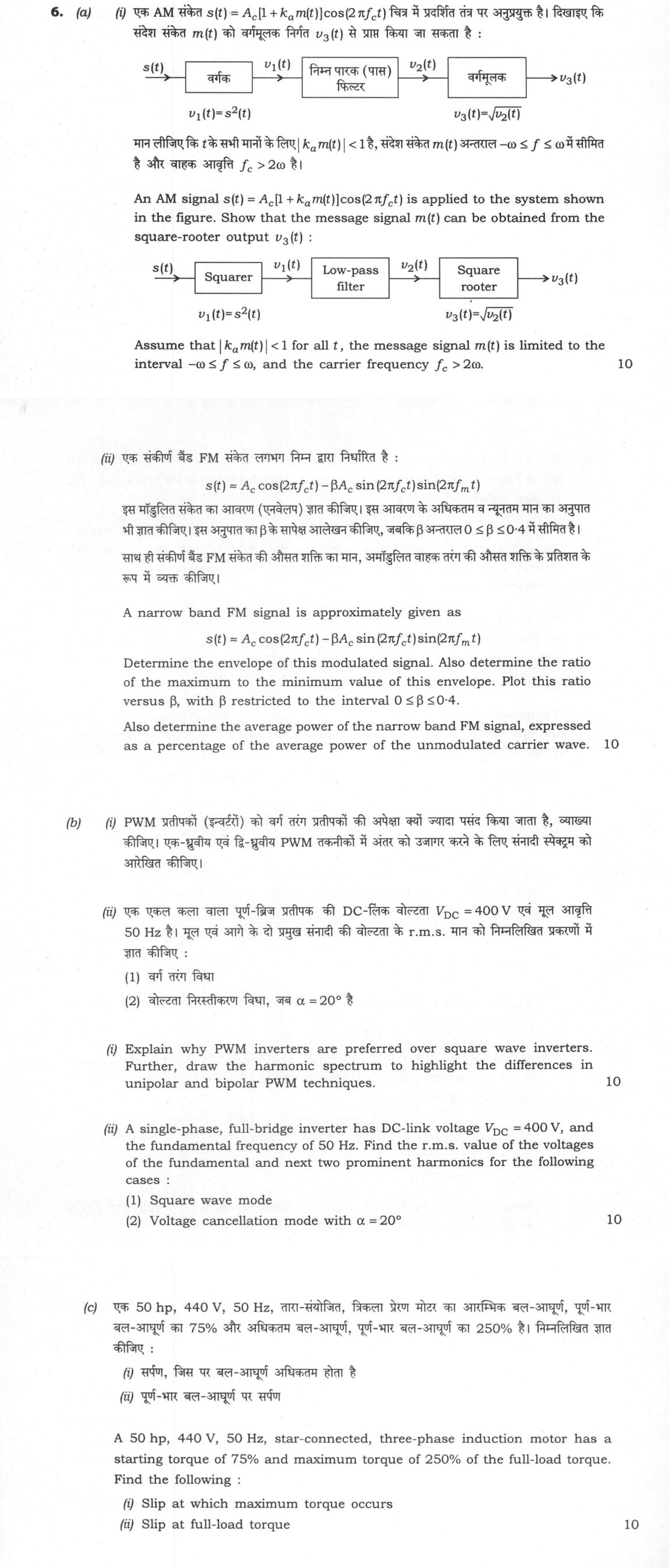
The figure this question refers to, in words
The question paper is a scan and the diagram did not survive as text. This is the figure as read from the original page — every component, value and label — so the question can be worked from the text below.
(a) A block diagram of a signal processing system. The input signal s(t) enters a block labeled 'Squarer'. The output of the Squarer is labeled v1(t) and is defined by the equation v1(t) = s^2(t). This signal v1(t) is the input to a block labeled 'Low-pass filter'. The output of the Low-pass filter is labeled v2(t). This signal v2(t) is the input to a block labeled 'Square rooter'. The output of the Square rooter is labeled v3(t) and is defined by the equation v3(t) = sqrt(v2(t)).
Model answer
Written by UPSC Answer Check against this question's marking rubric, to the expected length. UPSC does not publish answers for Mains — this is one way to score well, not an official key.
(a) (i) Use cos²x=(1+cos2x)/2. Then s(t)² = A_c²[1+k_a m(t)]² cos²(2πf_c t) = (A_c²/2)[1+k_a m(t)]² + (A_c²/2)[1+k_a m(t)]² cos(4πf_c t). The squarer output v_1(t) contains a DC term, a message term proportional to k_a m(t), a message-squared term proportional to k_a² m(t)², and the same terms at 2f_c. Because m(t) is limited to |f|≤ω, [1+k_a m(t)]² is limited to |f|≤2ω. The second term is centred at 2f_c. Since f_c>2ω, a low-pass filter with cutoff f_L satisfying 2ω<f_L<2f_c removes the 2f_c term and gives v_2(t)=(A_c²/2)[1+k_a m(t)]². Since |k_a m(t)|<1, the bracket is positive, so the square-rooter is exact and v_3(t)=√(v_2(t))=(A_c/√2)[1+k_a m(t)]. Thus m(t)=(√2 v_3(t)/A_c - 1)/k_a. This is a DC offset and scale. A_c is in V, k_a is dimensionless, f_c and ω are in Hz, v_2 is in V², and v_3 is in V.
(a) (ii) Use the quadrature-envelope method. Write s(t)=A_c cosω_c t - βA_c sinω_m t sinω_c t = X cosω_c t + Y sinω_c t, with X=A_c and Y=-βA_c sinω_m t. For f_c≫f_m, the envelope is E(t)=√(X²+Y²)=A_c√(1+β² sin²ω_m t). Thus E_max=A_c√(1+β²), E_min=A_c, and R(β)=E_max/E_min=√(1+β²). For 0≤β≤0.4, plot R versus β as y=√(1+β²); it is monotonic because dR/dβ=β/√(1+β²)≥0, and it passes through (0,1), (0.2,1.0198), and (0.4,1.0770). The ratio is not constant unless β=0; the curve is almost linear over this small range, but the exact expression should be used. For power, expand s(t)². The cross term averages to zero, and <sin²ω_m t>=<sin²ω_c t>=1/2, so P=(A_c²/2)(1+β²/2). The unmodulated carrier power is P_0=A_c²/2. Hence P/P_0=1+β²/2, percentage = (100+50β²)%; for β=0.4 it is 108%. The extra 50β²% is carried by the quadrature sideband term. If A_c is in V across 1 Ω, powers are in W.
(b) (i) Square-wave inverters have a fixed fundamental and large low-order odd harmonics. The fundamental rms is about 0.9 V_DC and cannot be reduced without reducing V_DC. The 3rd harmonic is one-third of the fundamental, which is a major problem for induction motors; they also have high THD, large filters, torque ripple, and poor power factor. PWM inverters control fundamental amplitude by dimensionless modulation index, push dominant harmonics to f_s, reduce THD, allow smaller filters, and improve current waveform and power factor. Spectrum:
- Square wave: lines at f_1, 3f_1, 5f_1, 7f_1 with relative rms 1, 1/3, 1/5, 1/7.
- Bipolar PWM: fundamental at f_1; clusters near multiples of f_s. Around f_s the sidebands are f_s±2f_1, f_s±4f_1, f_s±6f_1, ...; f_s±f_1 is absent.
- Unipolar PWM: fundamental at f_1; clusters near multiples of f_s. Around f_s the sidebands are f_s±f_1, f_s±2f_1, f_s±3f_1, ... . Unipolar switching uses +V_DC, 0, -V_DC, 0, so each voltage step is V_DC rather than 2V_DC, giving lower harmonic amplitudes than bipolar PWM. PWM amplitudes depend on modulation index and f_s/f_1, but the sideband locations above are the key difference.
(b) (ii) For the square wave, v(θ)=V_DC for 0<θ<π and -V_DC for π<θ<2π. The sine coefficient is b_n=(2/π)∫_0^π V_DC sin nθ dθ=(2V_DC/π n)(1-cos nπ). Thus b_n=0 for even n and b_n=4V_DC/(π n) for odd n. The alternating signs do not affect rms values. The rms value is V_n,rms=|b_n|/√2=(4V_DC)/(π n√2). The full-wave rms is V_DC, and the fundamental is 0.9 V_DC; the remaining power is in harmonics. With V_DC=400 V and f_1=50 Hz, taking the next two prominent harmonic orders as 3rd and 5th:
- Fundamental, 50 Hz: V_1,rms=1600/(π√2)=360.2 V.
- Third, 150 Hz: V_3,rms=120.1 V.
- Fifth, 250 Hz: V_5,rms=72.0 V. For the standard voltage-cancellation waveform, α is the angle by which voltage is cancelled at each end of a half-cycle; α=0 reduces to the square wave. The output is zero for 0<θ<α and π-α<θ<π, and +V_DC for α<θ<π-α; the negative half-cycle is symmetric. For odd n, b_n=(2/π)∫_α^(π-α) V_DC sin nθ dθ =(2V_DC/π n)(-cos n(π-α)+cos nα). For odd n, cos(nπ-nα)=-cos nα, so b_n=(4V_DC)/(π n)cos nα. Hence V_n,rms=(4V_DC)/(π n√2)|cos nα|. With α=20°:
- Fundamental: V_1,rms=360.2 cos20°=338.5 V.
- Third: V_3,rms=120.1 cos60°=60.0 V.
- Fifth: V_5,rms=72.0 |cos100°|=12.5 V. The 5th is small because cos100° is small, showing the cancellation effect. The 7th would be 39.4 V, but the next two harmonic orders are 3rd and 5th.
(c) (i) Use T(s)∝R_2 s/(R_2²+s²X_2²). Let s_m=R_2/X_2. Then T(s)∝s_m s/(s_m²+s²). Differentiating with respect to s and setting dT/ds=0 gives s=s_m, so T_max occurs at s_m. Also T_max∝1/2 and T_st∝s_m/(1+s_m²). Given T_st=0.75T_fl and T_max=2.5T_fl, T_max/T_st=10/3=(1+s_m²)/(2s_m). Thus 3s_m²-20s_m+3=0, so s_m=(10±√91)/3. The torque curve has two roots for a torque below T_max; the normal motoring maximum is the low-slip root below 1: s_m=(10-√91)/3=0.1535, i.e. 15.35%.
(c) (ii) Let full-load slip be s_f. Then T_max/T_fl=(s_m²+s_f²)/(2s_m s_f)=2.5. Thus s_f²-5s_m s_f+s_m²=0, so s_f=s_m(5±√21)/2. The larger root lies above s_m and is not the normal full-load slip. The full-load point is on the low-slip side, so s_f=s_m(5-√21)/2=0.0320, i.e. 3.20%. Check: T_fl/T_max=0.4 and T_st/T_fl=0.75, consistent with the data. The hp, voltage, and frequency data are not needed because the torque ratios fix the slips.
What "Derive" is asking you to do
Reach the stated expression from a starting relation, justifying every step. The destination is printed in the question, so only the route earns marks, and the assumptions you work under are part of that route.
Structure that answers it
Assumptions and notation defined → starting relation or governing equation → each step with its justification → the required expression → limiting case or boundary check
Where marks are lost
Writing the standard result first and fitting three lines to it, which an examiner reads at a glance. Marks also go on assumptions left unstated — lossless medium, small amplitude, errors independent with zero mean — and on symbols used before they are defined, even when the question says usual notations.
How this answer will be evaluated
Approach
(a(i)) derive: given > assumptions > stepwise derivation > result > check | (a(ii)) calculate: given > formula > substitution > result with units > interpretation | (b(i)) compare: paired headings or table > key differences > significance > conclusion | (b(ii)) calculate: given > formula > substitution > result with units > interpretation | (c) calculate: given > formula > substitution > result with units > interpretation Full marks: All parts fully derived/calculated with correct methods and clear presentation.
Key points expected
- Expand s(t) to find v1(t) = s^2(t)
- Identify DC, baseband, and 2fc terms in v1(t)
- Apply low-pass filter to isolate v2(t)
- Apply square-rooter to obtain v3(t) proportional to m(t)
- Determine envelope expression from s(t)
- Calculate ratio of max to min envelope values
- Plot ratio versus beta for 0 <= beta <= 0.4
- Calculate average power as percentage of carrier power
Evaluation rubric
Each sub-part is marked on its own, against the marks and word limit printed on the paper.
- (a(i)) Derive m(t) from v3(t) using the given block diagram. 10 marks
derive— given → assumptions → stepwise derivation → result → check
Must cover
- Expand s(t) to find v1(t) = s^2(t)
- Identify DC, baseband, and 2fc terms in v1(t)
- Apply low-pass filter to isolate v2(t)
- Apply square-rooter to obtain v3(t) proportional to m(t)
Loses marks
- Fails to expand the square of the AM signal
- Ignores the 2fc term in the squarer output
Earns more
- Explicitly states |ka m(t)| < 1 condition
- Uses frequency domain argument for filtering
Extra mark
- Sketches spectrum of v1(t) showing separation
- (a(ii)) Calculate envelope, max/min ratio, and power percentage for NBFM. 10 marks
calculate— given → formula → substitution → result with units → interpretation
Must cover
- Determine envelope expression from s(t)
- Calculate ratio of max to min envelope values
- Plot ratio versus beta for 0 <= beta <= 0.4
- Calculate average power as percentage of carrier power
Loses marks
- Incorrect envelope derivation
- Missing the power calculation
Earns more
- Correctly identifies envelope as sqrt(Ac^2 + ...)
- Accurate plot with labeled axes
Extra mark
- Mentions specific values at beta = 0 and 0.4
- (b(i)) Compare PWM and square wave inverters using harmonic spectra. 10 marks
compare— paired headings or table → key differences → significance → conclusion
Must cover
- Explain why PWM is preferred over square wave
- Draw harmonic spectrum for unipolar PWM
- Draw harmonic spectrum for bipolar PWM
- Highlight differences between unipolar and bipolar
Loses marks
- Fails to draw both spectra
- No clear distinction between unipolar and bipolar
Earns more
- Mentions lower THD for PWM
- Correctly labels harmonic orders in spectra
Extra mark
- Includes a small example of switching pattern
- (b(ii)) Calculate RMS voltages for fundamental and harmonics in two modes. 10 marks
calculate— given → formula → substitution → result with units → interpretation
Must cover
- Calculate RMS for fundamental in square wave mode
- Calculate RMS for next two harmonics in square wave mode
- Calculate RMS for fundamental in voltage cancellation mode
- Calculate RMS for next two harmonics in voltage cancellation mode
Loses marks
- Incorrect formula for voltage cancellation mode
- Missing units in final answers
Earns more
- Uses correct formulas for each mode
- Shows substitution of Vdc = 400V and alpha = 20 deg
Extra mark
- Provides a table summarizing the results
- (c) Calculate slip at maximum torque and full-load torque. 10 marks
calculate— given → formula → substitution → result with units → interpretation
Must cover
- Use torque-slip relationship for induction motor
- Calculate slip at maximum torque (sm)
- Calculate slip at full-load torque (sfl)
- Use given starting and max torque percentages
Loses marks
- Incorrect use of torque-slip formula
- Fails to convert percentages to decimals
Earns more
- Correctly applies the torque equation
- Shows step-by-step calculation
Extra mark
- Mentions the physical significance of the slips
Practice this exact question
Write your answer and it is marked point by point against the model answer above — what you covered, what you missed, what you got wrong.
Evaluate my answer →More from Electrical Engineering 2024 Paper I
- Q3 (a) Determine the time signal that corresponds to the following bilateral Laplace transfo…
- Q4 (a) In the circuit diagram given here, load resistance R_L is to be set for maximum power…
- Q5 (a) A uniform plane wave travels in vacuum along +y direction. The electric field of the…
- Q6 (a) (i) An AM signal s(t) = A_c[1 + kₐ m(t)]cos(2πf_c t) is applied to the system shown i…
- Q7 (a) (i) Draw the neat and properly labelled output voltage waveform of a three-phase, pha…
- Q8 (a) In the figure given below, region 1 is the side of the plane y+z=1 containing the ori…