Paper I — Q7
(a) (i) Draw the neat and properly labelled output voltage waveform of a three-phase, phase-controlled rectifier having firing…
Draw the neat and properly labelled output voltage waveform of a three-phase, phase-controlled rectifier having firing angle α. Also derive the relationship for average output voltage in terms of line voltage V_LL and firing angle α. 10 marks
A three-phase full-wave controlled rectifier is being operated from a star-connected, 415 V, 50 Hz supply. This rectifier is feeding a constant current load of 15 kW. It is required to obtain an average output voltage of 80% of maximum possible output voltage. Find the firing angle, r.m.s. value of line current and input power factor. Assume devices are ideal. 10 marks
Show that the maximum power that a synchronous generator can supply when connected to constant voltage, constant frequency busbars increases with the excitation. 10 marks
An 11 kV, 3-phase, star-connected turbo-alternator delivers 250 A at unity power factor when running on constant voltage and frequency busbars. If the excitation is increased so that the delivered current rises to 300 A, find the power factor at which now machine works and percentage increase in the induced e.m.f., assuming a constant steam supply and unchanged efficiency. The armature resistance is 0·5 Ω per phase and the synchronous reactance is 10 Ω per phase. 10 marks
A medium has infinite conductivity for z ≤ 0, εᵣ = 7 and μᵣ = 18, and σ = 0 for z > 0. The electric field for z > 0 is given as E⃗ = 10cos(3 × 10⁸ t - 15x)ẑ, as shown below. Determine the surface charge density and surface current density at location (3, 4, 0) at t = 0·8 ns. Given, μ₀ = 4π × 10⁻⁷ H/m, ε₀ = 1/(36π) × 10⁻⁹ F/m : 10 marks
हिंदी में प्रश्न पढ़ें
एक त्रिकला, कला-नियंत्रित दिष्कारी, जिसका फायरन कोण α है, का स्वच्छ एवं यथायोग्य चिह्नित निर्गत बोल्टता तरंगरूप आरेखित कीजिए। लाइन बोल्टता V_LL और फायरन कोण α के सापेक्ष औसत निर्गत बोल्टता के लिए संबंध भी व्युत्पन्न कीजिए। (10 अंक)
एक त्रिकला पूर्ण-तरंग नियंत्रित दिष्कारी एक तारा-संयोजित, 415 V, 50 Hz प्रदाय द्वारा संचालित है। यह दिष्कारी एक 15 kW के स्थिर धारा भार को पोषित करता है। अधिकतम संभव निर्गत बोल्टता का 80% औसत निर्गत बोल्टता प्राप्त करना वांछित है। फायरन कोण, लाइन धारा का r.m.s. मान और निवेश शक्ति गुणांक का मान ज्ञात कीजिए। मान लीजिए कि उपकरण आदर्श हैं। (10 अंक)
दिखाइए कि अधिकतम शक्ति, जो स्थिर बोल्टता, स्थिर आवृत्ति बसबार पर संयोजित एक तुल्यकालिक जनित्र प्रदान कर सकता है, उतेजन के साथ बढ़ती है। (10 अंक)
एक 11 kV, 3-कला, तारा-संयोजित टर्बो-प्रत्यावर्तित्र जब स्थिर बोल्टता और आवृत्ति के बसबार पर क्रियाशील है, इकाई शक्ति गुणांक पर 250 A देता है। यदि उतेजन को बढ़ा दिया जाता है ताकि प्रदत धारा 300 A तक बढ़ जाए, तो शक्ति गुणांक, जिस पर अब यंत्र काम करता है, और प्रेरित e.m.f. में प्रतिशत वृद्धि को स्थिर भार प्रदाय व अपरिवर्तित दक्षता मानते हुए ज्ञात कीजिए। आर्मेचर प्रतिरोध 0·5 Ω प्रति कला तथा तुल्यकालिक प्रतिघात 10 Ω प्रति कला है। (10 अंक)
z ≤ 0, εᵣ = 7 और μᵣ = 18 होने पर एक माध्यम की चालकता अनंत है और z > 0 के लिए σ = 0 है। z > 0 के लिए विद्युत क्षेत्र E⃗ = 10cos(3 × 10⁸ t - 15x)ẑ है, जैसा कि नीचे प्रदर्शित है। स्थान (3, 4, 0) पर t = 0·8 ns पर सतह आवेश घनत्व और सतह धारा घनत्व ज्ञात कीजिए। दिया गया है, μ₀ = 4π × 10⁻⁷ H/m, ε₀ = 1/(36π) × 10⁻⁹ F/m : (10 अंक)
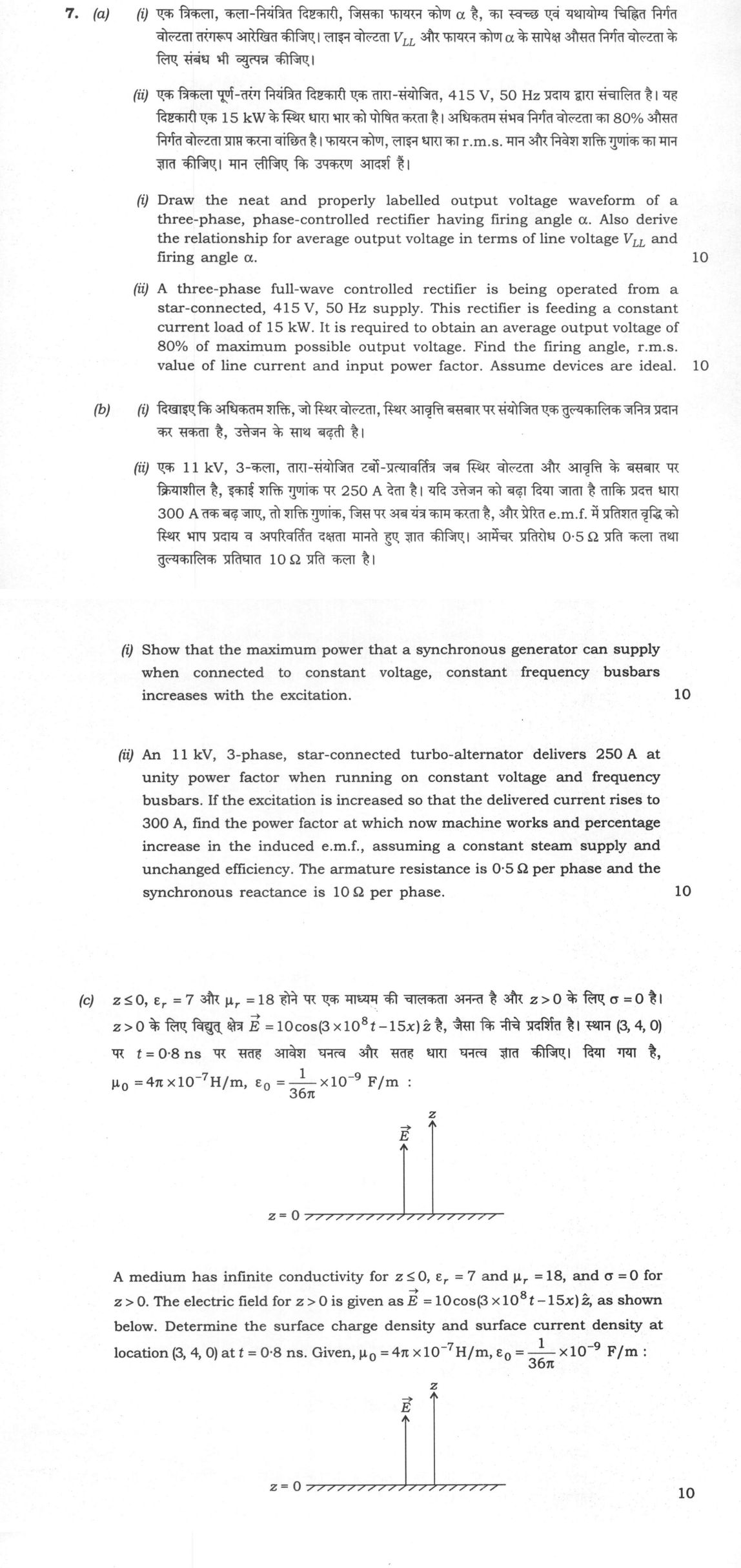
The figure this question refers to, in words
The question paper is a scan and the diagram did not survive as text. This is the figure as read from the original page — every component, value and label — so the question can be worked from the text below.
(c) A 2D diagram showing a horizontal boundary line labeled 'z = 0' with hatching marks below it, indicating a solid medium. Above the line, a vertical axis labeled 'z' points upwards. A vector arrow labeled 'E' (with a vector arrow symbol over the E) originates from the boundary and points vertically upwards, parallel to the z-axis.
What "Solve" is asking you to do
Choose the method, then carry it through to a final answer. Identifying what kind of problem this is and why that method applies is the first thing marked; a correct figure arrived at invisibly earns almost nothing.
Structure that answers it
Given data and what is required → method chosen, with the reason it applies → set-up (equation, circuit, free body, trial balance) → working, step by step → answer with units and any condition of validity
Where marks are lost
Doing the middle steps mentally and writing only the result. In mathematics papers, a further loss comes from giving a decimal where the exact value in surds or fractions was wanted, or from skipping the justification a part explicitly asks for.
How this answer will be evaluated
Approach
(a(i)) derive: given > assumptions > stepwise derivation > result > check | (a(ii)) calculate: given > formula > substitution > result with units > interpretation | (b(i)) justify: claim > 3-4 reasons > evidence > conclusion | (b(ii)) calculate: given > formula > substitution > result with units > interpretation | (c) calculate: given > formula > substitution > result with units > interpretation Full marks: All parts solved with correct derivations, calculations, and clear diagrams.
Key points expected
- Neatly labelled output voltage waveform
- Derivation of average voltage formula
- Expression in terms of V_LL and α
- Correct integration limits for conduction
- Calculation of firing angle α
- Calculation of RMS line current
- Calculation of input power factor
- Use of 415V, 50Hz, 15kW data
Evaluation rubric
Each sub-part is marked on its own, against the marks and word limit printed on the paper.
- (a(i)) Waveform of 3-phase phase-controlled rectifier and derivation of average output voltage. 10 marks
derive— given → assumptions → stepwise derivation → result → check
Must cover
- Neatly labelled output voltage waveform
- Derivation of average voltage formula
- Expression in terms of V_LL and α
- Correct integration limits for conduction
Loses marks
- Missing firing angle α in waveform
- Incorrect integration limits
Earns more
- Clear distinction between continuous and discontinuous modes
- Correct phase sequence labeling
Extra mark
- Sketch of phase voltage vs output voltage
- (a(ii)) Firing angle, RMS line current, and input power factor for a 3-phase full-wave rectifier. 10 marks
calculate— given → formula → substitution → result with units → interpretation
Must cover
- Calculation of firing angle α
- Calculation of RMS line current
- Calculation of input power factor
- Use of 415V, 50Hz, 15kW data
Loses marks
- Using phase voltage instead of line voltage
- Ignoring the 80% condition
Earns more
- Correct use of 80% max voltage condition
- Assumption of ideal devices stated
Extra mark
- Phasor diagram of input current
- (b(i)) Proof that maximum power of a synchronous generator increases with excitation. 10 marks
justify— claim → 3-4 reasons → evidence → conclusion
Must cover
- Power-angle equation derivation
- Identification of maximum power condition
- Relationship between E and P_max
- Assumption of constant busbar voltage
Loses marks
- Missing the sin(δ) term in derivation
- Confusing excitation with field current
Earns more
- Phasor diagram showing E and V
- Mention of stability limit
Extra mark
- Graph of P vs δ for different E
- (b(ii)) New power factor and percentage increase in induced e.m.f. for a turbo-alternator. 10 marks
calculate— given → formula → substitution → result with units → interpretation
Must cover
- Calculation of new power factor
- Calculation of percentage increase in e.m.f.
- Use of 11kV, 250A, 300A data
- Application of constant steam supply condition
Loses marks
- Ignoring armature resistance
- Incorrect calculation of induced e.m.f.
Earns more
- Correct use of per-phase values
- Calculation of internal angle δ
Extra mark
- Phasor diagram for both operating points
- (c) Surface charge density and surface current density at a specific point and time. 10 marks
calculate— given → formula → substitution → result with units → interpretation
Must cover
- Calculation of surface charge density
- Calculation of surface current density
- Use of given E-field expression
- Evaluation at t = 0.8 ns and (3,4,0)
Loses marks
- Incorrect time evaluation
- Ignoring the infinite conductivity condition
Earns more
- Correct application of boundary conditions
- Use of given μ0 and ε0 values
Extra mark
- Diagram of the medium interface
Model answer coming soon
Every evaluation on this site is marked against a verified model answer. This question's answer is still being written; evaluation opens the moment it lands.
More from Electrical Engineering 2024 Paper I
- Q4 (a) In the circuit diagram given here, load resistance R_L is to be set for maximum power…
- Q5 (a) A uniform plane wave travels in vacuum along +y direction. The electric field of the…
- Q6 (a) (i) An AM signal s(t) = A_c[1 + kₐ m(t)]cos(2πf_c t) is applied to the system shown i…
- Q7 (a) (i) Draw the neat and properly labelled output voltage waveform of a three-phase, pha…
- Q8 (a) In the figure given below, region 1 is the side of the plane y+z=1 containing the ori…