Paper I — Q2
(a) Draw the circuit diagram, function table, logic symbol and switch model for a CMOS gate (using six transistors) with two…
Draw the circuit diagram, function table, logic symbol and switch model for a CMOS gate (using six transistors) with two inputs A and B and an output Z, such that Z = 0 if A = 1 and B = 0, and Z = 1 otherwise 20 marks
For the signals f₁(t) and f₂(t) shown in the figures below, find and sketch ∫₋∞^t f(x) dx : 20 marks
In the circuit given here, find the value of voltage v₁ : 10 marks
हिंदी में प्रश्न पढ़ें
A और B दो निवेश तथा एक निर्गम Z वाले एक CMOS गेट (छह ट्रांजिस्टर प्रयोग करते हुए) के लिए परिपथ आरेख, फलन तालिका, तार्किक चिह्न तथा सिवचन नमूना इस प्रकार बनाइए कि Z = 0 यदि A = 1 और B = 0 हो तथा अन्य स्थितियों में Z = 1 हो (20 अंक)
नीचे दिए गए चित्र में प्रदर्शित संकेतों f₁(t) और f₂(t) के लिए ∫₋∞^t f(x) dx ज्ञात कीजिए एवं आरेखित कीजिए : (20 अंक)
यहाँ दिए गए परिपथ में वोल्टता v₁ का मान ज्ञात कीजिए : (10 अंक)
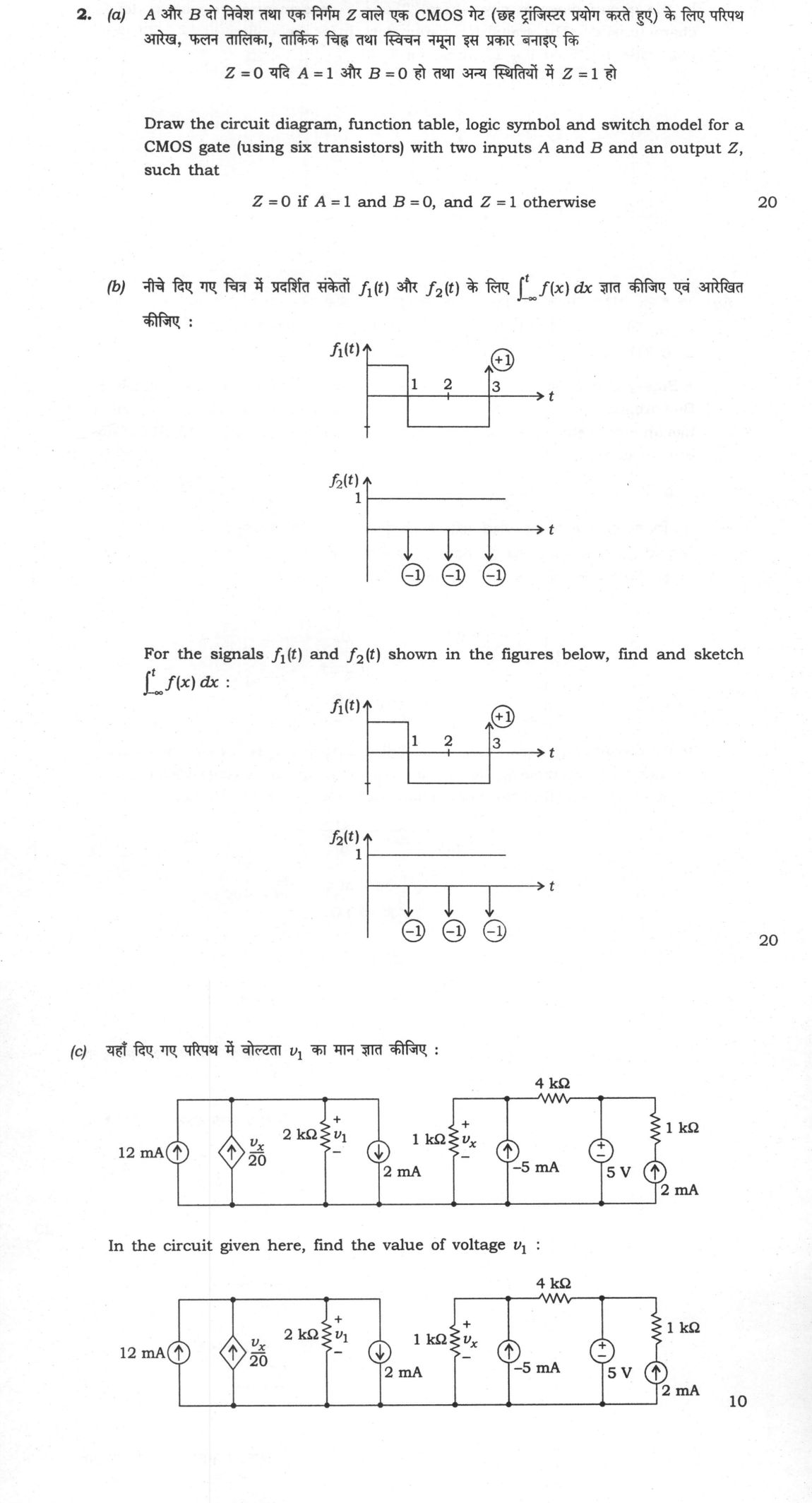
The figure this question refers to, in words
The question paper is a scan and the diagram did not survive as text. This is the figure as read from the original page — every component, value and label — so the question can be worked from the text below.
(b) Two signal plots:
- Signal f_1(t):
- Horizontal axis represents time t (with an arrow to the right), marked at t = 1, 2, and 3.
- Vertical axis represents f_1(t) (with an arrow pointing up), and extends below the horizontal axis with a downward-pointing arrow at t = 0.
- From t = 0 to t = 1, the signal has a constant positive value (amplitude appears to be 1).
- At t = 1, the signal drops to a constant negative value (amplitude appears to be -1) extending from t = 1 to t = 3.
- At t = 3, the signal steps back up to 0, and there is also an upward impulse at t = 3 indicated by an upward arrow with a circled '+1' above it.
- Signal f_2(t):
- Horizontal axis represents time t (with an arrow to the right).
- Vertical axis represents f_2(t) with a value of 1 marked on the positive axis.
- A constant horizontal line of height 1 starts at t = 0 and extends to the right.
- Three downward impulses are present at t = 1, t = 2, and t = 3, represented by downward-pointing vertical arrows from the horizontal axis, each terminated with a circled '-1' below it.
(c) The circuit consists of two electrically isolated subcircuits (left and right), coupled only through a dependent source:
Left subcircuit:
- Connected in parallel between a top node and a bottom reference rail are four branches:
- An independent current source of 12 mA with the arrow pointing upwards.
- A voltage-controlled current source (diamond symbol) with value labeled as v_x / 20 and arrow pointing upwards.
- A 2 kΩ resistor with voltage v_1 marked across it (+ at the top node, - at the bottom rail).
- An independent current source of 2 mA with the arrow pointing downwards.
Right subcircuit:
- Has a bottom reference rail and two upper nodes, Node A and Node B.
- Connected between Node A and the bottom rail in parallel are:
- A 1 kΩ resistor with voltage v_x marked across it (+ at Node A, - at the bottom rail).
- An independent current source of -5 mA with the arrow pointing upwards.
- A 4 kΩ resistor is connected horizontally between Node A and Node B.
- Connected to Node B are:
- An independent voltage source of 5 V connected between Node B and the bottom rail (+ terminal at Node B, - terminal at the bottom rail).
- A branch in parallel with the 5 V source consisting of a 1 kΩ resistor in series with a 2 mA independent current source (arrow pointing upwards); the top of the 1 kΩ resistor connects to Node B, its bottom connects to the 2 mA source, and the bottom of the 2 mA source connects to the bottom rail.
The question asks to find the value of voltage v_1.
Model answer
Written by UPSC Answer Check against this question's marking rubric, to the expected length. UPSC does not publish answers for Mains — this is one way to score well, not an official key.
(a) The required function is Z = 0 only for A = 1, B = 0. Hence Z = ¬A + B = A → B.
Six-transistor CMOS realisation: use a 2-transistor inverter to generate B′; then a 4-transistor static CMOS gate.
Circuit diagram: VDD ──┬── pMOS P1 (gate A) ──┬── Z └── pMOS P2 (gate B′) ─┘ Z ── nMOS N1 (gate A) ── nMOS N2 (gate B′) ── GND B drives inverter: VDD ── pMOS P3 (gate B) ── B′ ── nMOS N3 (gate B) ── GND.
Pull-up network: P1 and P2 in parallel. Pull-down network: N1 and N2 in series.
Function table: A B | Z 0 0 | 1 0 1 | 1 1 0 | 0 1 1 | 1
Logic symbol: an OR gate with a bubble on the A input, B connected directly; output Z = ¬A + B.
Switch model: VDD ── switch closed when A = 0 ── Z VDD ── switch closed when B′ = 0 ── Z Z ── switch closed when A = 1 ── switch closed when B′ = 1 ── GND The inverter switch model gives B′ = 0 when B = 1 and B′ = 1 when B = 0.
Check: for A = 1, B = 0, B′ = 1, so N1 and N2 both ON, P1 and P2 both OFF, Z = 0. For all other input combinations, the pull-up path is ON or the pull-down path is OFF, so Z = 1.
(b)(i) From the plot, f₁(t) = 0 for t < 0; f₁(t) = 1 for 0 ≤ t < 1; f₁(t) = −1 for 1 ≤ t < 3; f₁(t) = 0 for t > 3, with an impulse +1δ(t − 3) at t = 3.
Let y₁(t) = ∫ from −∞ to t f₁(x) dx.
For t < 0: y₁(t) = 0.
For 0 ≤ t < 1: y₁(t) = ∫ from 0 to t 1 dx = t.
For 1 ≤ t < 3: y₁(t) = ∫ from 0 to 1 1 dx + ∫ from 1 to t (−1) dx = 1 − (t − 1) = 2 − t.
For t ≥ 3: y₁(t) = 1 + (−2) + 1 = 0. Thus y₁(3) = 0; just before t = 3, y₁ → −1, so there is a jump of +1 at t = 3.
Sketch: y₁ rises linearly from 0 to 1 for 0 ≤ t ≤ 1; falls linearly from 1 to −1 for 1 ≤ t < 3; jumps to 0 at t = 3; stays 0 afterwards.
(b)(ii) From the plot, f₂(t) = 0 for t < 0; f₂(t) = 1 for t ≥ 0, with impulses −δ(t − 1), −δ(t − 2), −δ(t − 3).
Let y₂(t) = ∫ from −∞ to t f₂(x) dx.
For t < 0: y₂(t) = 0.
For 0 ≤ t < 1: y₂(t) = ∫ from 0 to t 1 dx = t.
For 1 ≤ t < 2: y₂(t) = ∫ from 0 to t 1 dx − 1 = t − 1.
For 2 ≤ t < 3: y₂(t) = ∫ from 0 to t 1 dx − 1 − 1 = t − 2.
For t ≥ 3: y₂(t) = ∫ from 0 to t 1 dx − 1 − 1 − 1 = t − 3.
At t = 1, 2, 3 the impulses cause downward jumps of 1. Sketch: y₂ rises linearly with slope 1 from 0 to 1 in each unit interval, then drops instantaneously to 0 at t = 1, 2, 3; after t = 3 it continues as t − 3.
(c) Use nodal analysis. Let the bottom rail be 0 V. In the right subcircuit, the 5 V source fixes node B at v_B = 5 V. Also v_A = v_x.
KCL at node A, taking currents leaving as positive: v_x/1 kΩ + 5 mA + (v_x − v_B)/4 kΩ = 0. Using kΩ and mA: v_x + 5 + (v_x − 5)/4 = 0. Multiply by 4: 4v_x + 20 + v_x − 5 = 0 5v_x + 15 = 0 v_x = −3 V.
Now KCL at the top node of the left circuit. Its voltage is v_1. The VCCS supplies v_x/20 mA upward. Thus: 12 mA + v_x/20 = v_1/2 kΩ + 2 mA. Using v_x = −3 V: 12 − 3/20 = v_1/2 + 2 12 − 0.15 − 2 = v_1/2 9.85 = v_1/2 v_1 = 19.7 V = 197/10 V.
Final answer for (c): v₁ = 19.7 V.
What "Draw" is asking you to do
Produce the diagram as the answer, not as an ornament to it. Where the question lists several items — circuit, function table, logic symbol, structure — each is separately marked, and the lines of text must refer to the diagram through its own labels.
Structure that answers it
Diagram drawn large and clean → every part, axis and terminal labelled → caption → two or three lines tying it to what was asked
Where marks are lost
Delivering part of the list and leaving the rest, which forfeits those marks directly. In chemistry, a flat sketch where the geometry or stereochemistry was the point; in engineering, unlabelled terminals, missing polarity, or no sign convention stated.
How this answer will be evaluated
Approach
(a) describe: define > structure or process in order > labelled diagram > significance | (b) calculate: given > formula > substitution > result with units > interpretation | (c) calculate: given > formula > substitution > result with units > interpretation Full marks: Complete, accurate, and clearly presented solutions for all parts with correct diagrams and calculations.
Key points expected
- Truth table showing Z=0 only for A=1, B=0
- Circuit diagram with 6 transistors (3 PMOS, 3 NMOS)
- Correct logic symbol for the derived function
- Switch model showing conduction paths
- Sketch of integral for f1(t) showing ramp and step changes
- Sketch of integral for f2(t) showing ramp and downward jumps
- Correct calculation of area under f1(t) segments
- Correct handling of impulses in f2(t) integration
Evaluation rubric
Each sub-part is marked on its own, against the marks and word limit printed on the paper.
- (a) Circuit diagram, function table, logic symbol, and switch model for a 6-transistor CMOS gate. 20 marks
describe— define → structure or process in order → labelled diagram → significance
Must cover
- Truth table showing Z=0 only for A=1, B=0
- Circuit diagram with 6 transistors (3 PMOS, 3 NMOS)
- Correct logic symbol for the derived function
- Switch model showing conduction paths
Loses marks
- Incorrect transistor count or type
- Logic symbol not matching the function
Earns more
- Identification of gate as A AND (NOT B)
- Clear labeling of PMOS and NMOS networks
Extra mark
- Mention of complementary pull-up/pull-down networks
- (b) Find and sketch the integral of f1(t) and f2(t) from -infinity to t. 20 marks
calculate— given → formula → substitution → result with units → interpretation
Must cover
- Sketch of integral for f1(t) showing ramp and step changes
- Sketch of integral for f2(t) showing ramp and downward jumps
- Correct calculation of area under f1(t) segments
- Correct handling of impulses in f2(t) integration
Loses marks
- Missing the effect of impulses on the integral
- Incorrect slope for the ramp sections
Earns more
- Labeling of key time points (t=1, 2, 3)
- Clear distinction between continuous and discontinuous parts
Extra mark
- Explicit integration steps for each interval
- (c) Find the value of voltage v1 in the given circuit. 10 marks
calculate— given → formula → substitution → result with units → interpretation
Must cover
- Redraw or annotate the circuit with node voltages
- Apply KCL at the node containing v1
- Correctly express dependent source current in terms of vx
- Solve the resulting equation for v1
Loses marks
- Sign errors in KCL equation
- Incorrect relationship between vx and v1
Earns more
- Clear identification of vx in terms of circuit variables
- Step-by-step algebraic solution
Extra mark
- Verification of the result using KCL at another node
Practice this exact question
Write your answer and it is marked point by point against the model answer above — what you covered, what you missed, what you got wrong.
Evaluate my answer →More from Electrical Engineering 2024 Paper I
- Q1 (a) Find the voltage on points A and B of the given circuit : (10 marks) (b) Determine th…
- Q2 (a) Draw the circuit diagram, function table, logic symbol and switch model for a CMOS ga…
- Q3 (a) Determine the time signal that corresponds to the following bilateral Laplace transfo…
- Q4 (a) In the circuit diagram given here, load resistance R_L is to be set for maximum power…
- Q5 (a) A uniform plane wave travels in vacuum along +y direction. The electric field of the…