Paper I — Q8
(a) In the figure given below, region 1 is the side of the plane y+z=1 containing the origin and in this region, μᵣ₁ = 5. In…
In the figure given below, region 1 is the side of the plane y+z=1 containing the origin and in this region, μᵣ₁ = 5. In region 2, μᵣ₂ = 7. It is given that B⃗₁ = 3·0a⃗ₓ + 1·0a⃗_y (T). Determine B⃗₂ and H⃗₂. Given, μ₀ = 4π × 10⁻⁷ H/m : 20 marks
The message signal m(t) has a bandwidth of 20 kHz, a power of 20 W and a maximum amplitude of 8. It is desired to transmit this message through a channel to the destination with 80 dB attenuation and additive white noise with power spectral density Sₙ(f) = (N₀)/2 = 0.5 × 10⁻¹² W/Hz and achieve an SNR at the modulator output of at least 50 dB. What is the required transmitter power and channel bandwidth, if the modulation scheme employed is as under? DSB-SC AM
SSB AM
Conventional DSB AM with modulation index 0·6 20 marks
An ideal DC-DC converter as shown in the figure has an input voltage of Vₛ = 20 V, the duty ratio D = 0.25 and the switching frequency is 20 kHz. The inductance L = 150 μ H and capacitance C = 240 μ F. The average diode current is 1.2 A. Determine the following : Peak-peak ripple current of the inductor
Peak current through the switch S 10 marks
हिंदी में प्रश्न पढ़ें
नीचे दिए गए चित्र में समतल y+z=1 के एक ओर क्षेत्र 1 है, जिसमें मूल है और इस क्षेत्र में μᵣ₁ = 5 है। क्षेत्र 2 में, μᵣ₂ = 7 है। यह दिया गया है कि B⃗₁ = 3·0a⃗ₓ + 1·0a⃗_y (T) है। B⃗₂ और H⃗₂ ज्ञात कीजिए। दिया गया है कि, μ₀ = 4π × 10⁻⁷ H/m : (20 अंक)
संदेश संकेत m(t) की पटिका चौड़ाई 20 kHz, शक्ति 20 W और अधिकतम आयाम 8 है। इस संदेश को 80 dB क्षीणन और Sₙ(f) = N₀/2 = 0.5 × 10⁻¹² W/Hz शक्ति वर्णक्रम घनत्व के संयोजक श्वेत रव वाले एक चैनल से होकर गंतव्य तक प्रेषित करना वांछित है और मॉडुलक निर्गत पर कम-से-कम 50 dB SNR उपार्जित करना है। निम्नलिखित मॉडुलन योजना होने पर वांछित प्रेषित शक्ति और चैनल पटिका चौड़ाई क्या होगी? DSB-SC AM
SSB AM
0·6 मॉडुलन सूचकांक के साथ प्रचलित DSB AM (20 अंक)
चित्र में दर्शाए अनुसार एक आदर्श DC-DC परिवर्तक की निवेश वोल्टता Vₛ = 20 V, उपयोगिता अनुपात D = 0.25 और स्विचन आवृत्ति 20 kHz है। प्रेरक L = 150 μ H और संधारिता C = 240 μ F है। औसत डायोड धारा 1.2 A है। निम्नलिखित ज्ञात कीजिए : प्रेरक में शिखर से शिखर उभयांश धारा
स्विच S से गुजरती हुई शिखर धारा (10 अंक)
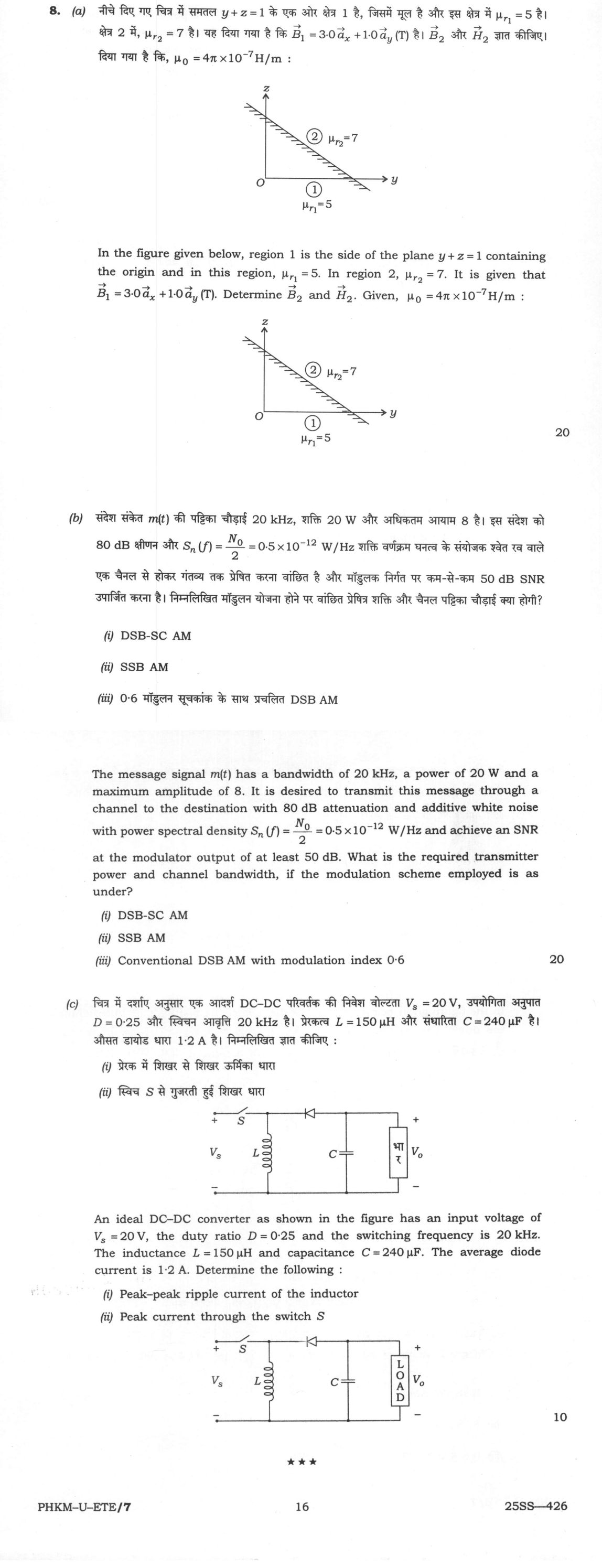
The figure this question refers to, in words
The question paper is a scan and the diagram did not survive as text. This is the figure as read from the original page — every component, value and label — so the question can be worked from the text below.
(a) A 3D Cartesian coordinate system with axes labeled x, y, and z. A plane is drawn passing through the y-axis and z-axis, separating the space into two regions. The plane is labeled with the equation y + z = 1. The region containing the origin (Region 1) is labeled with the relative permeability mu_r1 = 5. The region on the other side of the plane (Region 2) is labeled with the relative permeability mu_r2 = 7. The boundary between the two regions is indicated by hatching lines on the plane.
(c) Circuit diagram of a DC-DC converter. The input voltage source Vs is connected in series with a switch S. The switch S is in parallel with an inductor L. The node after the switch and inductor connects to the anode of a diode. The cathode of the diode connects to a capacitor C and a load resistor (labeled 'भार' in Hindi, meaning Load) in parallel. The output voltage Vo is measured across the capacitor and load. The bottom of the inductor, capacitor, and load are connected to the negative terminal of the source. The switch S is shown in the open position. The diode points from the switch/inductor node towards the output.
What "Solve" is asking you to do
Choose the method, then carry it through to a final answer. Identifying what kind of problem this is and why that method applies is the first thing marked; a correct figure arrived at invisibly earns almost nothing.
Structure that answers it
Given data and what is required → method chosen, with the reason it applies → set-up (equation, circuit, free body, trial balance) → working, step by step → answer with units and any condition of validity
Where marks are lost
Doing the middle steps mentally and writing only the result. In mathematics papers, a further loss comes from giving a decimal where the exact value in surds or fractions was wanted, or from skipping the justification a part explicitly asks for.
How this answer will be evaluated
Approach
Framework: Electrical Engineering, Paper 1. (a) calculate: given > formula > substitution > result with units > interpretation | (b) calculate: given > formula > substitution > result with units > interpretation | (c) calculate: given > formula > substitution > result with units > interpretation Full marks: Complete working with correct boundary conditions, SNR calculations, and converter analysis; all units and assumptions stated
Key points expected
- Identify normal and tangential components of B1
- Apply boundary condition for normal B (Bn1 = Bn2)
- Apply boundary condition for tangential H (Ht1 = Ht2)
- Calculate H2 using B2 = μ2H2
- Calculate required SNR at receiver (50 dB - 80 dB attenuation)
- Apply SNR formulas for DSB-SC, SSB, and Conventional AM
- Determine channel bandwidth for each scheme
- Calculate transmitter power for each scheme
Evaluation rubric
Each sub-part is marked on its own, against the marks and word limit printed on the paper.
- (a) Determine B2 and H2 at the interface using boundary conditions. 20 marks
calculate— given → formula → substitution → result with units → interpretation
Must cover
- Identify normal and tangential components of B1
- Apply boundary condition for normal B (Bn1 = Bn2)
- Apply boundary condition for tangential H (Ht1 = Ht2)
- Calculate H2 using B2 = μ2H2
Loses marks
- Confusing normal and tangential components
- Incorrect application of boundary conditions
Earns more
- Correctly identifies normal vector to plane y+z=1
- Explicitly states μ1 and μ2 values
Extra mark
- Sketch of field vectors at the interface
- (b) Calculate required transmitter power and channel bandwidth for three modulation schemes. 20 marks
calculate— given → formula → substitution → result with units → interpretation
Must cover
- Calculate required SNR at receiver (50 dB - 80 dB attenuation)
- Apply SNR formulas for DSB-SC, SSB, and Conventional AM
- Determine channel bandwidth for each scheme
- Calculate transmitter power for each scheme
Loses marks
- Incorrect SNR calculation at receiver
- Wrong bandwidth formulas for modulation schemes
Earns more
- Correctly converts dB values to linear scale
- Shows relationship between modulation index and power
Extra mark
- Comparison table of power and bandwidth for all three schemes
- (c) Determine peak-peak ripple current and peak switch current for DC-DC converter. 10 marks
calculate— given → formula → substitution → result with units → interpretation
Must cover
- Identify converter topology from circuit diagram
- Calculate inductor ripple current using ΔIL = (Vs - Vo)D/(Lf)
- Determine peak inductor current from average and ripple
- Calculate peak switch current
Loses marks
- Incorrect ripple current formula
- Confusing average and peak current values
Earns more
- Correctly identifies output voltage Vo from duty ratio
- Shows relationship between inductor and switch currents
Extra mark
- Waveform sketch of inductor and switch currents
Model answer coming soon
Every evaluation on this site is marked against a verified model answer. This question's answer is still being written; evaluation opens the moment it lands.
More from Electrical Engineering 2024 Paper I
- Q5 (a) A uniform plane wave travels in vacuum along +y direction. The electric field of the…
- Q6 (a) (i) An AM signal s(t) = A_c[1 + kₐ m(t)]cos(2πf_c t) is applied to the system shown i…
- Q7 (a) (i) Draw the neat and properly labelled output voltage waveform of a three-phase, pha…
- Q8 (a) In the figure given below, region 1 is the side of the plane y+z=1 containing the ori…