Paper I — Q5
(a) A uniform plane wave travels in vacuum along +y direction. The electric field of the wave at some instant is given as E⃗ =…
A uniform plane wave travels in vacuum along +y direction. The electric field of the wave at some instant is given as E⃗ = 4x̂ + 3ẑ. Find the vector magnetic field H⃗. (Given, μ₀ = 4π × 10⁻⁷ H/m, ε₀ = 1/(36π) × 10⁻⁹ F/m) 10 marks
The maximum efficiency of a 200 kVA, 3300/600 V, 50 Hz, single-phase transformer is 98% and occurs at 75% full load and unity power factor. If the leakage impedance is 10%, find the voltage regulation at full load and power factor 0.8 lagging. 10 marks
A diode circuit with an L-C load is shown in the figure, with the capacitor having an initial voltage V_C(t=0) = 120 V, capacitance C = 12 μF and inductance L = 48 μH. If switch S is closed at t = 0 s, then find the following: (i) Peak value of current i (ii) Conduction time of the diode 10 marks
How can linear pre-emphasis and de-emphasis filters be employed to improve the performance of an FM system? Is the improvement in output SNR dependent on both the frequency responses of the pre-emphasis filter and the de-emphasis filter? 10 marks
A transmission line is 25 m long. It has characteristic impedance Z₀ = 40 Ω and operates at 2 MHz. The line is terminated with a load of Z_L = (50 + j30) Ω. If the wave velocity is u = 0.8c (with c = 3×10⁸ m/s) on the line, determine (i) the reflection coefficient and (ii) the input impedance. 10 marks
हिंदी में प्रश्न पढ़ें
एक एकसमान समतल तरंग निर्वात में +y दिशा में चल रही है। तरंग का विद्युत क्षेत्र किसी समय पर E⃗ = 4x̂ + 3ẑ द्वारा प्रदर्शित है। सदिश चुंबकीय क्षेत्र H⃗ निकालिए। (दिया है, μ₀ = 4π × 10⁻⁷ H/m, ε₀ = 1/(36π) × 10⁻⁹ F/m) (10 अंक)
एक 200 kVA, 3300/600 V, 50 Hz, एकल कला परिणामित्र की अधिकतम दक्षता 98% है एवं पूर्ण भार के 75% भार तथा इकाई शक्ति गुणांक पर प्राप्त होती है। यदि क्षरण प्रतिबाधा 10% हो, तो पूर्ण भार एवं 0.8 पश्चगामी शक्ति गुणांक पर वोल्टता नियमन ज्ञात कीजिए। (10 अंक)
दर्शाए गए डायोड एवं L-C भार संयुक्त परिपथ में संधारित्र की प्रारंभिक वोल्टता V_C(t=0) = 120 V, धारिता का मान C = 12 μF एवं प्रेरकत्व का मान L = 48 μH है। यदि स्विच S को समय t = 0 s पर बंद किया जाए, तो निम्नलिखित ज्ञात कीजिए: (i) धारा i का शिखर मान (ii) डायोड का चालन समय (10 अंक)
रैखिक पूर्व-प्रबलन और विप्रबलन छक्कों (फिल्टरों) को एक FM तंत्र का प्रदर्शन उन्नत करने के लिए कैसे नियोजित किया जा सकता है? क्या निगत S/N अनुपात में उन्नयन पूर्व-प्रबलन छक्क और विप्रबलन छक्क दोनों की आवृत्ति प्रतिक्रियाओं पर निर्भर है? (10 अंक)
एक प्रेषण लाइन 25 m लम्बी है। इसकी लाक्षणिक प्रतिबाधा Z₀ = 40 Ω है और यह 2 MHz पर कार्य करती है। लाइन एक भार Z_L = (50 + j30) Ω पर समाप्त होती है। यदि लाइन पर तरंग वेग u = 0.8c है (जहाँ c = 3×10⁸ m/s है), तो (i) परावर्तन गुणांक और (ii) निवेश प्रतिबाधा ज्ञात कीजिए। (10 अंक)
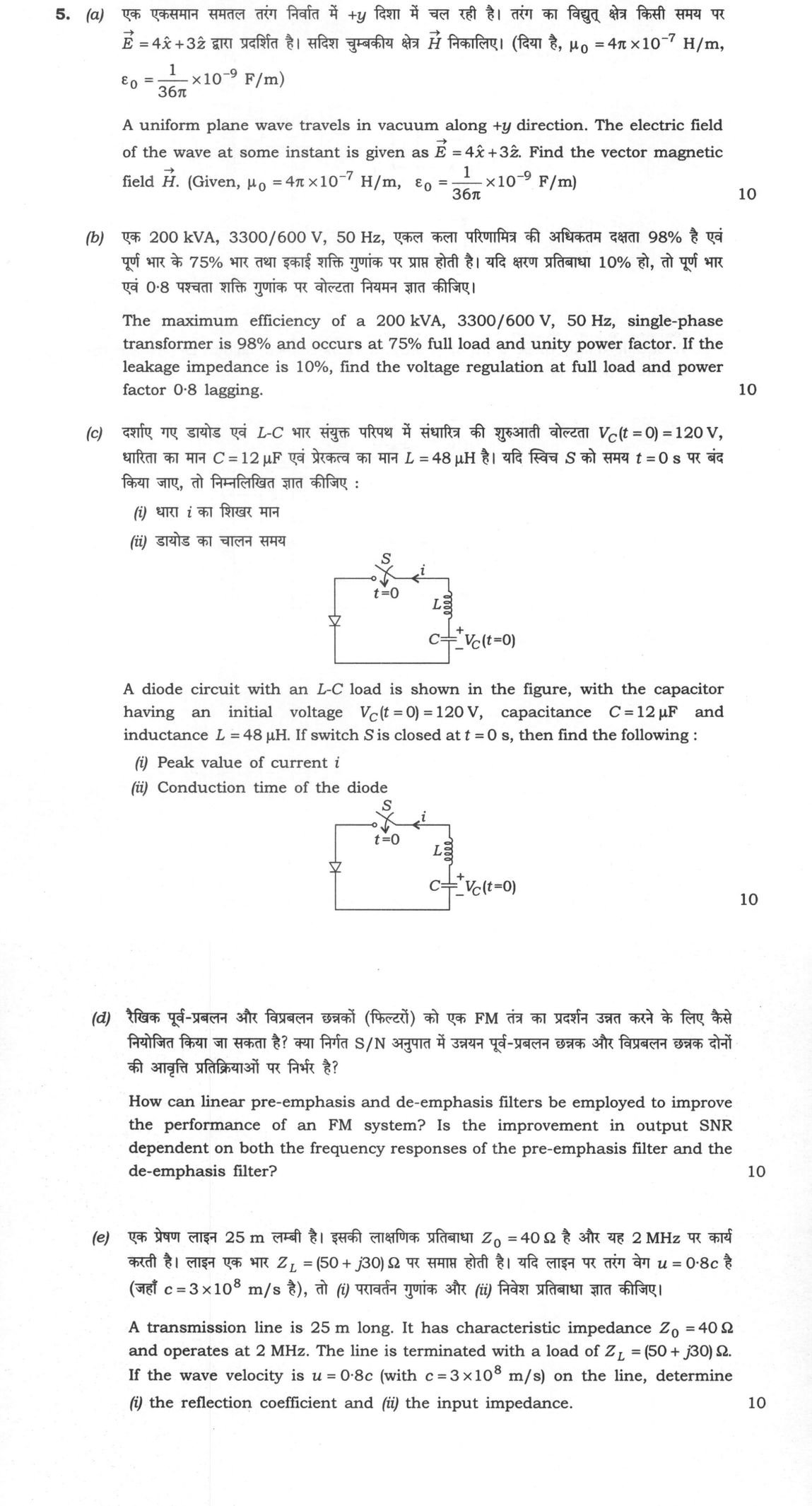
The figure this question refers to, in words
The question paper is a scan and the diagram did not survive as text. This is the figure as read from the original page — every component, value and label — so the question can be worked from the text below.
(c) A series circuit loop containing a diode, an inductor L, and a capacitor C. A switch S is in series with the diode. The inductor L and capacitor C are connected in series. The capacitor has an initial voltage labeled V_C(t=0) with + on top and - on bottom. The switch S is labeled t=0 and the current i is indicated flowing clockwise through the loop.
Model answer
Written by UPSC Answer Check against this question's marking rubric, to the expected length. UPSC does not publish answers for Mains — this is one way to score well, not an official key.
(a) For a uniform plane wave in vacuum, the intrinsic impedance is η₀ = √(μ₀/ε₀) = √[(4π × 10⁻⁷)/((1/(36π)) × 10⁻⁹)] = 120π Ω. The wave travels along +y, so âk = ây. The magnetic field is obtained from the plane-wave relation H⃗ = (1/η₀)(ây × E⃗). Given E⃗ = 4x̂ + 3ẑ, ây × E⃗ = ây × (4x̂ + 3ẑ) = 4(ây × x̂) + 3(ây × ẑ). Using ây × x̂ = −ẑ and ây × ẑ = x̂, ây × E⃗ = −4ẑ + 3x̂ = 3x̂ − 4ẑ. Therefore H⃗ = (3x̂ − 4ẑ)/(120π) A/m = x̂/(40π) − ẑ/(30π) A/m.
Final answer: H⃗ = x̂/(40π) − ẑ/(30π) A/m.
(b) Rated transformer: S = 200 kVA. At maximum efficiency, iron loss equals copper loss. Let the common loss be P. At 75% full load and unity power factor, output is Pout = 0.75 × 200 × 1 = 150 kW. ηmax = 0.98 = 150/(150 + 2P). So 150 + 2P = 150/0.98 = 153.0612 kW, giving P = 1.5306 kW. Thus iron loss Pi = 1.5306 kW and copper loss at 75% load is also 1.5306 kW. Full-load copper loss: Pcu,FL = 1.5306/(0.75²) = 2.7211 kW. On the transformer base, per-unit resistance is Req = Pcu,FL/S = 2.7211/200 = 0.013605 pu. Given leakage impedance |Zeq| = 0.10 pu, Xeq = √(0.10² − Req²) = √(0.01 − 0.0001851) = 0.099070 pu. At full load, I = 1 pu, power factor 0.8 lagging, so cosθ = 0.8, sinθ = 0.6. Exact regulation using phasor addition: Vs = 1 + I(Req cosθ + Xeq sinθ) + jI(Xeq cosθ − Req sinθ) = 1 + 0.070326 + j0.071093. |Vs| = √(1.070326² + 0.071093²) = 1.072685. %VR = (|Vs| − 1) × 100 = 7.2685%.
The usual first-order approximate formula gives %VR ≈ (Req cosθ + Xeq sinθ) × 100 = 7.0326%.
Final answer: Exact voltage regulation at full load, 0.8 pf lagging ≈ 7.27%. By the common approximate formula, it is 7.03%.
(c)(i) In the series L-C circuit, the capacitor initially has VC(0) = V₀ = 120 V. When S is closed, the diode conducts in the direction of current i. The natural angular frequency is ω₀ = 1/√(LC), and the characteristic impedance is Z₀ = √(L/C). With initial current i(0) = 0, the current is i(t) = (V₀/Z₀) sin(ω₀t). Peak current: Ipeak = V₀/Z₀ = V₀√(C/L). Here √(C/L) = √(12 × 10⁻⁶ / 48 × 10⁻⁶) = √(1/4) = 1/2. Hence Ipeak = 120 × 1/2 = 60 A.
Final answer: Peak value of current = 60 A.
(c)(ii) The diode conducts for the first positive half-cycle of the sinusoidal current and stops when i(t) first becomes zero. Thus ω₀t = π, so conduction time is tc = π/ω₀ = π√(LC). Now LC = 48 × 10⁻⁶ × 12 × 10⁻⁶ = 576 × 10⁻¹² s². √(LC) = 24 × 10⁻⁶ s = 24 μs. Therefore tc = 24π μs ≈ 75.40 μs.
Final answer: Conduction time of the diode = 24π μs ≈ 75.40 μs.
(d) In an FM receiver, the noise power spectral density at the discriminator output increases as f². Hence high audio frequencies suffer a poorer signal-to-noise ratio than low frequencies. A linear pre-emphasis filter at the transmitter boosts the high-frequency components of the modulating signal before modulation. At the receiver, after demodulation, a de-emphasis filter with the inverse frequency response attenuates those high frequencies back to their original relative amplitudes. If Hp(f) is the pre-emphasis response and Hd(f) is the de-emphasis response, then for undistorted signal recovery one requires Hp(f)Hd(f) ≈ 1 over the audio band. The signal is therefore restored to its flat spectrum, but the FM noise, whose power spectral density rises as f², is attenuated at high frequencies by |Hd(f)|². Thus the output SNR improves. The improvement factor is I = ∫₀^fm f² df / ∫₀^fm f² |Hd(f)|² df for a baseband 0 to fm, assuming ideal FM demodulation. This shows that the SNR improvement depends directly on the de-emphasis response. However, since the de-emphasis must be the inverse of the pre-emphasis to avoid signal distortion, the improvement depends on both responses as a matched pair. For a typical RC pre-emphasis with break frequency f₁ and de-emphasis 1/(1 + jf/f₁), the improvement is approximately I ≈ (fm/f₁)²/3 for fm ≫ f₁.
Final answer: Pre-emphasis boosts high-frequency signal components at the transmitter; de-emphasis attenuates them at the receiver, reducing high-frequency FM noise while restoring the signal. Yes, the SNR improvement depends on both pre-emphasis and de-emphasis responses, since they must act as inverse filters.
(e)(i) The load reflection coefficient is ΓL = (ZL − Z₀)/(ZL + Z₀). Given ZL = 50 + j30 Ω and Z₀ = 40 Ω, ΓL = (50 + j30 − 40)/(50 + j30 + 40) = (10 + j30)/(90 + j30). Divide numerator and denominator by 10: ΓL = (1 + j3)/(9 + j3). Rationalising: ΓL = (1 + j3)(9 − j3)/(9² + 3²) = (18 + j24)/90 = 0.2 + j0.2667. Magnitude: |ΓL| = √(0.2² + 0.2667²) = 1/3. Angle: θ = tan⁻¹(4/3) = 53.13°.
Final answer: ΓL = 0.2 + j0.2667 = (1/5) + j(4/15), |ΓL| = 1/3, angle = 53.13°.
(e)(ii) Wave velocity: u = 0.8c = 0.8 × 3 × 10⁸ = 2.4 × 10⁸ m/s. Frequency f = 2 MHz = 2 × 10⁶ Hz. Wavelength: λ = u/f = (2.4 × 10⁸)/(2 × 10⁶) = 120 m. Line length l = 25 m, so βl = 2πl/λ = 2π × 25/120 = 5π/12 = 75°. Thus tan βl = tan 75° = 2 + √3. The input impedance is Zin = Z₀ (ZL + jZ₀ tan βl)/(Z₀ + jZL tan βl). Substituting, Zin = 40[(50 + j30) + j40(2 + √3)]/[40 + j(50 + j30)(2 + √3)]. Numerator: 50 + j[30 + 40(2 + √3)] = 50 + j(110 + 40√3). Denominator: 40 + j(50 + j30)(2 + √3) = 40 − 30(2 + √3) + j50(2 + √3) = (−20 − 30√3) + j(100 + 50√3). Therefore Zin = 40[50 + j(110 + 40√3)]/[(-20 − 30√3) + j(100 + 50√3)] Ω. Numerically, Zin ≈ 29.857 − j22.232 Ω.
Final answer: Zin ≈ (29.86 − j22.23) Ω.
What "Solve" is asking you to do
Choose the method, then carry it through to a final answer. Identifying what kind of problem this is and why that method applies is the first thing marked; a correct figure arrived at invisibly earns almost nothing.
Structure that answers it
Given data and what is required → method chosen, with the reason it applies → set-up (equation, circuit, free body, trial balance) → working, step by step → answer with units and any condition of validity
Where marks are lost
Doing the middle steps mentally and writing only the result. In mathematics papers, a further loss comes from giving a decimal where the exact value in surds or fractions was wanted, or from skipping the justification a part explicitly asks for.
How this answer will be evaluated
Approach
(a) calculate: given > formula > substitution > result with units > interpretation | (b) calculate: given > formula > substitution > result with units > interpretation | (c) calculate: given > formula > substitution > result with units > interpretation | (d) explain: definition/context > points in order > small example > short close | (e) calculate: given > formula > substitution > result with units > interpretation Full marks: Correct method, clear steps, accurate calculations, proper units, and diagrams where relevant.
Key points expected
- Identify propagation direction as +y
- Calculate wave impedance η₀ = √(μ₀/ε₀) = 120π Ω
- Apply H = (1/η₀)(k̂ × E) using vector cross product
- State final H vector with correct units (A/m)
- Determine copper loss at full load from 75% max efficiency data
- Determine constant iron loss from efficiency equation
- Calculate voltage drop components (I R cosφ + I X sinφ)
- Compute % regulation = (V_drop / V_secondary) × 100
Evaluation rubric
Each sub-part is marked on its own, against the marks and word limit printed on the paper.
- (a) Determine the vector magnetic field H for a plane wave in vacuum. 10 marks
calculate— given → formula → substitution → result with units → interpretation
Must cover
- Identify propagation direction as +y
- Calculate wave impedance η₀ = √(μ₀/ε₀) = 120π Ω
- Apply H = (1/η₀)(k̂ × E) using vector cross product
- State final H vector with correct units (A/m)
Loses marks
- Sign error in cross product (k̂ × E vs E × k̂)
- Using E/H = η₀ instead of H = E/η₀
Earns more
- Explicit calculation of cross product components
- Verification that E, H, and k are mutually orthogonal
Extra mark
- Sketch of E, H, and propagation direction vectors
- (b) Find voltage regulation at full load, 0.8 lagging PF. 10 marks
calculate— given → formula → substitution → result with units → interpretation
Must cover
- Determine copper loss at full load from 75% max efficiency data
- Determine constant iron loss from efficiency equation
- Calculate voltage drop components (I R cosφ + I X sinφ)
- Compute % regulation = (V_drop / V_secondary) × 100
Loses marks
- Assuming copper loss is constant at all loads
- Ignoring the reactive component of voltage drop
Earns more
- Explicit separation of constant and variable losses
- Use of per-unit system for impedance calculations
Extra mark
- Phasor diagram showing V, I, and drop components
- (c) Find peak current and diode conduction time in L-C circuit. 10 marks
calculate— given → formula → substitution → result with units → interpretation
Must cover
- Calculate characteristic impedance Z₀ = √(L/C)
- Determine peak current I_peak = V₀/Z₀
- Calculate resonant frequency ω₀ = 1/√(LC)
- Determine conduction time t = π/ω₀ (half cycle)
Loses marks
- Using full cycle (2π/ω₀) for conduction time
- Confusing peak voltage with RMS voltage
Earns more
- Derivation of current equation i(t) = (V₀/Z₀)sin(ω₀t)
- Explicit calculation of ω₀ in rad/s
Extra mark
- Sketch of current waveform i(t) vs time
- (d) Explain pre-emphasis/de-emphasis in FM and SNR dependence. 10 marks
explain— definition/context → points in order → small example → short close
Must cover
- Define pre-emphasis (boost high freq) and de-emphasis (attenuate high freq)
- Explain noise increases with frequency in FM
- State that de-emphasis reduces high-frequency noise
- Answer: Yes, improvement depends on both filter responses
Loses marks
- Claiming improvement depends only on de-emphasis
- Failing to link noise spectrum to frequency
Earns more
- Mention of standard time constants (75μs pre, 75μs de)
- Explanation of how filters cancel each other for signal
Extra mark
- Block diagram of FM transmitter/receiver with filters
- (e) Determine reflection coefficient and input impedance. 10 marks
calculate— given → formula → substitution → result with units → interpretation
Must cover
- Calculate reflection coefficient Γ = (Z_L - Z₀)/(Z_L + Z₀)
- Calculate electrical length θ = βl = (2π/λ)l
- Use input impedance formula Z_in = Z₀(1+Γe^(-j2θ))/(1-Γe^(-j2θ))
- Compute final Z_in in rectangular form (R + jX)
Loses marks
- Using Z_in = Z₀(1+Γ)/(1-Γ) without phase term
- Error in calculating electrical length θ
Earns more
- Explicit calculation of wavelength λ = u/f
- Conversion of Γ to polar form for calculation
Extra mark
- Smith chart plot of Z_L and Z_in
Practice this exact question
Write your answer and it is marked point by point against the model answer above — what you covered, what you missed, what you got wrong.
Evaluate my answer →More from Electrical Engineering 2024 Paper I
- Q2 (a) Draw the circuit diagram, function table, logic symbol and switch model for a CMOS ga…
- Q3 (a) Determine the time signal that corresponds to the following bilateral Laplace transfo…
- Q4 (a) In the circuit diagram given here, load resistance R_L is to be set for maximum power…
- Q5 (a) A uniform plane wave travels in vacuum along +y direction. The electric field of the…
- Q6 (a) (i) An AM signal s(t) = A_c[1 + kₐ m(t)]cos(2πf_c t) is applied to the system shown i…
- Q7 (a) (i) Draw the neat and properly labelled output voltage waveform of a three-phase, pha…
- Q8 (a) In the figure given below, region 1 is the side of the plane y+z=1 containing the ori…