Paper II — Q1
(a) What are the limitations of (i) Proportional (P), (ii) Integral (I), (iii) Derivative (D), and (iv) PID Controllers? What is…
What are the limitations of (i) Proportional (P), (ii) Integral (I), (iii) Derivative (D), and (iv) PID Controllers? What is the application of positive feedback control system? 10 marks
Explain the operation performed by 8085 microprocessor when the following arithmetic instructions are executed: (i) ADD M (ii) ADC M (iii) DAD rp (iv) SBI d8 (v) DCR reg (5×2=10 marks)
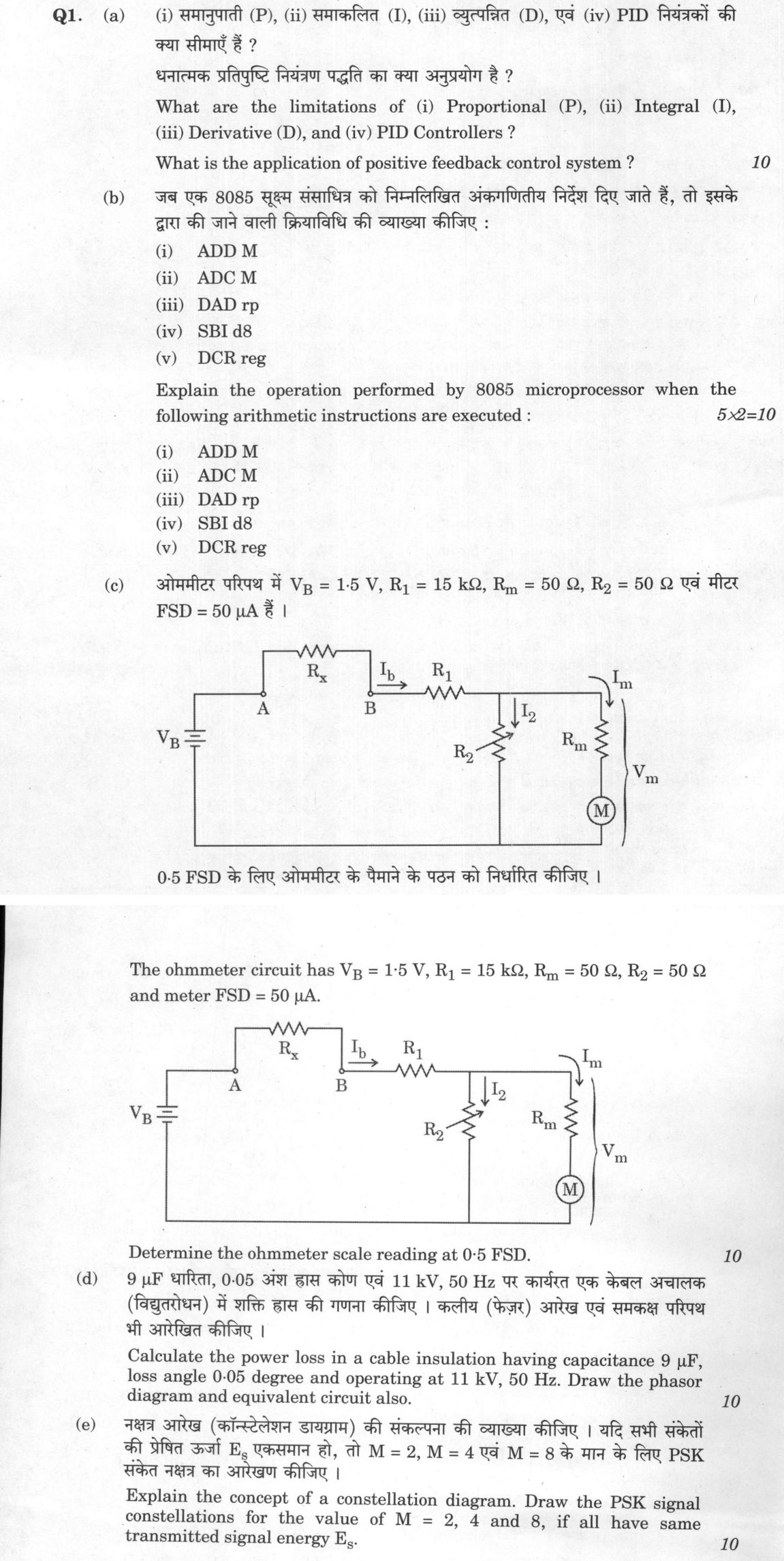
The ohmmeter circuit has V_B = 1·5 V, R_1 = 15 kΩ, R_m = 50 Ω, R_2 = 50 Ω and meter FSD = 50 μA. Determine the ohmmeter scale reading at 0·5 FSD.
Calculate the power loss in a cable insulation having capacitance 9 μF, loss angle 0.05 degree and operating at 11 kV, 50 Hz. Draw the phasor diagram and equivalent circuit also.
Explain the concept of a constellation diagram. Draw the PSK signal constellations for the value of M = 2, 4 and 8, if all have same transmitted signal energy E_s.
हिंदी में प्रश्न पढ़ें
समानुपाती (P), (ii) समाकलित (I), (iii) व्युत्पन्न (D), एवं (iv) PID नियंत्रकों की क्या सीमाएं हैं? धनात्मक प्रतिपुष्टि नियंत्रण पद्धति का क्या अनुप्रयोग है?
जब एक 8085 सूक्ष्म संसाधित्र को निम्नलिखित अंकगणितीय निर्देश दिए जाते हैं, तो इसके द्वारा की जाने वाली क्रियाविधि की व्याख्या कीजिए: (i) ADD M (ii) ADC M (iii) DAD rp (iv) SBI d8 (v) DCR reg
ओममीटर परिपथ में V_B = 1·5 V, R_1 = 15 kΩ, R_m = 50 Ω, R_2 = 50 Ω एवं मीटर FSD = 50 μA हैं। 0·5 FSD के लिए ओममीटर के पैमाने के पठन को निर्धारित कीजिए।
9 μF धारिता, 0·05 अंश हास कोण एवं 11 kV, 50 Hz पर कार्यरत एक केबल अचालक (विद्युतरोधन) में शक्ति हास की गणना कीजिए। कल्पीय (फेजर) आरेख एवं समकक्ष परिपथ भी आरेखित कीजिए।
नक्षत्र आरेख (कांस्टेलेशन डायग्राम) की संकल्पना की व्याख्या कीजिए। यदि सभी संकेतों की प्रेषित ऊर्जा E_s एकसमान हो, तो M = 2, M = 4 एवं M = 8 के मान के लिए PSK संकेत नक्षत्र का आरेखण कीजिए।
The figure this question refers to, in words
The question paper is a scan and the diagram did not survive as text. This is the figure as read from the original page — every component, value and label — so the question can be worked from the text below.
(c) A circuit diagram for an ohmmeter. A DC voltage source labeled V_B is connected in series with a variable resistor labeled R_x. The terminals of R_x are labeled A and B. From terminal B, the circuit continues to a fixed resistor R_1. After R_1, the circuit splits into two parallel branches. The first branch contains a variable resistor R_2. The second branch contains a fixed resistor R_m in series with a meter labeled M. The current entering the parallel section is labeled I_b. The current through the R_2 branch is labeled I_2. The current through the meter branch is labeled I_m. The voltage across the parallel combination of R_2 and the (R_m + M) branch is labeled V_m. The bottom of the voltage source, the bottom of R_2, and the bottom of the meter M are all connected to a common ground line.
Model answer
Written by UPSC Answer Check against this question's marking rubric, to the expected length. UPSC does not publish answers for Mains — this is one way to score well, not an official key.
(a) Controllers and positive feedback. A proportional controller gives an output proportional to the instantaneous error. It improves speed and reduces rise time, but for a step input it generally leaves a finite steady-state error or offset, because a non-zero error is required to maintain the control output. An integral controller accumulates error with time; it can remove steady-state offset, but it makes the response slower, can produce overshoot, and if the error persists while the actuator is saturated it causes integral windup, which may lead to instability when the loop recovers. A derivative controller responds to the rate of change of error; it adds damping and anticipates future error, but it amplifies high-frequency noise, can drive actuators into saturation, and is sensitive to sudden disturbances or measurement spikes. A PID controller combines these actions, so it is flexible but requires careful tuning of Kp, Ki and Kd; poor tuning can combine offset, oscillation, noise amplification and windup. Positive feedback is used when the output is deliberately fed back in phase to reinforce the input. Its main application is oscillators, where the Barkhausen criterion, loop gain unity and zero phase shift, sustains sinusoidal oscillations. It is also used in regenerative amplifiers and Schmitt triggers, where positive feedback gives rapid switching and hysteresis.
(b) 8085 arithmetic instructions. After the opcode is fetched and decoded, the ALU performs the specified transfer. For ADD M, the byte in the memory location whose address is in the HL pair is added to the accumulator: (A) ← (A) + [(HL)]. The result is stored in A and the flags S, Z, AC, P and CY are set according to the result. For ADC M, the same memory byte is added to A together with the carry flag: (A) ← (A) + [(HL)] + CY. This is used for multi-byte addition; the result is in A and the flags are affected. For DAD rp, the 16-bit content of the specified register pair rp (BC, DE, HL or SP) is added to the 16-bit HL pair: (HL) ← (HL) + (rp). The result is stored in HL; only the carry flag CY is affected, indicating a carry out of bit 15. For SBI d8, the 8-bit immediate data d8 and the carry flag are subtracted from the accumulator: (A) ← (A) − d8 − CY. The result is in A and the flags are affected; it is used for multi-byte subtraction. For DCR reg, the selected 8-bit register is decremented by one: (reg) ← (reg) − 1. The result is stored in the same register; S, Z, AC and P are affected, but CY is not changed.
(c) Ohmmeter reading. The meter branch has Rm = 50 Ω and the shunt R2 = 50 Ω, so the two parallel branches have equal resistance and the current divides equally. At 0.5 FSD the meter current is Im = 25 μA. Therefore the shunt current is also 25 μA, and the total loop current is Ib = 50 μA. The total resistance required to draw this current from VB = 1.5 V is Rtotal = VB/Ib = 1.5 / 50×10⁻⁶ = 30,000 Ω. The internal resistance of the ohmmeter is R1 plus the parallel combination of Rm and R2: Rint = 15,000 + (50×50)/(50+50) = 15,000 + 25 = 15,025 Ω. Hence the unknown resistance connected across A and B is Rx = Rtotal − Rint = 30,000 − 15,025 = 14,975 Ω, approximately 15 kΩ. Thus the ohmmeter scale reading at half full-scale deflection is about 15 kΩ.
(d) Cable insulation loss. The insulation can be represented by a parallel equivalent circuit: an ideal capacitance C in parallel with a loss resistance R. The equivalent resistance is R = 1/(ωC tanδ), so the same loss can be written P = V²/R. The loss angle δ is the small angle between the total current I and the capacitive current IC. In the phasor diagram, take voltage V along the horizontal axis; the resistive current IR is in phase with V, the capacitive current IC leads V by 90°, and the total current I is the vector sum of IR and IC. Since δ is small, IR = IC tanδ. The dielectric power loss is the real power in R: P = V IR = V IC tanδ = V²ωC tanδ. Substituting the given values, P = (11×10³)² × 2π×50 × 9×10⁻⁶ × tan(0.05°) ≈ 16.7 W. The small δ means the total current is almost purely capacitive, and only the in-phase component IR consumes real power; this loss appears as heat in the insulation.
(e) Constellation diagram. A constellation diagram plots the possible transmitted symbols in the in-phase (I) and quadrature (Q) plane. Each point represents a phase and amplitude of the modulated carrier; the distance from the origin is proportional to the signal amplitude and the angle gives the phase. For PSK with the same transmitted symbol energy Es, all points lie on a circle of radius √Es. For M = 2, BPSK has two points opposite each other, usually at 0° and 180°, i.e. +√Es and −√Es on the I axis. For M = 4, QPSK has four points separated by 90°; commonly they are placed at 45°, 135°, 225° and 315°, or equivalently at 0°, 90°, 180° and 270°, all on the same circle. For M = 8, 8-PSK has eight points separated by 45°, for example at 0°, 45°, 90°, 135°, 180°, 225°, 270° and 315°. A sketch would show a circle of radius √Es with the corresponding points marked on it: two diametrically opposite points for BPSK, four points at the corners of a square for QPSK, and eight equally spaced points for 8-PSK. In all three cases the radius remains √Es, so increasing M increases the number of phase states without changing the symbol energy, but the angular separation becomes smaller and the noise margin decreases. Thus, the answer follows from the governing mechanism in each case: error action in control, register transfer in the 8085, current division in the ohmmeter, dielectric loss in the insulation, and phase-state geometry in the constellation.
What "Explain" is asking you to do
Make the working of something clear — what sets it off, what follows from what, and what it produces. Explain is the Commission's mechanism word: it dominates the technical papers and the “explain why” stems, where the marks sit in the causal chain and not in the label.
Structure that answers it
State what it is → the initiating condition → the chain of cause, step by step → an instance where it plays out → what the chain produces
Where marks are lost
Describing what something looks like instead of why it works that way. Naming the stages without linking them reads as description too.
How this answer will be evaluated
Approach
Framework: Control Systems & Digital Electronics Analysis. (a) explain: Definition/Context > Points in order > Small example > Short close | (b) explain: Definition/Context > Points in order > Small example > Short close | (c) derive: Given > Assumptions > Stepwise derivation > Result > Check | (d) derive: Given > Assumptions > Stepwise derivation > Result > Check | (e) explain: Definition/Context > Points in order > Small example > Short close Full marks: Precise derivations, correct diagrams, and clear definitions.
Key points expected
- PID limitations: P (error), I (instability), D (noise)
- 8085: SBI subtracts immediate and carry
- Ohmmeter: Thevenin equivalent is key to finding Rx
- Cable loss: P = V^2 * ωC * tan(δ)
- PSK: Points lie on a circle of radius sqrt(Es)
Evaluation rubric
Each sub-part is marked on its own, against the marks and word limit printed on the paper.
- (a) List limitations of P, I, D, PID controllers and one positive feedback application. 10 marks
explain— Definition/Context → Points in order → Small example → Short close
Must cover
- P: Steady-state error, overshoot
- I: Slower response, instability risk
- D: Noise amplification, no error correction
- PID: Tuning complexity, derivative kick
Loses marks
- Defining terms without listing limitations
- Confusing positive with negative feedback
Earns more
- Positive feedback: Regenerative oscillators
- Positive feedback: Schmitt triggers
Extra mark
- Block diagram of positive feedback loop
- (b) Describe the specific operation of five 8085 arithmetic instructions. 10 marks
explain— Definition/Context → Points in order → Small example → Short close
Must cover
- ADD M: A = A + M
- ADC M: A = A + M + Carry
- DAD rp: 16-bit add to register pair
- SBI d8: A = A - d8 - Carry
Loses marks
- Confusing SBI with SUB
- Ignoring the Carry flag in ADC/SBI
Earns more
- DCR reg: Decrement register by 1
- Mentioning flag effects (Z, C, S)
Extra mark
- Mentioning 16-bit carry for DAD
- (c) Calculate the unknown resistance Rx at 0.5 FSD using the given circuit. 10 marks
derive— Given → Assumptions → Stepwise derivation → Result → Check
Must cover
- Calculate Thevenin equivalent (Vth, Rth)
- Apply current divider for meter branch
- Set Im = 0.5 * FSD (25 μA)
- Solve for Rx
Loses marks
- Ignoring the parallel branch R2
- Using total current instead of meter current
Earns more
- Correct calculation of Rth (15k || 50)
- Correct calculation of Vth (1.5 * 50/15k)
Extra mark
- Redrawn Thevenin equivalent circuit
- (d) Calculate dielectric power loss and draw phasor/equivalent diagrams. 10 marks
derive— Given → Assumptions → Stepwise derivation → Result → Check
Must cover
- Calculate capacitive current Ic = VωC
- Calculate loss current Id = Ic sin(δ)
- Calculate Power P = V * Id
- Draw equivalent parallel circuit (R || C)
Loses marks
- Using cos(δ) instead of sin(δ) for loss
- Missing the phasor diagram
Earns more
- Phasor diagram showing V, Ic, Id
- Correct unit conversion (kV to V)
Extra mark
- Mentioning dissipation factor tan(δ)
- (e) Define constellation diagram and draw PSK constellations for M=2, 4, 8. 10 marks
explain— Definition/Context → Points in order → Small example → Short close
Must cover
- Define constellation diagram (I-Q plane)
- Draw M=2 (BPSK) on real axis
- Draw M=4 (QPSK) at 90-degree intervals
- Draw M=8 (8-PSK) at 45-degree intervals
Loses marks
- Drawing QAM instead of PSK
- Unequal radii for PSK points
Earns more
- Labeling points with binary values
- Showing equal radius for all points
Extra mark
- Mentioning minimum distance between points
Practice this exact question
Write your answer and it is marked point by point against the model answer above — what you covered, what you missed, what you got wrong.
Evaluate my answer →More from Electrical Engineering 2024 Paper II
- Q1 (a) What are the limitations of (i) Proportional (P), (ii) Integral (I), (iii) Derivative…
- Q2 (a) The open-loop transfer function of a feedback control system incorporating a dead tim…
- Q3 (a) An underdamped second order system having a transfer function of the form M(s) = (Kωₙ…
- Q4 (a) The capacitance of a piezoelectric transducer is 2000 pF and charge sensitivity is 30…