Paper II — Q6
(a) Calculate the power loss in the transmission system given in the following figure. The numerical values of transmission…
Calculate the power loss in the transmission system given in the following figure. The numerical values of transmission system are: I₁ = 0·75 ∠0° PU, I₂ = 0·8 ∠0° PU, V₃ = 1·2 ∠0° PU, Z₁ = (0·07 + j0·15) PU, Z₂ = (0·06 + j0·20) PU, Z₃ = (0·05 + j0·06) PU 20 marks
The fuel input equations of two power plant operations are given as: F₁ = 0·3 P₁² + 35 P₁ + 125, ₹/hr F₂ = 0·2 P₂² + 30 P₂ + 140, ₹/hr If the maximum and minimum loading on each unit is 90 MW and 20 MW respectively and the total consumption demand is 200 MW, then calculate the economical operating schedule and corresponding cost of generation. If load is equally shared by both units, calculate the savings achieved by loading the units as per equal incremental production cost. Neglect the transmission losses. 20 marks
A DM transmitter with a fixed step size of 0·25 V is given a sinusoidal message signal. Determine the maximum permissible amplitude of the message signal, if slope overload is to be avoided. Assume sampling frequency ten times the Nyquist rate. 10 marks
हिंदी में प्रश्न पढ़ें
निम्नलिखित चित्र में दी गई संचरण प्रणाली में शक्ति हानि की गणना कीजिए । संचरण प्रणाली के आंकिक मान निम्न प्रकार हैं : I₁ = 0·75 ∠0° PU, I₂ = 0·8 ∠0° PU, V₃ = 1·2 ∠0° PU, Z₁ = (0·07 + j0·15) PU, Z₂ = (0·06 + j0·20) PU, Z₃ = (0·05 + j0·06) PU 20 अंक
दो शक्ति संयंत्रों के संचालन के ईंधन निविष्ट समीकरण निम्न प्रकार हैं : F₁ = 0·3 P₁² + 35 P₁ + 125, ₹/घंटे F₂ = 0·2 P₂² + 30 P₂ + 140, ₹/घंटे यदि प्रत्येक इकाई पर अधिकतम व न्यूनतम भार क्रमशः: 90 MW और 20 MW तथा कुल खपत मांग 200 MW हो, तो मितव्ययी परिचालन अनुसूची और उससे संबंधित उत्पादन लागत की गणना कीजिए । यदि दोनों इकाइयों द्वारा कुल भार को समान रूप से सहभाजित किया जाता है, तो समान बढ़ोतरी उत्पादन लागत के अनुसार इकाइयों के भारण से प्राप्त बचत की गणना कीजिए । संचरण हानि को उपेक्षित किया गया है । 20 अंक
एक 0·25 V के स्थायी चरण परिमाण वाले DM प्रेषित्र (ट्रांसमीटर) को एक ज्यावक्रीय सूचना संकेत दिया जाता है । यदि प्रवणता अधिभार (स्लोप ओवरलोड) से बचना है, तो सूचना संकेत के अधिकतम अनुज्ञेय आयाम का निर्धारण कीजिए । न्यूनतम चयन आवृत्ति को नाइक्विस्ट दर से दस गुना माना गया है । 10 अंक
The figure this question refers to, in words
The question paper is a scan and the diagram did not survive as text. This is the figure as read from the original page — every component, value and label — so the question can be worked from the text below.
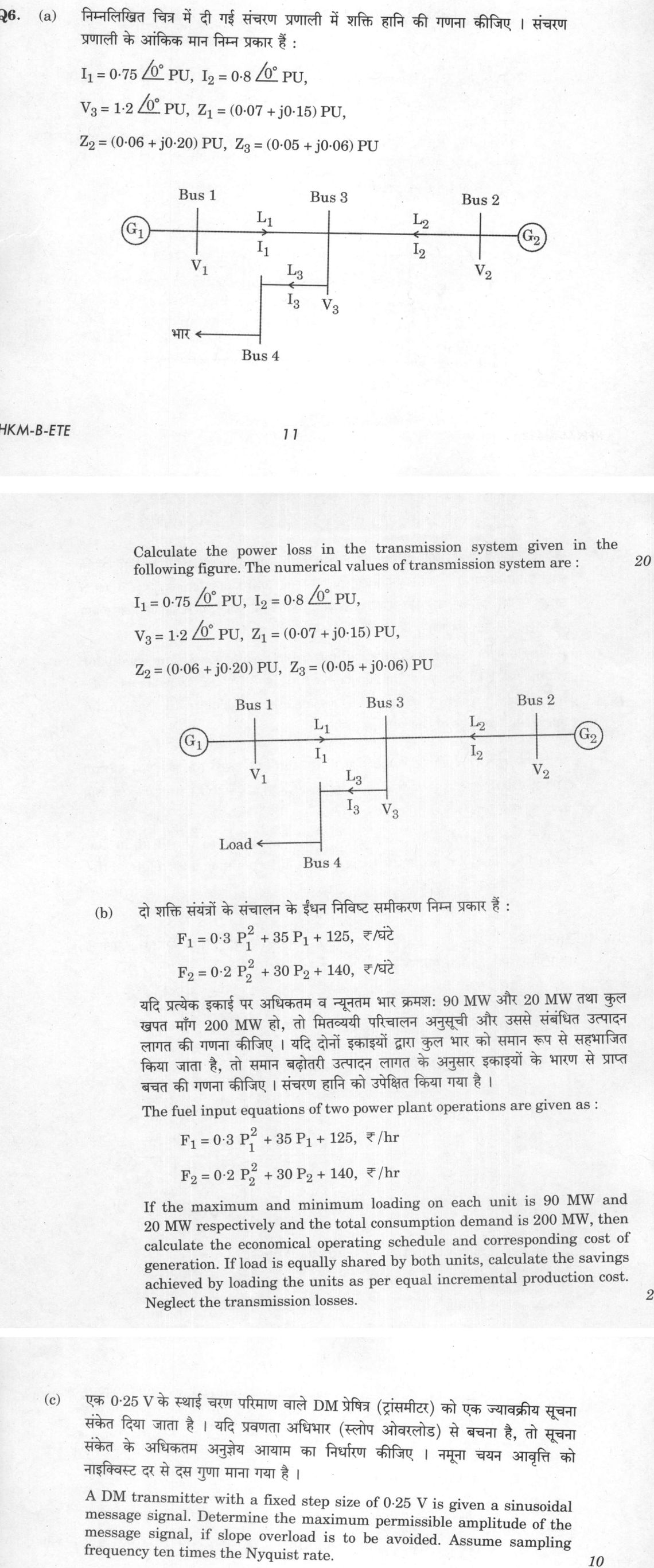
(a) A single-line diagram of a 4-bus power system: Bus 1 is connected to a generator G1 on the left and has bus voltage V1. Bus 2 is connected to a generator G2 on the right and has bus voltage V2. Transmission line L1 connects Bus 1 to Bus 3, carrying current I1 with an arrow directed from Bus 1 to Bus 3. Transmission line L2 connects Bus 2 to Bus 3, carrying current I2 with an arrow directed from Bus 2 to Bus 3. Bus 3 has bus voltage V3 and connects via line L3 to Bus 4, with line L3 carrying current I3 with an arrow directed towards Bus 4. Bus 4 connects to a load indicated by a leftward arrow labeled 'भार' (Load). The given system parameters are: I1 = 0.75 angle 0 degrees PU, I2 = 0.8 angle 0 degrees PU, V3 = 1.2 angle 0 degrees PU, line impedances Z1 = (0.07 + j0.15) PU, Z2 = (0.06 + j0.20) PU, and Z3 = (0.05 + j0.06) PU. The question asks to calculate the power loss in the transmission system.
(a) A power transmission system with 4 buses and 3 transmission lines: Bus 1 is connected to a generator G1 and has voltage V1. Transmission line L1 connects Bus 1 to Bus 3, carrying current I1 directed towards Bus 3. Bus 2 is connected to a generator G2 and has voltage V2. Transmission line L2 connects Bus 2 to Bus 3, carrying current I2 directed towards Bus 3. Bus 3 has voltage V3. Transmission line L3 connects Bus 3 to Bus 4, carrying current I3 directed towards Bus 4. Bus 4 connects to a load with current directed away from Bus 4 towards 'Load'.
Model answer
Written by UPSC Answer Check against this question's marking rubric, to the expected length. UPSC does not publish answers for Mains — this is one way to score well, not an official key.
(a) At Bus 3, apply Kirchhoff’s current law (KCL). The arrows show I₁ and I₂ entering Bus 3 and I₃ leaving toward Bus 4. Therefore, I₃ = I₁ + I₂ = 0.75∠0° + 0.80∠0° = 1.55∠0° PU.
The active power lost in a series transmission line is the I²R loss: P_loss = ∑ |I_k|² R_k.
- Line 1: P₁ = 0.75² × 0.07 = 0.5625 × 0.07 = 0.039375 PU.
- Line 2: P₂ = 0.80² × 0.06 = 0.64 × 0.06 = 0.038400 PU.
- Line 3: P₃ = 1.55² × 0.05 = 2.4025 × 0.05 = 0.120125 PU.
Total active power loss: P_loss = 0.039375 + 0.038400 + 0.120125 = 0.197900 PU.
For completeness, the reactive power absorbed is Q_loss = 0.75² × 0.15 + 0.80² × 0.20 + 1.55² × 0.06 = 0.084375 + 0.128000 + 0.144150 = 0.356525 PU. Thus S_loss = 0.197900 + j0.356525 PU.
Final: active power loss = 0.1979 PU. In MW, it is 0.1979 × S_base, where S_base is the base MVA. V₃ = 1.2∠0° PU is not needed once all branch currents and resistances are known.
(b) The incremental fuel costs are obtained by differentiating the fuel-cost equations.
dF₁/dP₁ = 0.6P₁ + 35 ₹/MWh dF₂/dP₂ = 0.4P₂ + 30 ₹/MWh
For economical load dispatch, neglecting transmission losses, the equal incremental production cost criterion is used: 0.6P₁ + 35 = 0.4P₂ + 30.
The demand constraint is: P₁ + P₂ = 200 MW.
Substitute P₂ = 200 − P₁: 0.6P₁ + 35 = 0.4(200 − P₁) + 30 0.6P₁ + 35 = 80 − 0.4P₁ + 30 0.6P₁ + 35 = 110 − 0.4P₁ P₁ = 75 MW.
Then, P₂ = 200 − 75 = 125 MW.
Now check the stated limits: 20 ≤ P₁ ≤ 90 is satisfied for P₁ = 75 MW, but P₂ = 125 MW > 90 MW. Hence the unconstrained economical schedule violates the upper limit of Unit 2.
If P₂ is forced to its maximum, P₂ = 90 MW, then P₁ = 200 − 90 = 110 MW, which violates P₁ ≤ 90 MW.
Thus, with the stated limits, the maximum possible total generation is: 90 + 90 = 180 MW, which is less than the demand 200 MW. Therefore no feasible economical operating schedule exists under the stated limits, and the corresponding cost and savings cannot be defined.
For reference, if the upper limit were not binding, the unconstrained ED cost would be: F₁ = 0.3(75)² + 35(75) + 125 = 4437.5 ₹/hr F₂ = 0.2(125)² + 30(125) + 140 = 7015 ₹/hr Total = 11452.5 ₹/hr.
Equal sharing would give P₁ = P₂ = 100 MW, which also violates the stated 90 MW maximum. Its cost would be: F₁ = 0.3(100)² + 35(100) + 125 = 6625 ₹/hr F₂ = 0.2(100)² + 30(100) + 140 = 5140 ₹/hr Total = 11765 ₹/hr. The apparent saving would be 11765 − 11452.5 = 312.5 ₹/hr, but this comparison violates the stated maximum limits.
(c) For delta modulation, slope overload is avoided when the maximum slope of the message signal does not exceed the maximum possible staircase slope: max |dm(t)/dt| ≤ δ f_s.
For a sinusoidal message m(t) = A_m sin(2π f_m t), the maximum slope is max |dm(t)/dt| = 2π f_m A_m.
Nyquist rate = 2f_m. Given that the sampling frequency is ten times the Nyquist rate: f_s = 10 × 2f_m = 20f_m.
Slope-overload condition: 2π f_m A_m ≤ δ f_s 2π f_m A_m ≤ 0.25 × 20f_m 2π f_m A_m ≤ 5f_m.
Cancel f_m: A_m ≤ 5/(2π) = 2.5/π V.
Thus, A_m,max = 2.5/π V = 0.7957747... V ≈ 0.796 V.
Final: maximum permissible amplitude = 2.5/π V ≈ 0.796 V.
What "Calculate" is asking you to do
Apply the standard formula or schedule to data the question has already supplied — a table of readings, cost records, a balance sheet — and produce the number. The method is rarely in doubt; the marks sit in the named intermediate quantities, each of which has to appear as a labelled line.
Structure that answers it
Data as given → formula or standard treatment, named → substitution → each intermediate, labelled → result with units
Where marks are lost
Omitting an intermediate the marking scheme pays for separately, or rounding at an intermediate line so the final figure drifts. In commerce and accountancy, any figure in a statement that no numbered working note supports is treated as unearned.
How this answer will be evaluated
Approach
(a) calculate: given > formula > substitution > result with units > interpretation | (b) calculate: given > formula > substitution > result with units > interpretation | (c) calculate: given > formula > substitution > result with units > interpretation Full marks: All parts show complete method, correct calculations, and clear interpretation.
Key points expected
- Redraw circuit with bus labels and current directions
- Apply KCL at Bus 3 to find I3
- Calculate loss in each line using I²R
- Sum losses for total system loss
- Derive incremental cost equations dF/dP
- Equate incremental costs for economic dispatch
- Solve for P1 and P2 with P1+P2=200
- Calculate savings by comparing total costs
Evaluation rubric
Each sub-part is marked on its own, against the marks and word limit printed on the paper.
- (a) Total power loss in the transmission system in PU. 20 marks
calculate— given → formula → substitution → result with units → interpretation
Must cover
- Redraw circuit with bus labels and current directions
- Apply KCL at Bus 3 to find I3
- Calculate loss in each line using I²R
- Sum losses for total system loss
Loses marks
- Sign error in KCL for I3
- Using |Z| instead of R for loss
- Missing current calculation for I3
Earns more
- Explicitly state per-unit basis
- Show complex power calculation
- Verify KCL balance
Extra mark
- Phasor diagram of currents
- Table of individual line losses
- (b) Economical schedule, cost, and savings vs equal sharing. 20 marks
calculate— given → formula → substitution → result with units → interpretation
Must cover
- Derive incremental cost equations dF/dP
- Equate incremental costs for economic dispatch
- Solve for P1 and P2 with P1+P2=200
- Calculate savings by comparing total costs
Loses marks
- Ignoring unit limits in dispatch
- Arithmetic error in quadratic solution
- Confusing fuel cost with power output
Earns more
- Check limits (20-90 MW) for validity
- Show equal sharing cost calculation
- State assumption of no transmission loss
Extra mark
- Graph of incremental cost curves
- Sensitivity analysis on load
- (c) Maximum permissible amplitude of sinusoidal signal. 10 marks
calculate— given → formula → substitution → result with units → interpretation
Must cover
- State slope overload condition (max slope < step rate)
- Determine sampling frequency from Nyquist rate
- Relate signal slope to amplitude and frequency
- Solve for maximum amplitude A
Loses marks
- Confusing Nyquist rate with sampling rate
- Missing derivative of sinusoidal signal
- Incorrect unit conversion for step size
Earns more
- Explicit definition of Nyquist rate
- Show step size vs slope relationship
- State assumption of sinusoidal signal
Extra mark
- Diagram of signal vs staircase
- Comparison with quantization noise
Practice this exact question
Write your answer and it is marked point by point against the model answer above — what you covered, what you missed, what you got wrong.
Evaluate my answer →More from Electrical Engineering 2024 Paper II
- Q3 (a) An underdamped second order system having a transfer function of the form M(s) = (Kωₙ…
- Q4 (a) The capacitance of a piezoelectric transducer is 2000 pF and charge sensitivity is 30…
- Q5 (a) The block diagram of a position control system is shown in the figure. Determine the…
- Q6 (a) Calculate the power loss in the transmission system given in the following figure. Th…
- Q7 (a) Calculate the real and reactive power at sending end of a transmission line while del…
- Q8 (a) Two sources M₁ and M₂ emit messages x₁, x₂, x₃ and y₁, y₂, y₃ with the joint probabil…