Paper II — Q4
(a) The capacitance of a piezoelectric transducer is 2000 pF and charge sensitivity is 30 × 10⁻³ C/m. Assume the capacitance of…
The capacitance of a piezoelectric transducer is 2000 pF and charge sensitivity is 30 × 10⁻³ C/m. Assume the capacitance of the connecting cable as 150 pF, when the oscilloscope used for readout has a readout input resistance of 1 MΩ with parallel capacitance of 100 pF.
Calculate the following : 20 marks
Sensitivity of transducer alone
High frequency sensitivity of the entire measuring system
Lowest frequency that can be measured with 5% amplitude error by the entire system
Value of the external shunt capacitance that can be connected in order to extend the range of 5% error down to 20 Hz
Identify and explain briefly the addressing modes of 8085 microprocessor in the given instructions : 20 marks
ADD reg
MOV rd, M
CALL addr 16
LDA addr 16
CMA
The first order system and its response to unit step input are shown in Figure I and II respectively. Determine the system parameters 'a' and 'K'. 10 marks
हिंदी में प्रश्न पढ़ें
एक पीजोइलेक्ट्रिक (दाब-विद्युत) ट्रांसड्यूसर (परांतक) की संधारिता 2000 pF तथा आवेश संवेदनशीलता (सुग्राहिता) 30 × 10⁻³ C/m है । माना 1 MΩ पटनीय निवेश प्रतिरोध सहित 100 pF की समांतर संधारिता के अध्ययन हेतु प्रयुक्त दोलनदर्शी के पटन के लिए जोड़ने वाले केबल की धारिता 150 pF है ।
निम्नलिखित की गणना कीजिए : (20 अंक)
केबल ट्रांसड्यूसर (परांतक) की संवेदनशीलता (सुग्राहिता)
सम्पूर्ण मापन प्रणाली की उच्च आवृत्ति संवेदनशीलता (सुग्राहिता)
सबसे कम आवृत्ति जिसे सम्पूर्ण प्रणाली द्वारा 5% आयाम त्रुटि के साथ मापा जा सकता है
बाह्य पार्श्व धारिता का मान जिसे 5% त्रुटि पारस को 20 kHz तक बढ़ाने के लिए जोड़ा जा सकता है
दिए गए निर्देशों के लिए 8085 सूक्ष्म संसाधित्र के एड्रेसिंग मोड की पहचान कीजिए एवं संक्षिप्त व्याख्या कीजिए : (20 अंक)
ADD reg
MOV rd, M
CALL addr 16
LDA addr 16
CMA
इकाई चरण निवेश हेतु प्रथम क्रम (ऑर्डर) तंत्र और उसकी अनुक्रिया को क्रमशः चित्र I एवं II में प्रदर्शित किया गया है । पद्धति प्राचल 'a' एवं 'K' का निर्धारण कीजिए । (10 अंक)
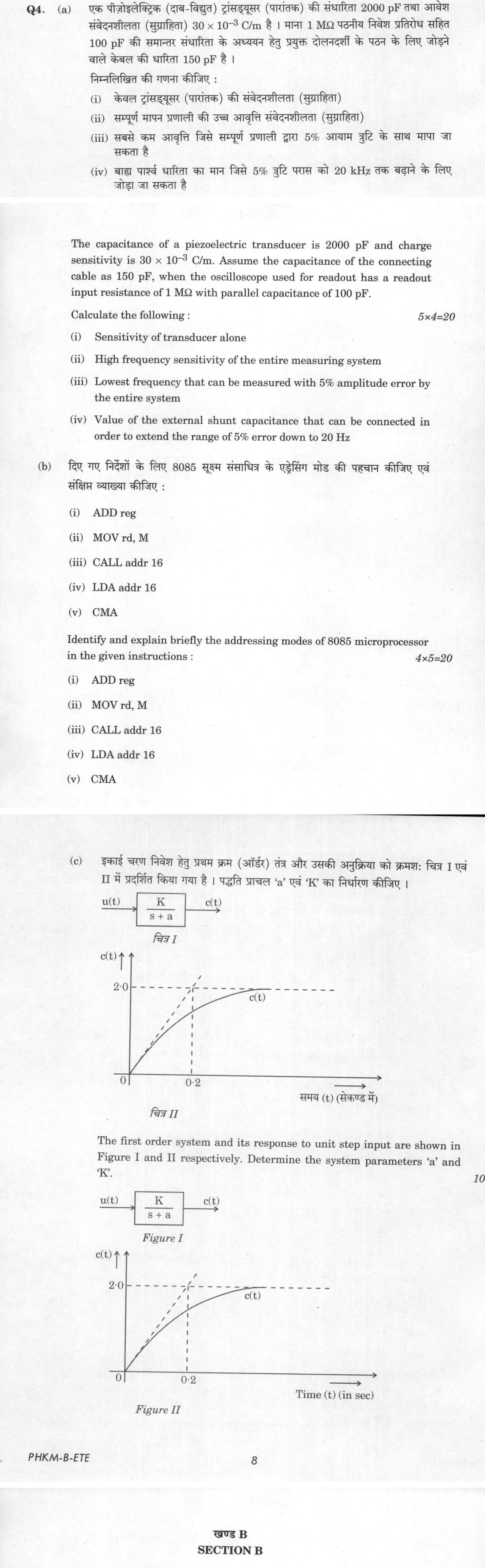
The figure this question refers to, in words
The question paper is a scan and the diagram did not survive as text. This is the figure as read from the original page — every component, value and label — so the question can be worked from the text below.
(c) Figure I: A block diagram of a first order system. Input signal u(t) enters from the left into a rectangular block labelled K/(s+a). The output signal c(t) exits from the right of the block. Figure II: A graph of the unit step response. The vertical axis is labelled c(t) with an arrow pointing up. The horizontal axis is labelled Time (t) (in sec) with an arrow pointing right. The origin is marked 0. A dashed horizontal line is drawn at c(t) = 2.0. A curve labelled c(t) starts at the origin, rises with decreasing slope, and asymptotically approaches the dashed line at 2.0. A dashed straight line is drawn from the origin, tangent to the initial part of the curve, and it intersects the horizontal dashed line at 2.0 at a time t = 0.2 on the horizontal axis. A vertical dashed line drops from this intersection point to the horizontal axis at 0.2.
Model answer
Written by UPSC Answer Check against this question's marking rubric, to the expected length. UPSC does not publish answers for Mains — this is one way to score well, not an official key.
(a) Let d = 30×10⁻³ C/m, C_t = 2000 pF = 2.000×10⁻⁹ F, C_c = 150 pF, C_o = 100 pF, R = 1 MΩ = 10⁶ Ω. Total capacitance of the entire system is C_total = C_t + C_c + C_o = 2000 + 150 + 100 = 2250 pF = 2.250×10⁻⁹ F.
(i) For a piezoelectric transducer, generated charge q = d x. The voltage sensitivity of the transducer alone is obtained by dividing charge sensitivity by its own capacitance. S_t = d/C_t = (30×10⁻³)/(2000×10⁻¹²) S_t = 15×10⁶ V/m = 15 MV/m. Thus the charge sensitivity itself is 30×10⁻³ C/m, and the voltage sensitivity of the transducer alone is 15 MV/m.
(ii) At high frequency, the input resistance R is effectively open compared with the capacitive reactances, so all capacitances act in parallel. The high-frequency sensitivity of the entire measuring system is S_HF = d/C_total = (30×10⁻³)/(2250×10⁻¹²) S_HF = 13.333×10⁶ V/m = 13.33 MV/m.
(iii) For sinusoidal input, the low-frequency response relative to the high-frequency response is S_low/S_HF = ωRC_total/√(1+(ωRC_total)²). For 5% amplitude error, S_low = 0.95 S_HF. Hence ωRC_total/√(1+(ωRC_total)²) = 0.95. Let x = ωRC_total. Then x²/(1+x²) = 0.95², so x² = 0.95²/(1−0.95²) = 361/39. Therefore x = 19/√39 = 3.042. Now RC_total = 10⁶ × 2.250×10⁻⁹ = 2.250×10⁻³ s. f_low = x/(2πRC_total) = 3.042/(2π×2.250×10⁻³) f_low ≈ 215.2 Hz. So the lowest frequency measurable with 5% amplitude error is about 215 Hz.
(iv) To extend the 5% error range down to 20 Hz, the new total capacitance C_new must satisfy x = 2πfRC_new at f = 20 Hz. C_new = x/(2πfR) = 3.042/(2π×20×10⁶) C_new = 24.21×10⁻⁹ F = 24.21 nF. Therefore the required external shunt capacitance is C_ext = C_new − C_total = 24.21 nF − 2.25 nF C_ext = 21.96 nF ≈ 21960 pF. It must be connected in parallel with the existing cable and oscilloscope capacitances.
(b) (i) ADD reg: Register addressing mode. The operand is an 8-bit register specified in the instruction; the accumulator is the implied destination. Example: ADD B performs A ← A + B.
(ii) MOV rd, M: Register indirect addressing mode. Here M denotes the memory location whose address is stored in the HL register pair. The byte from memory address [HL] is copied to the destination register rd. Example: MOV B, M performs B ← [HL].
(iii) CALL addr16: Immediate addressing mode for the target address. The 16-bit subroutine address is embedded in the instruction itself. The microprocessor pushes the return address onto the stack and loads the program counter with addr16. Example: CALL 2050H.
(iv) LDA addr16: Direct addressing mode. The memory address is given directly in the instruction. The accumulator is loaded from that memory location. Example: LDA 2050H performs A ← [2050H].
(v) CMA: Implied or implicit addressing mode. No operand is specified in the instruction; the accumulator is implied. The operation complements the accumulator: A ← A̅.
(c) The first-order system has transfer function C(s)/U(s) = K/(s+a). For a unit step input, U(s) = 1/s. Therefore C(s) = K/[s(s+a)] = (K/a)[1/s − 1/(s+a)]. Taking inverse Laplace transform, c(t) = (K/a)(1 − e^(−a t)). The final value is c(∞) = K/a. From the graph, the response asymptotically approaches c(t) = 2.0, so K/a = 2.0, hence K = 2a.
The initial slope of the response is c'(0) = K. The tangent drawn from the origin is therefore c = K t. It meets the final value c = 2.0 at t = 0.2 s. Thus K(0.2) = 2.0, so K = 10 s⁻¹. Then a = K/2 = 5 s⁻¹.
Final values: a = 5 s⁻¹, K = 10 s⁻¹. The system time constant is 1/a = 0.2 s, and the condition a > 0 ensures a stable first-order response.
What "Calculate" is asking you to do
Apply the standard formula or schedule to data the question has already supplied — a table of readings, cost records, a balance sheet — and produce the number. The method is rarely in doubt; the marks sit in the named intermediate quantities, each of which has to appear as a labelled line.
Structure that answers it
Data as given → formula or standard treatment, named → substitution → each intermediate, labelled → result with units
Where marks are lost
Omitting an intermediate the marking scheme pays for separately, or rounding at an intermediate line so the final figure drifts. In commerce and accountancy, any figure in a statement that no numbered working note supports is treated as unearned.
How this answer will be evaluated
Approach
Framework: Piezoelectric Charge Amplifier Analysis & 8085 Instruction Set Architecture. (a) calculate: given > formula > substitution > result with units > interpretation | (b) explain: definition/context > points in order > small example > short close | (c) calculate: given > formula > substitution > result with units > interpretation Full marks: All calculations correct with clear steps; addressing modes accurately identified; system parameters correctly determined.
Key points expected
- Equivalent circuit for piezoelectric transducer
- Voltage sensitivity calculation
- Lowest frequency calculation
- Shunt capacitance calculation
- 8085 addressing modes: Register, Indirect Memory, Immediate, Direct Memory, Implied
- First-order system parameters from step response
Evaluation rubric
Each sub-part is marked on its own, against the marks and word limit printed on the paper.
- (a) Compute sensitivity, HF sensitivity, lowest frequency, and shunt capacitance. 20 marks
calculate— given > formula > substitution > result with units > interpretation
Must cover
- Equivalent circuit with C_T, C_c, C_i, R_i
- Voltage sensitivity formula S_v = S_q / C_total
- Lowest frequency formula f_min = 1 / (2π R_i C_total)
- Shunt capacitance calculation for 20 Hz
Loses marks
- Using charge sensitivity directly as voltage sensitivity
- Ignoring cable or oscilloscope capacitance in total C
Earns more
- Correct unit conversion (pF to F)
- Explicit calculation of total capacitance
- Clear labeling of each sub-part (i)-(iv)
Extra mark
- Sketch of the equivalent circuit
- (b) Identify and explain the addressing mode for each of the five instructions. 20 marks
explain— definition/context > points in order > small example > short close
Must cover
- Register mode for ADD reg
- Indirect memory mode for MOV rd, M
- Immediate mode for CALL addr 16
- Direct memory mode for LDA addr 16
Loses marks
- Confusing direct and indirect memory addressing
- Failing to identify CMA as implied addressing
Earns more
- Explanation of CMA as implied addressing
- Brief description of how each mode operates
- Clear distinction between direct and indirect memory
Extra mark
- Mention of 8085 instruction set categories
- (c) Determine system parameters 'a' and 'K' from the step response. 10 marks
calculate— given > formula > substitution > result with units > interpretation
Must cover
- Steady-state value c(∞) = K/a
- Time constant τ = 1/a
- Initial slope = K
- Calculation of a and K from graph
Loses marks
- Confusing time constant with settling time
- Incorrect calculation of steady-state value
Earns more
- Correct interpretation of the graph
- Clear calculation steps
- Units for a and K
Extra mark
- Sketch of the step response with labeled parameters
Practice this exact question
Write your answer and it is marked point by point against the model answer above — what you covered, what you missed, what you got wrong.
Evaluate my answer →More from Electrical Engineering 2024 Paper II
- Q1 (a) What are the limitations of (i) Proportional (P), (ii) Integral (I), (iii) Derivative…
- Q2 (a) The open-loop transfer function of a feedback control system incorporating a dead tim…
- Q3 (a) An underdamped second order system having a transfer function of the form M(s) = (Kωₙ…
- Q4 (a) The capacitance of a piezoelectric transducer is 2000 pF and charge sensitivity is 30…
- Q5 (a) The block diagram of a position control system is shown in the figure. Determine the…
- Q6 (a) Calculate the power loss in the transmission system given in the following figure. Th…
- Q7 (a) Calculate the real and reactive power at sending end of a transmission line while del…