Paper II — Q8
(a) Two sources M₁ and M₂ emit messages x₁, x₂, x₃ and y₁, y₂, y₃ with the joint probability P(X,Y) as shown below in the matrix…
Two sources M₁ and M₂ emit messages x₁, x₂, x₃ and y₁, y₂, y₃ with the joint probability P(X,Y) as shown below in the matrix form.
P(X, Y) →
Determine H(X), H(Y), H(X/Y) and H(Y/X). 20 marks
Calculate the current setting of a relay for fault that draws up to 400% of the rated current. The relay is used for differential protection of a delta-star, 50 MVA, 66/11 kV transformer. The CT ratio on secondary side is 3000 : 5 and primary side is 600 : 5. 20 marks
Calculate the peak voltage which appears across the terminals of a circuit breaker when it suddenly interrupts 20 A current at 20% of its peak value in a circuit. The inductance and stray capacitance of circuit are 15 H and 3000 pF respectively. 10 marks
हिंदी में प्रश्न पढ़ें
दो स्रोत M₁ एवं M₂ दो सूचनाओं x₁, x₂, x₃ तथा y₁, y₂, y₃ को संयुक्त संभावना P(X, Y) के साथ उत्सर्जित करते हैं, जैसा कि नीचे आवृत्त में दर्शाया गया है ।
P(X, Y) →
H(X), H(Y), H(X/Y) एवं H(Y/X) का निर्धारण कीजिए । (20 अंक)
एक रिले की धारा सेटिंग की गणना कीजिए जो दोष (फॉल्ट) के समय निर्धारित (रेटेड) धारा की 400% दोष-धारा ग्रहण करती है । एक डेल्टा-स्टार, 50 MVA, 66/11 kV परिणामित्र के अवकलीय संरक्षण के लिए रिले का प्रयोग किया गया है । द्वितीयक तरफ CT का अनुपात 3000 : 5 तथा प्राथमिक तरफ 600 : 5 है । (20 अंक)
एक परिपथ विचोजक के टर्मिनलों के आर-पार उत्पन्न शिखर वोल्टता की गणना कीजिए जो परिपथ में 20 A धारा को तब अचानक बाधित करता है जब परिपथ में धारा शिखर मान की 20% होती है । परिपथ का प्रेरकत्व एवं अवांछित (स्ट्रे) धारिता क्रमशः: 15 H तथा 3000 pF है । (10 अंक)
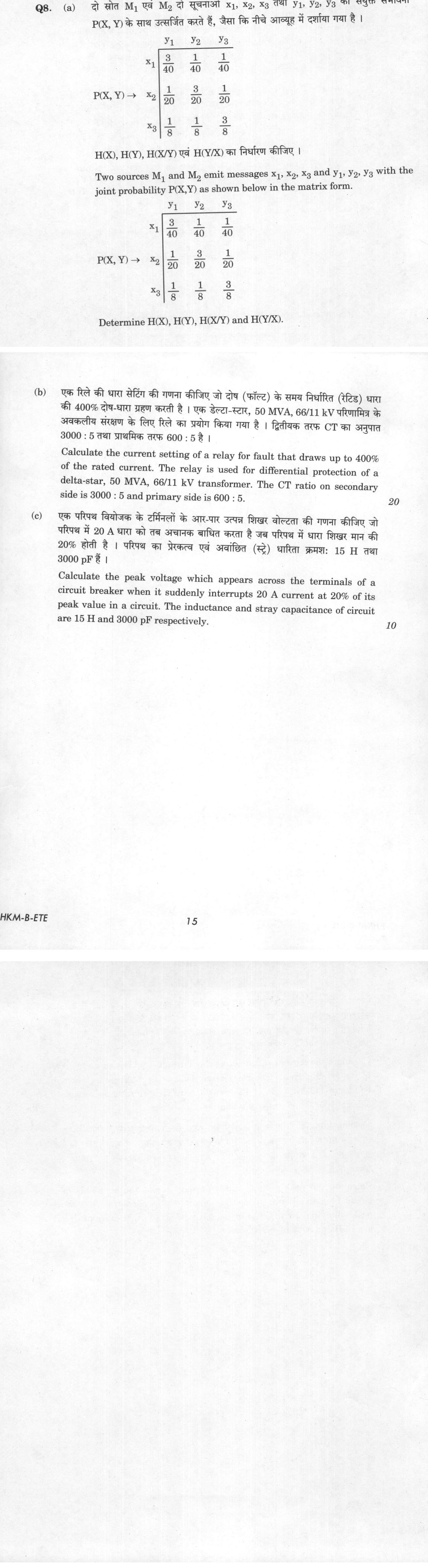
The figure this question refers to, in words
The question paper is a scan and the diagram did not survive as text. This is the figure as read from the original page — every component, value and label — so the question can be worked from the text below.
(a) Table of joint probability P(X, Y) in matrix form: Header: y1, y2, y3 x1: 3/40, 1/40, 1/40 x2: 1/20, 3/20, 1/20 x3: 1/8, 1/8, 3/8
Model answer
Written by UPSC Answer Check against this question's marking rubric, to the expected length. UPSC does not publish answers for Mains — this is one way to score well, not an official key.
(a) The joint probabilities, converted to a common denominator 40, are x₁: 3/40, 1/40, 1/40 x₂: 2/40, 6/40, 2/40 x₃: 5/40, 5/40, 15/40
Marginals: P(X)= [1/8, 1/4, 5/8] P(Y)= [1/4, 3/10, 9/20]
Using H = -Σ p log₂ p, H(X) = 11/4 - (5/8) log₂ 5 bits ≈ 1.2988 bits
H(Y) = 17/10 + (3/4) log₂ 5 - (6/5) log₂ 3 bits ≈ 1.5395 bits
For H(Y/X), use H(Y/X) = Σ p(x) H(Y|X=x). The row conditional distributions are [3/5, 1/5, 1/5], [1/5, 3/5, 1/5], [1/5, 1/5, 3/5]. Each has the same entropy: H(Y|X=x) = log₂ 5 - (3/5) log₂ 3 bits. Therefore, H(Y/X) = log₂ 5 - (3/5) log₂ 3 ≈ 1.3710 bits
For H(X/Y), use H(X/Y) = Σ p(y) H(X|Y=y). y₁: conditional [3/10, 1/5, 1/2], H = 4/5 + (1/2) log₂ 5 - (3/10) log₂ 3 y₂: conditional [1/12, 1/2, 5/12], H = 3/2 + (1/2) log₂ 3 - (5/12) log₂ 5 y₃: conditional [1/18, 1/9, 5/6], H = 8/9 + (7/6) log₂ 3 - (5/6) log₂ 5 Then H(X/Y) = (1/4)H₁ + (3/10)H₂ + (9/20)H₃ = 21/20 + (3/5) log₂ 3 - (3/8) log₂ 5 bits ≈ 1.1303 bits
(b) Take 66 kV as primary (delta) and 11 kV as secondary (star). Rated primary current: I₁ = 50×10⁶ / (√3 × 66×10³) = 437.386 A Rated secondary current: I₂ = 50×10⁶ / (√3 × 11×10³) = 2624.318 A
CT secondary currents at rated: i₁ = 437.386 × 5/600 = 3.645 A i₂ = 2624.318 × 5/3000 = 4.374 A
For a delta-star transformer, the star-side CTs are connected in delta to compensate the 30° phase shift. Hence the relay current on the secondary side becomes i₂′ = √3 × 4.374 = 7.576 A
At rated condition, the differential spill current is 7.576 - 3.645 = 3.931 A
For a fault drawing 400% of rated current, all currents scale by 4. Therefore the spill current is 4 × 3.931 = 15.724 A
Thus the relay current setting must be at least about 15.73 A If the relay rated current is 5 A, the setting is 15.73/5 = 3.146, i.e. about 315% of relay rated current.
(c) When the breaker interrupts current i, the energy stored in inductance is W_L = 1/2 L i² This energy charges the stray capacitance to peak voltage V_m: 1/2 C V_m² = 1/2 L i² So V_m = i √(L/C)
Given i = 20 A, L = 15 H, C = 3000 pF = 3×10⁻⁹ F: V_m = 20 × √(15 / 3×10⁻⁹) = 20 × √(5×10⁹) = 20 × 70710.678 = 1,414,213.56 V
Therefore the peak voltage across the breaker terminals is ≈ 1.414×10⁶ V = 1.414 MV
The 20% value implies the peak current is 100 A, but the instantaneous chopped current is 20 A, which is the value used in the energy conversion.
What "Calculate" is asking you to do
Apply the standard formula or schedule to data the question has already supplied — a table of readings, cost records, a balance sheet — and produce the number. The method is rarely in doubt; the marks sit in the named intermediate quantities, each of which has to appear as a labelled line.
Structure that answers it
Data as given → formula or standard treatment, named → substitution → each intermediate, labelled → result with units
Where marks are lost
Omitting an intermediate the marking scheme pays for separately, or rounding at an intermediate line so the final figure drifts. In commerce and accountancy, any figure in a statement that no numbered working note supports is treated as unearned.
How this answer will be evaluated
Approach
Framework: null. (a) calculate: given > formula > substitution > result with units > interpretation | (b) calculate: given > formula > substitution > result with units > interpretation | (c) calculate: given > formula > substitution > result with units > interpretation Full marks: All parts solved with correct formulas, clear steps, and accurate final values with units.
Key points expected
- Calculate marginal probabilities P(X) and P(Y) from the matrix
- Apply entropy formula H(X) = -Σ P(x) log P(x)
- Calculate conditional probabilities P(X|Y) or P(Y|X)
- Compute conditional entropies H(X/Y) and H(Y/X)
- Calculate rated primary and secondary currents of the transformer
- Determine the current in the CT secondary for the fault condition
- Account for the delta-star connection phase shift or current magnitude difference
- Calculate the differential current seen by the relay
Evaluation rubric
Each sub-part is marked on its own, against the marks and word limit printed on the paper.
- (a) Compute H(X), H(Y), H(X/Y), and H(Y/X) from the joint probability matrix.
calculate— given → formula → substitution → result with units → interpretation
Must cover
- Calculate marginal probabilities P(X) and P(Y) from the matrix
- Apply entropy formula H(X) = -Σ P(x) log P(x)
- Calculate conditional probabilities P(X|Y) or P(Y|X)
- Compute conditional entropies H(X/Y) and H(Y/X)
Loses marks
- Using log base 10 instead of base 2 without stating
- Arithmetic errors in marginal probability sums
Earns more
- Explicitly show the summation steps for each entropy
- Verify that H(X,Y) = H(X) + H(Y/X) = H(Y) + H(X/Y)
Extra mark
- Calculate mutual information I(X;Y) as a check
- (b) Determine the relay current setting for 400% fault on a 50 MVA, 66/11 kV delta-star transformer. 20 marks
calculate— given → formula → substitution → result with units → interpretation
Must cover
- Calculate rated primary and secondary currents of the transformer
- Determine the current in the CT secondary for the fault condition
- Account for the delta-star connection phase shift or current magnitude difference
- Calculate the differential current seen by the relay
Loses marks
- Ignoring the delta-star connection effect on current magnitude
- Confusing primary and secondary CT ratios
Earns more
- Draw a single-line diagram of the transformer and CTs
- Explicitly state the CT ratio conversion factors
Extra mark
- Discuss the effect of CT saturation on the setting
- (c) Calculate the peak voltage across a circuit breaker interrupting 20 A at 20% of peak. 10 marks
calculate— given → formula → substitution → result with units → interpretation
Must cover
- Identify the circuit as an LC oscillation problem
- Use the energy conservation principle (1/2 L I^2 = 1/2 C V^2)
- Substitute the given values for L, C, and I
- Calculate the final peak voltage V
Loses marks
- Using the full 20 A instead of the 20% value (4 A)
- Unit conversion errors for pF to F
Earns more
- State the assumption of an ideal LC circuit with no resistance
- Show the derivation of the voltage formula from energy balance
Extra mark
- Mention the frequency of the resulting oscillation
Practice this exact question
Write your answer and it is marked point by point against the model answer above — what you covered, what you missed, what you got wrong.
Evaluate my answer →More from Electrical Engineering 2024 Paper II
- Q5 (a) The block diagram of a position control system is shown in the figure. Determine the…
- Q6 (a) Calculate the power loss in the transmission system given in the following figure. Th…
- Q7 (a) Calculate the real and reactive power at sending end of a transmission line while del…
- Q8 (a) Two sources M₁ and M₂ emit messages x₁, x₂, x₃ and y₁, y₂, y₃ with the joint probabil…