Paper II — Q1
(a) The block diagram of a system is as shown below : Evaluate the overall transfer function (Y(s))/(R(s)) using block diagram…
The block diagram of a system is as shown below : Evaluate the overall transfer function (Y(s))/(R(s)) using block diagram reduction technique. 10 marks
Explain the operation performed by 8085 microprocessor when the following instructions are executed : JMP unconditionally
POP
PUSH
RET
STC 2×5=10
For the circuit shown in the figure below give expression for the overall uncertainty in the value of combined resistance R. Further, evaluate the overall uncertainty in the value of combined resistance R, when individual values of the resistors are as R₁ = 50 ± 0·1 Ω, R₂ = 100 ± 0·2 Ω, R₃ = 100 ± 0·2 Ω. 10 marks
A factory has a fixed load of 860 kW and is operating at 0·85 power factor. The electric utility company offers to supply energy at the following two alternate rates : LV supply at ₹ 30/kVA max demand/annum + 12 paise/kWh
HV supply at ₹ 25/kVA max demand/annum + 10 paise/kWh The HV switchgear costs ₹ 50/kVA and switchgear losses at full load amount to 4%. Interest and depreciation charges for switchgear are 10% of the capital cost. If the factory is to work 48 hours/week, then determine the more economical tariff option. 10 marks
If the generator polynomial is (x⁴ + x + 1) and the message bits are 1101101, then obtain the CRC code. 10 marks
हिंदी में प्रश्न पढ़ें
एक तंत्र का खंड आरेख नीचे दर्शाया गया है : खंड आरेख लघुकरण विधि का उपयोग करते हुए समग्र अंतरण फलन (Y(s))/(R(s)) का मान निकालिये। 10
8085 सूक्ष्म-संसाधित्र (माइक्रोप्रोसर) द्वारा की जाने वाली क्रियाविधि की व्याख्या कीजिए, जब निम्नलिखित निर्देशों का निष्पादन होता है : JMP अप्रतिबंधित (अनकंडीशनली)
POP
PUSH
RET
STC 2×5=10
नीचे चित्र में दर्शाये गये परिपथ के लिए इसके संयुक्त प्रतिरोध R के मान में समग्र अनिश्चितता के लिये व्यंजक दीजिये। इसके आगे, संयुक्त प्रतिरोध R के मान में समग्र अनिश्चितता का मान निकालिये, जब अन्य प्रतिरोधों के वैयक्तिक मान हैं R₁ = 50 ± 0·1 Ω, R₂ = 100 ± 0·2 Ω, R₃ = 100 ± 0·2 Ω। 10
एक कारखाने का नियत भार 860 kW है और यह 0·85 के शक्ति गुणक पर कार्य करता है। विद्युत उपयोगिता कम्पनी इसे ऊर्जा प्रदान करने के लिये निम्नलिखित दो वैकल्पिक दरें प्रस्तावित करती है : LV आपूर्ति ₹ 30/kVA अधिकतम माँग/वर्ष + 12 पैसे/kWh पर
HV आपूर्ति ₹ 25/kVA अधिकतम माँग/वर्ष + 10 पैसे/kWh पर HV स्विचगियर की कीमत ₹ 50/kVA और पूर्ण भार पर इसकी हानि 4% है। स्विचगियर का ब्याज और मूल्यह्रास शुल्क इसकी पूँजी लागत का 10% है। यदि कारखाना एक हफ्ते में 48 घंटे चलता है, तो अधिक किफायती ऊर्जा की वैकल्पिक दर का निर्धारण कीजिये। 10
यदि जनित्र (जनरेटर) बहुपद (x⁴ + x + 1) है और संदेश बिट 1101101 है, तो CRC कूट (कोड) प्राप्त कीजिये। 10
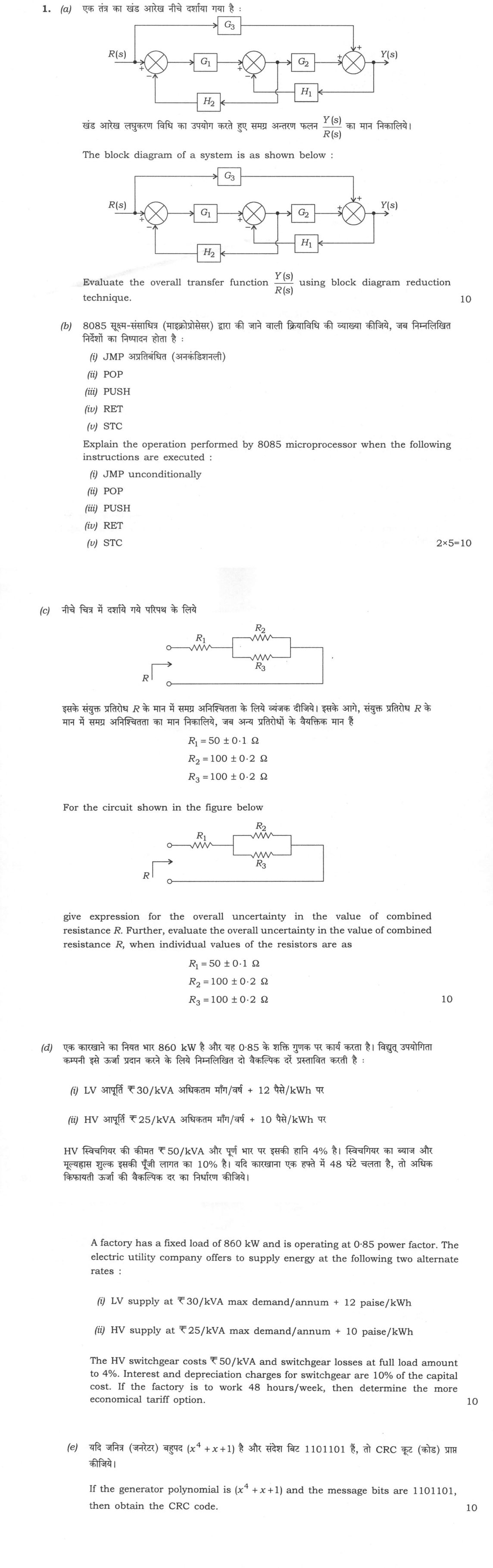
The figure this question refers to, in words
The question paper is a scan and the diagram did not survive as text. This is the figure as read from the original page — every component, value and label — so the question can be worked from the text below.
(a) A block diagram of a control system. The input is R(s) and the output is Y(s). The signal R(s) enters a summing junction (J1) with a positive sign. The output of J1 enters a block G1. The output of G1 enters a second summing junction (J2) with a positive sign. The output of J2 enters a block G2. The output of G2 enters a third summing junction (J3) with a positive sign. The output of J3 is Y(s). There are three feedback/feedforward paths: 1. A path from the output of J2 goes through a block H1 and enters J2 with a negative sign. 2. A path from the output of J2 goes through a block H2 and enters J1 with a negative sign. 3. A path from the input R(s) goes through a block G3 and enters J3 with a positive sign.
(c) A circuit diagram showing a combination of three resistors. The input terminals are on the left. The top terminal connects to a resistor labeled R1. The right side of R1 connects to a node where the circuit splits into two parallel branches. The top branch contains a resistor labeled R2. The bottom branch contains a resistor labeled R3. The right sides of R2 and R3 connect together at a node, which then connects to the bottom input terminal. The total equivalent resistance of the network is labeled R with an arrow pointing into the terminals.
Model answer
Written by UPSC Answer Check against this question's marking rubric, to the expected length. UPSC does not publish answers for Mains — this is one way to score well, not an official key.
(a) Block diagram reduction. Let E1 be the output of J1 and V2 the output of J2. The H1 path is a negative feedback loop around G1 at J2, so the inner loop reduces to G1/(1+H1). No take-off shifting is needed because H1 and H2 are both taken from the same V2 point; if a take-off were moved across a block, the feedback signal would have to be multiplied by that block. The H2 path returns V2 to J1 with negative sign, so the second loop encloses the reduced block G1/(1+H1). Reducing it gives V2/R = [G1/(1+H1)]/[1+H2G1/(1+H1)] = G1/(1+H1+G1H2). Equivalently, E1=R-H2V2 and V2=G1E1-H1V2, which solves to the same result. The V2 signal then passes through G2 to J3, while R also enters J3 positively through G3. Therefore Y=G2V2+G3R, and Y/R = G1G2/(1+H1+G1H2)+G3 = [G1G2+G3(1+H1+G1H2)]/(1+H1+G1H2).
(b) 8085 instructions. JMP is an unconditional 16-bit jump. It requires 6 T-states: one opcode-fetch cycle, followed by two memory-read cycles that fetch the low and high address bytes, after which PC is loaded with the 16-bit address. No flags are affected. PUSH is a 10 T-state stack instruction. After opcode fetch, it performs two memory-write cycles: SP is decremented and the high-order byte of the register pair is written, then SP is decremented again and the low-order byte is written; for PUSH PSW the accumulator and flag byte are stored. POP is the reverse operation and also takes 10 T-states. It performs two memory-read cycles: the byte at SP is loaded into the low-order register, SP is incremented, the next byte is loaded into the high-order register, and SP is incremented again; POP PSW restores the accumulator and flags. RET is an unconditional return instruction, not a conditional one, and takes 10 T-states. It pops the 16-bit return address from the stack into PC using two memory reads and two SP increments; flags are unchanged. STC is a 6 T-state flag instruction. It sets the carry flag to 1, leaves the other flags unchanged, and involves no memory read or write.
(c) Uncertainty in combined resistance. The circuit is R1 in series with the parallel combination of R2 and R3, so R=R1+R2R3/(R2+R3). Because R is nonlinear in R2 and R3, the partial-derivative method is used. For independent uncertainties, the absolute uncertainty is ΔR=[(∂R/∂R1 ΔR1)²+(∂R/∂R2 ΔR2)²+(∂R/∂R3 ΔR3)²]¹/2. Here ∂R/∂R1=1, ∂R/∂R2=R3²/(R2+R3)², and ∂R/∂R3=R2²/(R2+R3)². Hence ΔR=[(ΔR1)²+(R3²/(R2+R3)² ΔR2)²+(R2²/(R2+R3)² ΔR3)²]¹/2. Substituting R1=50 Ω, R2=R3=100 Ω, ΔR1=0.1 Ω, ΔR2=ΔR3=0.2 Ω gives R=50+100×100/(100+100)=100 Ω. The derivative terms are 1, 0.25 and 0.25, so ΔR=[0.1²+(0.25×0.2)²+(0.25×0.2)²]¹/2=[0.01+0.0025+0.0025]¹/2=0.122 Ω. To the precision justified by the data, R=100±0.12 Ω by root-sum-square. If the tolerances are interpreted as worst-case limits, the bound is 0.1+0.05+0.05=0.20 Ω.
(d) Tariff economics. The maximum demand of the factory is 860/0.85=1011.76 kVA. The annual running hours are 48×52=2496 h, so the annual load energy is 860×2496=2,146,560 kWh. The LV tariff gives an annual demand charge of 30×1011.76=₹30,353 and an energy charge of 12 paise/kWh, i.e. ₹0.12×2,146,560=₹257,587. Total LV cost is therefore ₹287,940 per annum. For HV supply, the switchgear losses are 4% of full load. In apparent power this is 0.04×1011.76=40.47 kVA, and in active power at the same power factor it is 0.04×860=34.4 kW. These losses must be included both in the billed maximum demand and in the energy billed. The billed maximum demand is 1011.76+40.47=1052.24 kVA, so the HV demand charge is 25×1052.24=₹26,306. The billed energy is 2,146,560+34.4×2496=2,232,422 kWh, giving an energy charge of ₹0.10×2,232,422=₹223,242. The switchgear capital cost is 50×1011.76=₹50,588, and 10% interest and depreciation gives an annual charge of ₹5,059. Total HV cost is 26,306+223,242+5,059=₹254,607 per annum. If the switchgear capital is assessed on the billed kVA rather than the load kVA, the annual charge rises only to ₹5,261 and the total to ₹254,809, so the verdict is unchanged. HV supply is therefore more economical by about ₹33,333 per annum.
(e) CRC code. The generator polynomial x⁴+x+1 corresponds to the 5-bit divisor 10011. Since the generator degree is 4, four zeros are appended to the 7-bit message 1101101, giving 11011010000. Binary division is performed by XOR. The first five bits 11011⊕10011=01000; bringing down the next 0 gives 10000. Then 10000⊕10011=00011; bringing down 1 gives 00111. The leading bit is 0, so bring down 0 to get 01110; again the leading bit is 0, so bring down 0 to get 11100. Now 11100⊕10011=01111; bringing down 0 gives 11110. Then 11110⊕10011=01101; bringing down 0 gives 11010. Finally 11010⊕10011=01001. The 4-bit remainder is 1001. The CRC code is the message followed by this remainder: 11011011001. As a check, dividing 11011011001 by 10011 gives remainder 0000, confirming that the codeword is divisible by the generator polynomial. The overall economic verdict is that HV supply is the more economical tariff option.
What "Evaluate" is asking you to do
Judge how well something has performed against the standard it set for itself — its stated aim, mandate or promise — and commit to a verdict. Name the yardstick before you judge; an unanchored judgement reads as opinion.
Structure that answers it
Name the yardstick — stated aim, mandate or benchmark → performance against it → shortfall against it → why the gap exists → verdict
Where marks are lost
Presenting both sides and then declining to decide, or delivering a verdict against a standard you never stated, which makes it look arbitrary.
How this answer will be evaluated
Approach
Framework: Block Diagram Reduction / Error Propagation / Tariff Comparison / CRC Division. (a) evaluate: Redraw diagram > Step-by-step reduction > Final transfer function | (b) explain: Instruction definition > Stack/PC operation > Flag impact | (c) evaluate: Circuit simplification > Uncertainty formula > Numerical calculation | (d) evaluate: Load calculation > Cost comparison > Decision | (e) evaluate: Polynomial setup > Binary division > Remainder extraction Full marks: Complete working with correct final values and clear diagrams/steps.
Key points expected
- Block diagram reduction rules
- 8085 stack operations
- Uncertainty propagation formula
- Tariff cost comparison
- CRC binary division
Evaluation rubric
Each sub-part is marked on its own, against the marks and word limit printed on the paper.
- (a) Derive Y(s)/R(s) using block diagram reduction rules. 10 marks
evaluate— Redraw diagram → Step-by-step reduction → Final transfer function
Must cover
- Identify inner loop G2H1
- Reduce inner loop to G2/(1+G2H1)
- Handle outer loop with H2
- Add parallel path G3
Loses marks
- Sign error in feedback sum
- No reduction steps shown
Earns more
- Correct sign of feedback loops
- Clear intermediate block diagrams
Extra mark
- Mason's gain formula verification
- (b) Describe 8085 operation for JMP, POP, PUSH, RET, STC. 10 marks
explain— Instruction definition → Stack/PC operation → Flag impact
Must cover
- JMP: PC loaded with 16-bit address
- PUSH: SP decremented, data stored
- POP: Data loaded, SP incremented
- RET: PC loaded from stack
Loses marks
- Confusing PUSH/POP stack direction
- Omitting PC update for JMP/RET
Earns more
- STC sets carry flag to 1
- Mention 2-byte address for JMP
Extra mark
- Mention cycle count for instructions
- (c) Find R expression and overall uncertainty. 10 marks
evaluate— Circuit simplification → Uncertainty formula → Numerical calculation
Must cover
- R = R1 + (R2*R3)/(R2+R3)
- Partial derivatives for uncertainty
- Calculate nominal R value
- Calculate total uncertainty
Loses marks
- Treating parallel as series
- Arithmetic error in final value
Earns more
- Correct parallel resistance formula
- Proper unit handling
Extra mark
- Percentage uncertainty calculation
- (d) Compare LV vs HV tariff costs. 10 marks
evaluate— Load calculation → Cost comparison → Decision
Must cover
- Calculate kVA demand (860/0.85)
- Calculate annual energy (kWh)
- Include switchgear cost and losses for HV
- Compare total annual costs
Loses marks
- Using kW instead of kVA for demand charge
- Omitting interest/depreciation on switchgear
Earns more
- Correct kVA calculation
- Inclusion of 4% switchgear loss
Extra mark
- Break-even analysis
- (e) Compute CRC code for given message and polynomial. 10 marks
evaluate— Polynomial setup → Binary division → Remainder extraction
Must cover
- Append 4 zeros to message
- Perform binary division by generator
- Extract 4-bit remainder
- Append remainder to message
Loses marks
- Wrong number of zeros appended
- Arithmetic error in division
Earns more
- Correct binary division steps
- Final CRC code format
Extra mark
- Verification of division
Practice this exact question
Write your answer and it is marked point by point against the model answer above — what you covered, what you missed, what you got wrong.
Evaluate my answer →More from Electrical Engineering 2025 Paper II
- Q1 (a) The block diagram of a system is as shown below : Evaluate the overall transfer funct…
- Q2 (a) An LTI system with the following state-space representation is given : ẋ = [0 1] x +…
- Q3 (a) (i) Sketch the approximate root locus plot for a time-delay system approximated by th…
- Q4 (a) (i) Consider a second-order type-1 system with no zeros. The system under unity feedb…