Paper II — Q8
(a) The figure below shows the single-line diagram of a generator connected through parallel transmission lines to an infinite…
The figure below shows the single-line diagram of a generator connected through parallel transmission lines to an infinite bus. The machine is delivering 1 pu power, and both the terminal voltage and the infinite bus voltage are 1 pu. The numbers on the diagram indicate the values of the reactances on a common system base. The transient reactance of the generator is 0·20 pu as indicated. Determine the power-angle equation for the system applicable to the operating conditions. Also develop the swing equation of the machine : Given H = 4 MJ/MVA. 20 marks
Draw the diagram of a 1/3 rate convolution encoder. Write the corresponding code tree for the 1/3 rate convolution encoder. 20 marks
The capacitances of a 3-core cable of belted type are measured and found to be as follows : Between 3 cores bunched together and the sheath, 8 µF
Between one conductor and the other two connected together to the sheath, 5 µF Calculate the capacitance to the neutral and the total charging kVA, when the cable is connected to an 11 kV, 50 Hz, 3-phase supply. 10 marks
हिंदी में प्रश्न पढ़ें
नीचे दर्शाये गये चित्र के एकल-लाइन आरेख में एक जनित्र, समानांतर संचरण लाइन के द्वारा एक अनंत बस से जुड़ा है। मशीन 1 pu की शक्ति प्रदान करती है, एवं टर्मिनल की वोल्टता तथा अनंत बस की वोल्टता, दोनों ही 1 pu हैं। आरेख पर दर्शाये गये अंक, एक सामान्य (साझे) आधार प्रणाली पर प्रतिघातों के मान को दर्शाते हैं। जैसा दर्शाया गया है, जनित्र का क्षणिक प्रतिघात 0·20 pu है। प्रचालन दशा में तंत्र के लिये अनुप्रयोज्य होने वाले शक्ति-कोण (पावर-एंगल) समीकरण का निर्धारण कीजिये। मशीन के लिये स्विंग समीकरण को भी विकसित कीजिये : H = 4 MJ/MVA दिया गया है। (20 अंक)
1/3 दर संवलन कूट्र (कांवोल्यूशन एनकोडर) का आरेख आरेखित कीजिये। 1/3 दर संवलन कूट्र के लिये तत्संगत कूट (कोड) वृक्ष (ट्री) लिखिये। (20 अंक)
पिंडित (बेल्टेड) प्रकार के एक 3-कोर केबिल की धारितायें मापित होने पर निम्नवत् पायी जाती हैं : तीनों कोरों को एक-दूसरे से गुच्छित (बंच्ड) करके उनके और कोष (आवरण) के बीच, 8 μF
एक चालक और कोष के बीच, जबकि अन्य दो चालक कोष के साथ जुड़े हैं, 5 μF न्यूट्रल के साथ केबिल की धारिता एवं सम्पूर्ण आवेशन kVA की गणना कीजिये, जबकि केबिल 11 kV, 50 Hz, 3-कला स्रोत (सप्लाई) से संयोजित है। (10 अंक)
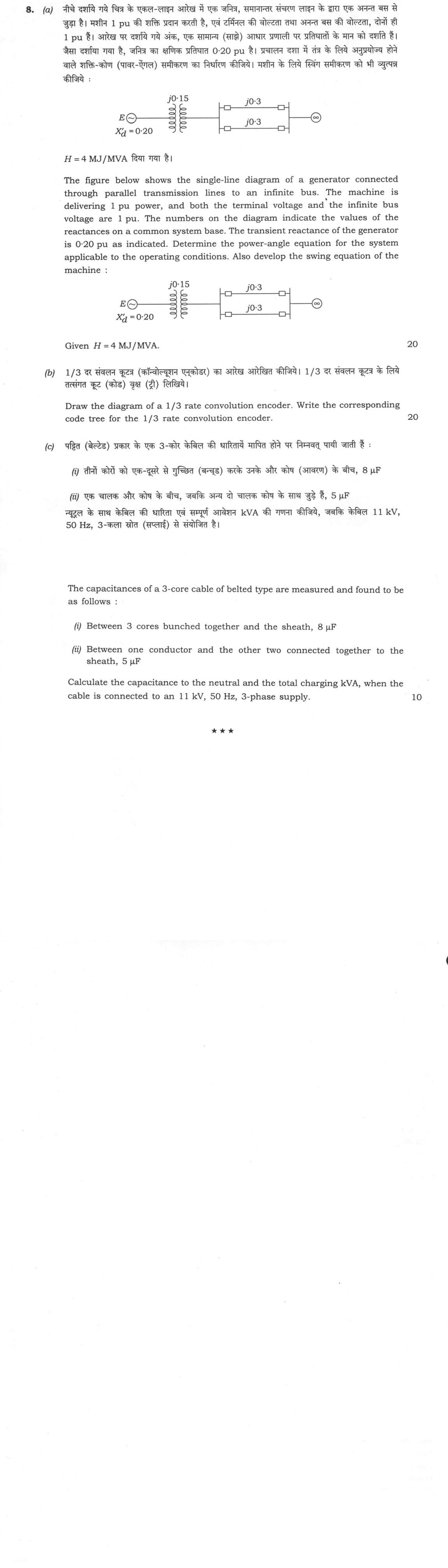
The figure this question refers to, in words
The question paper is a scan and the diagram did not survive as text. This is the figure as read from the original page — every component, value and label — so the question can be worked from the text below.
(a) Single-line diagram: an ideal voltage source E with transient reactance X'd = 0.20 pu in series, connected through a transformer/reactance of j0.15 to a bus that splits into two parallel transmission lines each of reactance j0.3, which then join at an infinite bus (shown as an infinity symbol). The generator delivers 1 pu power; terminal voltage and infinite bus voltage are both 1 pu. Given H = 4 MJ/MVA.
Model answer
Written by UPSC Answer Check against this question's marking rubric, to the expected length. UPSC does not publish answers for Mains — this is one way to score well, not an official key.
(a) Method: per-unit power-angle equation and swing equation. The two line reactances in parallel give X_line = (0.30 × 0.30)/(0.30 + 0.30) = 0.15 pu. Hence the total reactance from internal emf E′ to infinite bus is X = 0.20 + 0.15 + 0.15 = 0.50 pu. The reactance from generator terminal to infinite bus is X_rest = 0.15 + 0.15 = 0.30 pu.
Let V_t = 1∠θ and V∞ = 1∠0. Since P = V_t V∞ sin θ / X_rest = 1 pu, sin θ = 0.30 = 3/10. For stable operation, cos θ = √(1 − 9/100) = √91/10. Thus V_t = (√91/10) + j(3/10) pu.
Generator current is I = (V_t − V∞)/(j X_rest). Therefore E′ = V_t + j X′_d I = V_t + (X′_d/X_rest)(V_t − V∞) = V_t + (2/3)(V_t − 1). So E′ = (5/3)V_t − 2/3 = ((√91 − 4)/6) + j(1/2) pu. Thus |E′| = √[((√91 − 4)/6)² + (1/2)²] = (1/3)√(29 − 2√91) ≈ 1.05 pu.
Power-angle equation: P_e = (|E′| V∞ / X) sin δ = [ (1/3)√(29 − 2√91) / 0.50 ] sin δ = (2/3)√(29 − 2√91) sin δ pu ≈ 2.10 sin δ pu, where δ is the rotor angle of E′ with respect to the infinite bus. At the given operating point, δ₀ = arcsin(1/2.10) ≈ 28.44°.
For H = 4 MJ/MVA and f = 50 Hz, M = H/(π f) = 4/(50π) = 2/(25π) ≈ 0.02546 s². The swing equation is M d²δ/dt² = P_m − P_e. Hence (2/(25π)) d²δ/dt² = P_m − (2/3)√(29 − 2√91) sin δ. Equivalently, d²δ/dt² = (25π/2)(P_m − P_e) rad/s² ≈ 39.27(P_m − 2.10 sin δ) rad/s². In degrees, d²δ/dt² = 2250(P_m − 2.10 sin δ) deg/s². Initially P_m = 1 pu.
(b) A rate-1/3 encoder is not fixed by rate alone; the standard constraint-length-3 choice is used: g1 = 1 + D + D², g2 = 1 + D², g3 = 1 + D. Input u enters shift register D1 then D2. Modulo-2 adders give y1 = u ⊕ D1 ⊕ D2, y2 = u ⊕ D2, y3 = u ⊕ D1. Diagram: u → D1 → D2; y1 is XOR of u, D1, D2; y2 is XOR of u, D2; y3 is XOR of u, D1.
Code tree: start state 00; upper branch = input 0, lower = input 1. Branch label is output triplet and next state.
- 0: 000 → state 00
- 0: 000 → state 00
- 0: 000 → state 00
- 1: 111 → state 10
- 1: 111 → state 10
- 0: 101 → state 01
- 1: 010 → state 11
- 1: 111 → state 10
- 0: 101 → state 01
- 0: 110 → state 00
- 1: 001 → state 10
- 1: 010 → state 11
- 0: 011 → state 01
- 1: 100 → state 11
(c) Let C_s be capacitance of each core to sheath and C_c the capacitance between any two cores. (i) Three cores bunched to sheath: C_b = 3 C_s = 8 µF ⇒ C_s = 8/3 µF. (ii) One core to other two and sheath: C_1 = C_s + 2 C_c = 5 µF. Hence 2 C_c = 5 − 8/3 = 7/3 µF ⇒ C_c = 7/6 µF. Capacitance to neutral per phase: C_n = C_s + 3 C_c = 8/3 + 3(7/6) = 8/3 + 7/2 = 37/6 µF ≈ 6.17 µF.
Total charging kVA for 3-phase at V_L = 11 kV, f = 50 Hz: ω = 2π f = 100π rad/s. Q = ω C_n V_L² = 100π × (37/6 × 10⁻⁶) × (11000)² = (223850π/3) var = (22385π/300) kVA ≈ 234.4 kVA.
Final answers: (a) P_e = (2/3)√(29 − 2√91) sin δ pu ≈ 2.10 sin δ pu; (2/(25π)) d²δ/dt² = P_m − P_e. (b) Encoder and code tree as above. (c) C_n = 37/6 µF ≈ 6.17 µF; total charging kVA ≈ 234.4 kVA.
What "Solve" is asking you to do
Choose the method, then carry it through to a final answer. Identifying what kind of problem this is and why that method applies is the first thing marked; a correct figure arrived at invisibly earns almost nothing.
Structure that answers it
Given data and what is required → method chosen, with the reason it applies → set-up (equation, circuit, free body, trial balance) → working, step by step → answer with units and any condition of validity
Where marks are lost
Doing the middle steps mentally and writing only the result. In mathematics papers, a further loss comes from giving a decimal where the exact value in surds or fractions was wanted, or from skipping the justification a part explicitly asks for.
How this answer will be evaluated
Approach
(a) derive: given > assumptions > stepwise derivation > result > check | (b) describe: define > structure or process in order > labelled diagram > significance | (c) calculate: given > formula > substitution > result with units > interpretation Full marks: Complete derivations with all steps, correct diagrams, proper units, and clear interpretation of results.
Key points expected
- Redraw equivalent circuit with parallel lines combined
- Calculate total reactance and internal EMF (E')
- Derive power-angle equation P = (E'V/X)sin(δ)
- Develop swing equation using H = 4 MJ/MVA
- Draw encoder with 3 output branches
- Show memory elements and XOR gates
- Construct code tree with 2^k states
- Label branches with 3-bit output sequences
Evaluation rubric
Each sub-part is marked on its own, against the marks and word limit printed on the paper.
- (a) Power-angle equation and swing equation for the generator-infinite bus system. 20 marks
derive— given → assumptions → stepwise derivation → result → check
Must cover
- Redraw equivalent circuit with parallel lines combined
- Calculate total reactance and internal EMF (E')
- Derive power-angle equation P = (E'V/X)sin(δ)
- Develop swing equation using H = 4 MJ/MVA
Loses marks
- Missing equivalent circuit diagram
- Incorrect parallel reactance combination
- No units in final equations
Earns more
- Show per-unit calculations clearly
- State assumptions about infinite bus
- Include phasor diagram
- Verify power angle for 1 pu power
Extra mark
- Stability margin calculation
- Critical clearing angle
- (b) 1/3 rate convolution encoder diagram and corresponding code tree. 20 marks
describe— define → structure or process in order → labelled diagram → significance
Must cover
- Draw encoder with 3 output branches
- Show memory elements and XOR gates
- Construct code tree with 2^k states
- Label branches with 3-bit output sequences
Loses marks
- Missing memory elements in diagram
- Incomplete code tree structure
- No output sequence labeling
Earns more
- Show generator polynomials
- Include state diagram
- Mark free-running paths
- Show first 4-5 levels of tree
Extra mark
- Trellis diagram
- Free distance calculation
- (c) Capacitance to neutral and total charging kVA for 3-core belted cable. 10 marks
calculate— given → formula → substitution → result with units → interpretation
Must cover
- Use given capacitances: 8 µF and 5 µF
- Calculate capacitance to neutral (Cn)
- Compute charging current at 11 kV, 50 Hz
- Calculate total charging kVA
Loses marks
- Wrong capacitance formula for belted type
- Missing phase voltage conversion
- No units in final answer
Earns more
- Show formula for belted cable capacitance
- Include phase voltage calculation
- State assumptions about symmetry
- Show all unit conversions
Extra mark
- Capacitance per phase calculation
- Power factor discussion
Practice this exact question
Write your answer and it is marked point by point against the model answer above — what you covered, what you missed, what you got wrong.
Evaluate my answer →More from Electrical Engineering 2025 Paper II
- Q5 (a) Given a second-order linear time-invariant system G(s) with a relative degree of 2. G…
- Q6 (a) Determine the sending-end voltage, current, power factor of a single-phase, 50 Hz, 76…
- Q7 (a) Two generators are connected in parallel to the low-voltage side of a 3-phase, Δ-Y tr…
- Q8 (a) The figure below shows the single-line diagram of a generator connected through paral…