Paper II — Q3
(a) (i) Sketch the approximate root locus plot for a time-delay system approximated by the transfer function G(s) =…
Sketch the approximate root locus plot for a time-delay system approximated by the transfer function
G(s) = (K(1-s/2))/(s(s+1)(1+s/2))
Also compute the largest value of K for which the system is stable under unity feedback. Verify this value from the root locus plot. 10 marks
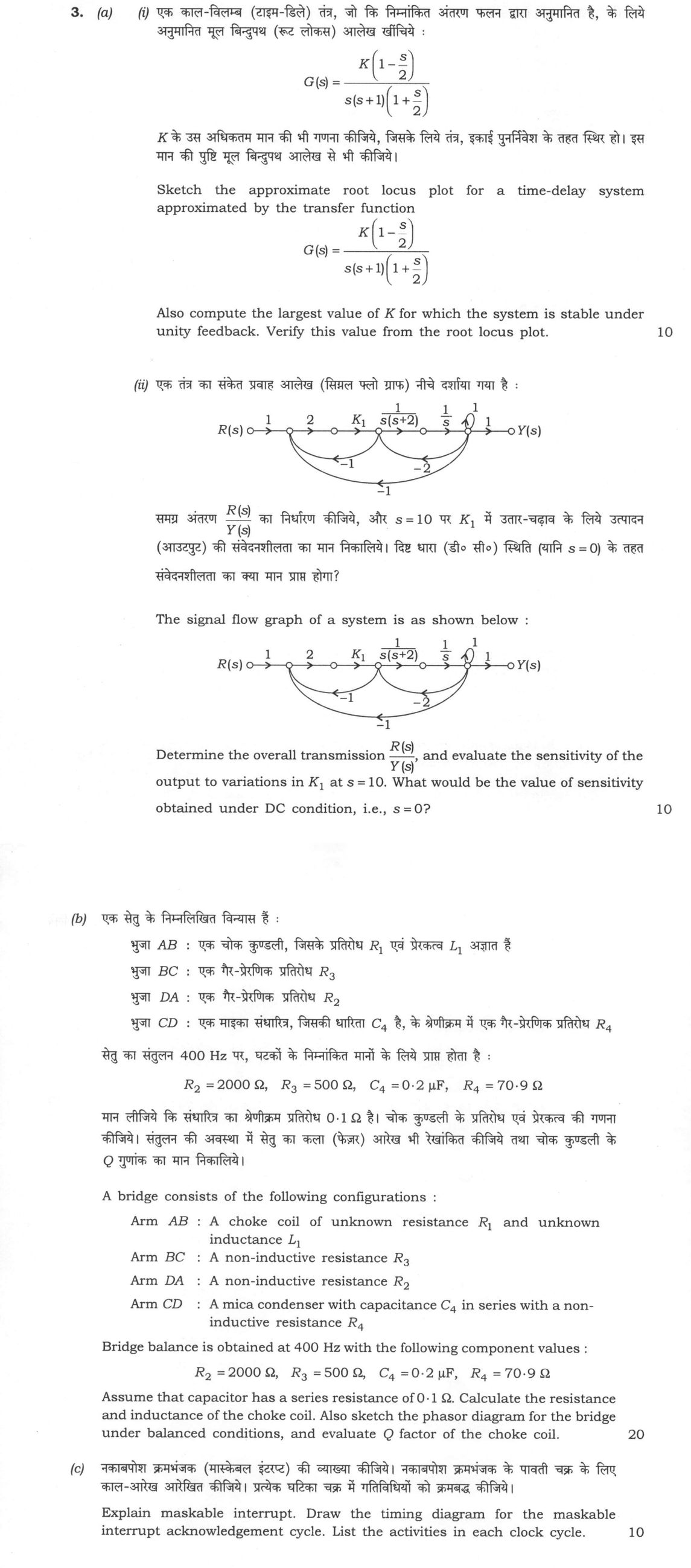
The signal flow graph of a system is as shown below :
[Diagram]
Determine the overall transmission (R(s))/(Y(s)), and evaluate the sensitivity of the output to variations in K₁ at s=10. What would be the value of sensitivity obtained under DC condition, i.e., s=0? 10 marks
A bridge consists of the following configurations :
Arm AB : A choke coil of unknown resistance R₁ and unknown inductance L₁
Arm BC : A non-inductive resistance R₃
Arm DA : A non-inductive resistance R₂
Arm CD : A mica condenser with capacitance C₄ in series with a non-inductive resistance R₄
Bridge balance is obtained at 400 Hz with the following component values :
R₂ = 2000 Ω, R₃ = 500 Ω, C₄ = 0·2 μF, R₄ = 70·9 Ω
Assume that capacitor has a series resistance of 0·1 Ω. Calculate the resistance and inductance of the choke coil. Also sketch the phasor diagram for the bridge under balanced conditions, and evaluate Q factor of the choke coil. 20 marks
Explain maskable interrupt. Draw the timing diagram for the maskable interrupt acknowledgement cycle. List the activities in each clock cycle. 10 marks
हिंदी में प्रश्न पढ़ें
एक काल-विलम्ब (टाइम-डिले) तंत्र, जो कि निम्नांकित अंतरण फलन द्वारा अनुमानित है, के लिये अनुमानित मूल बिन्दुपथ (रूट लोकस) आलेख खींचिये :
G(s) = (K(1-s/2))/(s(s+1)(1+s/2))
K के उस अधिकतम मान की भी गणना कीजिये, जिसके लिये तंत्र, इकाई पुनर्निवेश के तहत स्थिर हो। इस मान की पुष्टि मूल बिन्दुपथ आलेख से भी कीजिये। 10
एक तंत्र का संकेत प्रवाह आलेख (सिग्नल फ्लो ग्राफ) नीचे दर्शाया गया है :
[Diagram]
समग्र अंतरण (R(s))/(Y(s)) का निर्धारण कीजिये, और s=10 पर K₁ में उतार-चढ़ाव के लिये उत्पादन (आउटपुट) की संवेदनशीलता का मान निकालिये। दिष्ट धारा (डी. सी.) स्थिति (यानि s=0) के तहत संवेदनशीलता का क्या मान प्राप्त होगा? 10 marks
एक सेतु के निम्नलिखित विन्यास हैं :
भुजा AB : एक चोक कुण्डली, जिसके प्रतिरोध R₁ एवं प्रेरकत्व L₁ अज्ञात हैं
भुजा BC : एक गैर-प्रेरणिक प्रतिरोध R₃
भुजा DA : एक गैर-प्रेरणिक प्रतिरोध R₂
भुजा CD : एक माइका संधारित्र, जिसकी धारिता C₄ है, के श्रेणीक्रम में एक गैर-प्रेरणिक प्रतिरोध R₄
सेतु का संतुलन 400 Hz पर, घटकों के निम्नांकित मानों के लिये प्राप्त होता है :
R₂ = 2000 Ω, R₃ = 500 Ω, C₄ = 0·2 μF, R₄ = 70·9 Ω
मान लीजिये कि संधारित्र का श्रेणीक्रम प्रतिरोध 0·1 Ω है। चोक कुण्डली के प्रतिरोध एवं प्रेरकत्व की गणना कीजिये। संतुलन की अवस्था में सेतु का कला (फेजर) आरेख भी रेखांकित कीजिये तथा चोक कुण्डली के Q गुणांक का मान निकालिये। 20
नकाबपोश क्रमभंजक (मास्केबल इंटरप्ट) की व्याख्या कीजिये। नकाबपोश क्रमभंजक के पावती चक्र के लिये काल-आरेख आरेखित कीजिये। प्रत्येक घड़ीका चक्र में गतिविधियों को क्रमबद्ध कीजिये। 10
The figure this question refers to, in words
The question paper is a scan and the diagram did not survive as text. This is the figure as read from the original page — every component, value and label — so the question can be worked from the text below.
(a) A block diagram of a unity feedback control system. The input signal R enters a summing junction (with a plus sign for R and a minus sign for the feedback). The output of the summing junction is the input to a forward path block with the transfer function K / [s(s+a)]. The output of this block is Y, which is the system output. A feedback line connects Y back to the negative input of the summing junction. Below the diagram, the unit step response is given by the equation: y(t) = 1 - 1.15 e^(-2t) sin(3.464t + pi/3).
(c) A 2D graph with the vertical axis labeled F(N) and the horizontal axis labeled t. The origin is marked as 0. The vertical axis has a tick mark at 0.2. The horizontal axis has a tick mark at 4x10^-3 s. The plot shows a rectangular pulse: the function value is 0.2 from t=0 to t=4x10^-3 s, and drops to 0 for t > 4x10^-3 s.
What "Solve" is asking you to do
Choose the method, then carry it through to a final answer. Identifying what kind of problem this is and why that method applies is the first thing marked; a correct figure arrived at invisibly earns almost nothing.
Structure that answers it
Given data and what is required → method chosen, with the reason it applies → set-up (equation, circuit, free body, trial balance) → working, step by step → answer with units and any condition of validity
Where marks are lost
Doing the middle steps mentally and writing only the result. In mathematics papers, a further loss comes from giving a decimal where the exact value in surds or fractions was wanted, or from skipping the justification a part explicitly asks for.
How this answer will be evaluated
Approach
(a(i)) map: locate accurately > label > one line on why it matters | (a(ii)) calculate: given > formula > substitution > result with units > interpretation | (b) calculate: given > formula > substitution > result with units > interpretation | (c) explain: definition/context > points in order > small example > short close Full marks: Complete, accurate, and well-structured answers with all required elements and correct calculations
Key points expected
- Identify poles and zeros of G(s)
- Sketch root locus with asymptotes and breakaway points
- Compute largest K for stability using Routh-Hurwitz
- Verify stability limit from the root locus plot
- Determine overall transmission R(s)/Y(s) using Mason's gain formula
- Calculate sensitivity of output to K1 at s=10
- Calculate sensitivity under DC condition (s=0)
- Calculate resistance R1 of the choke coil
Evaluation rubric
Each sub-part is marked on its own, against the marks and word limit printed on the paper.
- (a(i)) Root locus plot and stability limit for the given transfer function 10 marks
map— locate accurately → label → one line on why it matters
Must cover
- Identify poles and zeros of G(s)
- Sketch root locus with asymptotes and breakaway points
- Compute largest K for stability using Routh-Hurwitz
- Verify stability limit from the root locus plot
Loses marks
- Missing the zero at s=2 in the plot
- Incorrect application of Routh-Hurwitz criterion
Earns more
- Correctly identifies the zero at s=2
- Shows the locus crossing the imaginary axis
Extra mark
- Calculates the exact breakaway point
- (a(ii)) Overall transmission and sensitivity of output to K1 10 marks
calculate— given → formula → substitution → result with units → interpretation
Must cover
- Determine overall transmission R(s)/Y(s) using Mason's gain formula
- Calculate sensitivity of output to K1 at s=10
- Calculate sensitivity under DC condition (s=0)
Loses marks
- Incorrect identification of non-touching loops
- Arithmetic errors in sensitivity calculation
Earns more
- Correctly identifies all loops and forward paths
- Shows the sensitivity formula used
Extra mark
- Provides a simplified expression for the transmission
- (b) Resistance, inductance, phasor diagram, and Q factor of the choke coil 20 marks
calculate— given → formula → substitution → result with units → interpretation
Must cover
- Calculate resistance R1 of the choke coil
- Calculate inductance L1 of the choke coil
- Sketch the phasor diagram for the balanced bridge
- Evaluate the Q factor of the choke coil
Loses marks
- Ignoring the series resistance of the capacitor
- Incorrect phasor diagram orientation
Earns more
- Correctly applies the bridge balance condition
- Includes the series resistance of the capacitor in calculations
Extra mark
- Provides a detailed derivation of the balance equations
- (c) Explanation of maskable interrupt and its timing diagram 10 marks
explain— definition/context → points in order → small example → short close
Must cover
- Define maskable interrupt
- Draw the timing diagram for the acknowledgement cycle
- List the activities in each clock cycle
Loses marks
- Missing the timing diagram
- Vague description of clock cycle activities
Earns more
- Mentions the role of the interrupt mask register
- Clearly labels each phase in the timing diagram
Extra mark
- Compares maskable and non-maskable interrupts
Model answer coming soon
Every evaluation on this site is marked against a verified model answer. This question's answer is still being written; evaluation opens the moment it lands.
More from Electrical Engineering 2025 Paper II
- Q1 (a) The block diagram of a system is as shown below : Evaluate the overall transfer funct…
- Q2 (a) An LTI system with the following state-space representation is given : ẋ = [0 1] x +…
- Q3 (a) (i) Sketch the approximate root locus plot for a time-delay system approximated by th…
- Q4 (a) (i) Consider a second-order type-1 system with no zeros. The system under unity feedb…
- Q5 (a) Given a second-order linear time-invariant system G(s) with a relative degree of 2. G…
- Q6 (a) Determine the sending-end voltage, current, power factor of a single-phase, 50 Hz, 76…