Paper II — Q7
(a) Two generators are connected in parallel to the low-voltage side of a 3-phase, Δ-Y transformer as shown below : Generator 1…
Two generators are connected in parallel to the low-voltage side of a 3-phase, Δ-Y transformer as shown below : Generator 1 is rated 60 MVA, 13·8 kV Generator 2 is rated 30 MVA, 13·8 kV
Each generator has a subtransient reactance of 20%. The transformer is rated 90 MVA, 13·8 Δ/69 Y kV with a reactance of 10%. Before the fault occurs, the voltage on the high-tension side of the transformer is 66 kV. The transformer is unloaded, and there is no circulating current between the generators. Find the subtransient current in each generator, when a 3-phase short circuit occurs on the high-tension side of the transformer : 20 marks
What is line coding? For the data sequence 10101110, draw the waveforms for the following line coding schemes : 1. Polar NRZ scheme 2. Bipolar NRZ scheme 3. Differential Manchester scheme 4. RZ polar scheme 10 marks
A PCM system uses 4096 quantization levels to handle telephone signals with a volume range of 40 dB. 1. What is the SNR for maximum sinusoidal signal level? 2. What is the SNR level for the smallest sinusoidal signal level? 3. With a 10 dB compression provided, what will be the new SNR? 10 marks
With the help of schematic and circuit diagrams, describe the operation of a static differential protection relay, using the rectifier bridge amplitude comparator. 10 marks
हिंदी में प्रश्न पढ़ें
जैसा कि निम्न चित्र में दर्शाया गया है, दो जनित्र, एक 3-कला, Δ-Y परिणामित्र की निम्न-वोल्टता की ओर समानांतर में जुड़े हैं : जनित्र 1 की अनुमत क्षमता (रेटिंग) 60 MVA, 13·8 kV है जनित्र 2 की अनुमत क्षमता 30 MVA, 13·8 kV है
प्रत्येक जनित्र का उपक्षणिक प्रतिघात 20% है। परिणामित्र की अनुमत क्षमता (रेटिंग) 90 MVA, 13·8 Δ/69 Y kV, 10% प्रतिघात के साथ है। दोष (फॉल्ट) के पहले उच्च-वोल्टता की ओर परिणामित्र की वोल्टता 66 kV है। परिणामित्र पर कोई भार नहीं है, और जनित्रों के मध्य कोई भी परिसंचरण धारा नहीं है। प्रत्येक जनित्र की उपक्षणिक धारा का मान ज्ञात कीजिये, जबकि एक 3-कला लघु परिपथन (शॉर्ट सर्किट) दोष, परिणामित्र की उच्च-वोल्टता की ओर घटित होता है : (20 अंक)
लाइन कोडिंग क्या है? डाटा अनुक्रम 10101110 के लिये निम्नलिखित लाइन कोडिंग योजनाओं के तहत तरंगरूपों (वेवफॉर्म) को आरेखित कीजिये : 1. ध्रुवीय NRZ योजना 2. द्वि-ध्रुवीय NRZ योजना 3. विभेदक (डिफरेंशियल) मैनचेस्टर योजना 4. RZ ध्रुवीय योजना (10 अंक)
एक PCM तंत्र 4096 कांटन स्तरों (क्वांटाइजेशन लेवल) का प्रयोग करते हुए 40 dB आयतन परास (वॉल्यूम रेंज) के टेलीफोन संकेतों को संभालता है। 1. उच्चतम ज्यावक्रीय संकेत स्तर के लिये SNR क्या है? 2. निम्नतम ज्यावक्रीय संकेत स्तर के लिये SNR स्तर क्या है? 3. 10 dB का संपीडन (कंप्रेशन) देने के साथ नया SNR क्या होगा? (10 अंक)
योजनाबद्ध एवं परिपथ आरेखों की सहायता से दिष्कारी (रेक्टिफायर) सेतु आयाम तुलनित्र (कंपरेटर) का प्रयोग करते हुए एक स्थिर (स्टैटिक) विभेदीय संरक्षण रिले की क्रियाविधि का वर्णन कीजिये। (10 अंक)
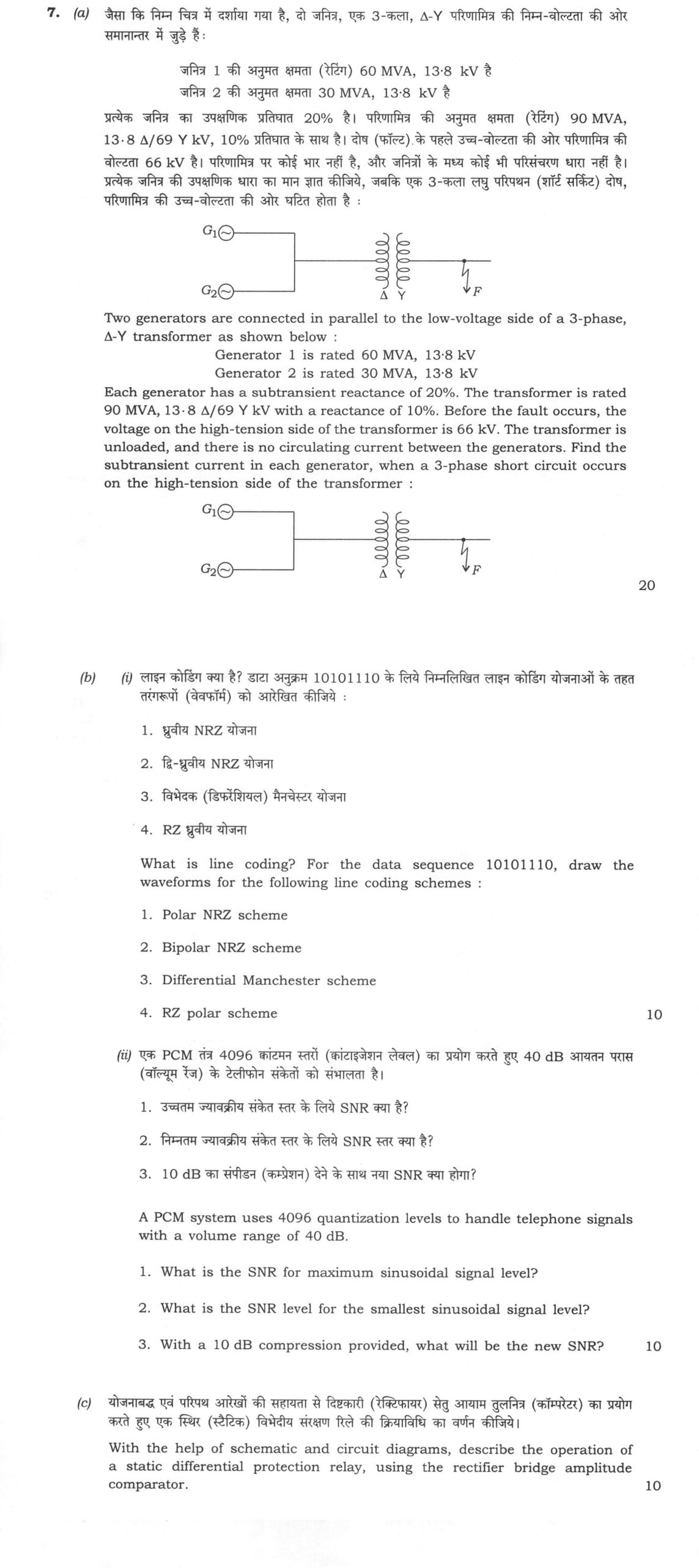
The figure this question refers to, in words
The question paper is a scan and the diagram did not survive as text. This is the figure as read from the original page — every component, value and label — so the question can be worked from the text below.
(a) Two generators G1 and G2 are connected in parallel to the primary (delta) side of a three-phase delta-star transformer. The secondary (star) side of the transformer is connected to a fault point F through a line, with a short-circuit fault indicated at F. The transformer is rated 90 MVA, 13.8 delta / 69 Y kV with a reactance of 10%. Generator 1 is rated 60 MVA, 13.8 kV and Generator 2 is rated 30 MVA, 13.8 kV, each with a subtransient reactance of 20%. The question asks to find the subtransient current in each generator when a 3-phase short circuit occurs on the high-tension side of the transformer.
(c) Graph of force F in newtons versus time t in seconds. The vertical axis is labelled F(N) with a marked value 0.2. The horizontal axis is labelled t with a marked value 4x10^-3 s. The waveform is a rectangular pulse: F = 0 for t < 0, F = 0.2 N constant from t = 0 to t = 4x10^-3 s, and F = 0 for t > 4x10^-3 s.
Model answer
Written by UPSC Answer Check against this question's marking rubric, to the expected length. UPSC does not publish answers for Mains — this is one way to score well, not an official key.
(a) Choose common base S_base = 90 MVA (transformer rating). Base voltages: LV side 13.8 kV, HV side 69 kV. Base current on LV side: I_base(LV) = S_base / (√3 × V_base(LV)) = 90×10⁶ / (√3 × 13.8×10³) = 3765.33 A.
Generator subtransient reactances on their own bases are both 0.20 pu. Convert to 90 MVA base: X₁ = 0.20 × (90/60) = 0.30 pu. X₂ = 0.20 × (90/30) = 0.60 pu. Transformer reactance Xₜ = 0.10 pu on 90 MVA, 13.8/69 kV.
Pre-fault HV voltage = 66 kV. Since the transformer is unloaded, no voltage drop occurs, so the internal EMF behind each generator subtransient reactance equals this voltage. In per-unit on the 69 kV HV base: V₀ = 66/69 = 22/23 = 0.95652 pu. This is also the per-unit voltage on the LV side because the voltage bases are chosen in the transformer turns ratio.
The two generator subtransient reactances are in parallel, in series with the transformer reactance to the fault. Parallel generator reactance: X_p = (0.30 × 0.60) / (0.30 + 0.60) = 0.18 / 0.90 = 0.20 pu. Total reactance to fault: X_total = X_p + Xₜ = 0.20 + 0.10 = 0.30 pu.
Total subtransient fault current in per-unit: I_f = V₀ / X_total = (22/23) / 0.30 = (22/23) × (10/3) = 220/69 = 3.1884 pu.
The current divides between the parallel generators inversely as their reactances. The voltage across the parallel combination is the same, so: I₁ X₁ = I₂ X₂ ⇒ I₁/I₂ = X₂/X₁ = 0.60/0.30 = 2. Thus I₁ = (2/3) I_f and I₂ = (1/3) I_f.
I₁ = (2/3) × (220/69) = 440/207 = 2.1256 pu. I₂ = (1/3) × (220/69) = 220/207 = 1.0628 pu.
Actual RMS subtransient currents on the LV side: I₁(actual) = 2.1256 × 3765.33 = 8003.6 A. I₂(actual) = 1.0628 × 3765.33 = 4001.8 A.
(b)(i) Line coding is the process of converting a binary data stream into a discrete-time voltage or current waveform for baseband transmission. It defines the levels, transitions, DC balance, and clock recovery properties.
Let bit duration be T_b, and use levels +V, −V, 0, with L and H as low and high levels. The data sequence is 1 0 1 0 1 1 1 0.
- Polar NRZ: 1 = +V, 0 = −V, held for the entire bit. Waveform levels: +V, −V, +V, −V, +V, +V, +V, −V.
- Bipolar NRZ (AMI): 1 alternates in polarity, 0 = 0 V. First 1 is positive. Ones occur at positions 1, 3, 5, 6, 7. Waveform levels: +V, 0, −V, 0, +V, −V, +V, 0.
- Differential Manchester: A mid-bit transition always occurs. A start transition represents 0, and no start transition represents 1. Assume the initial level before bit 1 is L. Half-bit pairs for bits 1 to 8: Bit 1 (1): L H Bit 2 (0): L H Bit 3 (1): H L Bit 4 (0): H L Bit 5 (1): L H Bit 6 (1): H L Bit 7 (1): L H Bit 8 (0): L H So the sequence is LH, LH, HL, HL, LH, HL, LH, LH. (The inverted waveform with initial H is equally valid.)
- RZ polar: 1 = positive for first half and zero for second half; 0 = negative for first half and zero for second half. Half-bit pairs: (+V,0), (−V,0), (+V,0), (−V,0), (+V,0), (+V,0), (+V,0), (−V,0).
(b)(ii) Number of quantization levels M = 4096. Number of bits per sample: n = log₂ 4096 = 12 bits.
For a full-scale sinusoidal signal in uniform PCM, the maximum signal-to-quantization-noise ratio is: (S/N)_max = 1.76 + 6.02 n dB = 1.76 + 6.02 × 12 = 1.76 + 72.24 = 74.0 dB.
Volume range = 40 dB. The smallest sinusoidal signal is 40 dB below the maximum. Therefore: (S/N)_min = 74.0 − 40 = 34.0 dB.
With 10 dB compression, the effective dynamic range at the quantizer is reduced by 10 dB, i.e., from 40 dB to 30 dB. Hence the new minimum SNR is: (S/N)_min(new) = 74.0 − 30 = 44.0 dB. The maximum SNR remains 74.0 dB.
(c) Static differential protection relay using a rectifier bridge amplitude comparator:
In the schematic, current transformers CT₁ and CT₂ are placed on the two sides of the protected equipment (e.g., transformer, generator, or busbar). Their secondaries are connected in a differential loop. Each secondary current is fed to a full-wave rectifier bridge. Bridge BR₁ produces a DC voltage V₁ proportional to |I₁|, and bridge BR₂ produces V₂ proportional to |I₂|. These DC voltages are filtered and applied in opposition to a static amplitude comparator. A restraint (bias) quantity is derived from the sum of the rectified currents, often by connecting the bridges to a common burden resistor.
In normal load or external fault conditions, the currents entering and leaving the protected zone are essentially equal, so I₁ ≈ I₂, V₁ ≈ V₂, and the net operating quantity is below the setting. The output transistor or thyristor remains off, and the trip coil is not energized.
For an internal fault, the currents become unequal, producing a differential current. The rectified outputs V₁ and V₂ differ. When the operating quantity |V₁ − V₂| exceeds the restraint or threshold set by the bias circuit, the comparator conducts. This triggers the thyristor (SCR), energizes the trip coil, and opens the circuit breaker.
The percentage bias characteristic ensures stability on external faults and high sensitivity on internal faults. Being static, the relay has no moving contacts, giving fast response, low burden, and high reliability.
What "Calculate" is asking you to do
Apply the standard formula or schedule to data the question has already supplied — a table of readings, cost records, a balance sheet — and produce the number. The method is rarely in doubt; the marks sit in the named intermediate quantities, each of which has to appear as a labelled line.
Structure that answers it
Data as given → formula or standard treatment, named → substitution → each intermediate, labelled → result with units
Where marks are lost
Omitting an intermediate the marking scheme pays for separately, or rounding at an intermediate line so the final figure drifts. In commerce and accountancy, any figure in a statement that no numbered working note supports is treated as unearned.
How this answer will be evaluated
Approach
Framework: null. (a) calculate: given > formula > substitution > result with units > interpretation | (b(i)) describe: define > structure or process in order > labelled diagram > significance | (b(ii)) calculate: given > formula > substitution > result with units > interpretation | (c) describe: define > structure or process in order > labelled diagram > significance Full marks: Complete, accurate, and well-structured answers with all required elements and correct calculations.
Key points expected
- Convert all reactances to a common base (90 MVA, 13.8 kV)
- Calculate equivalent reactance of parallel generators
- Determine total fault current in per-unit
- Calculate individual generator currents using current division
- Clear definition of line coding
- Correct waveform for Polar NRZ
- Correct waveform for Bipolar NRZ
- Correct waveform for Differential Manchester
Evaluation rubric
Each sub-part is marked on its own, against the marks and word limit printed on the paper.
- (a) Subtransient current in each generator during a 3-phase fault on the HT side. 20 marks
calculate— given → formula → substitution → result with units → interpretation
Must cover
- Convert all reactances to a common base (90 MVA, 13.8 kV)
- Calculate equivalent reactance of parallel generators
- Determine total fault current in per-unit
- Calculate individual generator currents using current division
Loses marks
- Using different bases without conversion
- Incorrect parallel reactance calculation
- Missing units in final answer
Earns more
- Correct per-unit conversion for each component
- Accurate calculation of parallel reactance
- Proper application of current division rule
- Final answer in both per-unit and amperes
Extra mark
- Phasor diagram showing current distribution
- Verification of total current equals sum of individual currents
- (b(i)) Definition of line coding and waveforms for four specified schemes. 10 marks
describe— define → structure or process in order → labelled diagram → significance
Must cover
- Clear definition of line coding
- Correct waveform for Polar NRZ
- Correct waveform for Bipolar NRZ
- Correct waveform for Differential Manchester
Loses marks
- Missing or incorrect waveform for any scheme
- No definition of line coding
- Confusing transition rules for Differential Manchester
Earns more
- Accurate timing and amplitude for each scheme
- Clear labeling of bits and transitions
- Proper representation of RZ polar scheme
- Consistent time scale across all waveforms
Extra mark
- Comparison table of scheme characteristics
- Note on DC component or bandwidth for each
- (b(ii)) SNR values for maximum, minimum, and compressed signal levels. 10 marks
calculate— given → formula → substitution → result with units → interpretation
Must cover
- Calculate SNR for maximum sinusoidal signal
- Calculate SNR for smallest sinusoidal signal
- Apply 10 dB compression to find new SNR
- Use correct quantization noise formula
Loses marks
- Incorrect quantization level calculation
- Missing compression effect on SNR
- No units or dB notation in final answers
Earns more
- Correct use of 4096 quantization levels
- Proper application of volume range (40 dB)
- Accurate compression calculation
- Clear step-by-step derivation
Extra mark
- Formula for quantization noise power
- Note on dynamic range improvement
- (c) Operation of static differential protection relay with rectifier bridge comparator. 10 marks
describe— define → structure or process in order → labelled diagram → significance
Must cover
- Schematic diagram of the relay circuit
- Explanation of rectifier bridge function
- Description of amplitude comparator operation
- How differential current triggers the relay
Loses marks
- Missing schematic or circuit diagram
- No explanation of comparator operation
- Confusing differential with directional protection
Earns more
- Clear labeling of components in diagram
- Explanation of normal vs fault conditions
- Role of setting resistor or bias
- Response to through-faults vs internal faults
Extra mark
- Circuit diagram with component values
- Note on sensitivity or pickup current
Practice this exact question
Write your answer and it is marked point by point against the model answer above — what you covered, what you missed, what you got wrong.
Evaluate my answer →More from Electrical Engineering 2025 Paper II
- Q4 (a) (i) Consider a second-order type-1 system with no zeros. The system under unity feedb…
- Q5 (a) Given a second-order linear time-invariant system G(s) with a relative degree of 2. G…
- Q6 (a) Determine the sending-end voltage, current, power factor of a single-phase, 50 Hz, 76…
- Q7 (a) Two generators are connected in parallel to the low-voltage side of a 3-phase, Δ-Y tr…
- Q8 (a) The figure below shows the single-line diagram of a generator connected through paral…