Paper II — Q4
(a) (i) Consider a second-order type-1 system with no zeros. The system under unity feedback admits a resonant peak of 1·36 at…
Consider a second-order type-1 system with no zeros. The system under unity feedback admits a resonant peak of 1·36 at resonant frequency 8·2 rad/s. Compute the transfer function G(s), and its steady-state error due to input signal x(t) = 2u(t) + 3t·u(t) under unity feedback. 10 marks
For the system shown in the figure below
the unit step response is given by
y(t) = 1 - 1.15 e^-2t sin(3.464t + (π)/3)
Obtain the state-space representation of the system in observable canonical form. 10 marks
For 8085 microprocessor, write a program to do the following : 1. Clear the accumulator 2. Add 47H (using ADI instruction) 3. Subtract 92H 4. Add 64H 5. Display the results after subtracting 92H and after adding 64H
Specify the answer you would expect at the output port. Also give the reason for clearing the accumulator before adding the number 47H directly to the accumulator.
Write the instruction to clear the CY flag to load FFH in register B and increment (B). If the CY flag is set, display 1 at the output port; otherwise, display the contents of register B. Explain your result.
A quartz piezoelectric transducer having a capacitance of 3000 pF and voltage sensitivity of 0.06 V-m/N has a resistance of 10⁷ MΩ. The impedance of the measuring system has a capacitance of 300 pF in parallel with a 1 MΩ resistance. A force as shown in the figure is applied across the transducer :
Find the voltages just before and after t = 4 ms. [Permittivity of quartz is 40.6×10^-12 F/m]
हिंदी में प्रश्न पढ़ें
एक द्वितीय क्रम (ऑर्डर) प्रकार-1 (टाइप-1) तंत्र जिसमें कोई शून्य नहीं है, दिया गया है। यह तंत्र इकाई पुनर्निवेश के तहत 8·2 rad/s की अनुनाद आवृत्ति पर अनुनाद शिखर का मान 1·36 देता है। तंत्र के अंतरण फलन G(s) की गणना कीजिये, एवं इकाई पुनर्निवेश के तहत निवेश (इनपुट) सिग्नल x(t) = 2u(t) + 3t·u(t) के लिये इसकी स्थायी-दशा त्रुटि की गणना कीजिये। 10
नीचे चित्र में दर्शाये गये तंत्र के लिये
इकाई पद अनुक्रिया (रेस्पांस)
y(t) = 1 - 1.15 e^-2t sin(3.464t + (π)/3)
द्वारा दी गई है। तंत्र का अवस्था-समीकरण (स्टेट-स्पेस) निरूपण, प्रेक्षणीय (आब्जर्वेबल) विहित (कैनोनिकल) रूप में प्राप्त कीजिये। 10
8085 सूक्ष्म-संसाधित्र (माइक्रोप्रोसेसर) में निम्नलिखित कार्य करने के लिये एक प्रोग्राम लिखिये : 1. संचायक (एक्युमुलेटर) को खाली (क्लियर) कीजिये 2. 47H को जोड़िये (ADI निर्देश का उपयोग करते हुए) 3. 92H को घटाइये 4. 64H को जोड़िये 5. 92H को घटाने और 64H को जोड़ने के पश्चात् परिणाम प्रदर्शित कीजिये
आप जिस उत्तर की आशा करते हैं उसे निर्गत पोर्ट पर निर्दिष्ट कीजिये। संचायक में सीधे अंक 47H जोड़ने के पहले संचायक को खाली करने का कारण भी बताइये।
CY फ्लैग को खाली (क्लियर) करने और FFH को पंजी (रजिस्टर) B में भरने तथा पंजी B में वृद्धि के लिये निर्देश लिखिये। यदि CY फ्लैग सेट है, तो निर्गत पोर्ट पर 1 प्रदर्शित कीजिये अन्यथा पंजी B की अंतर्वस्तुओं (कांटेंट) को प्रदर्शित कीजिये। अपने परिणाम की व्याख्या कीजिये।
एक क्वार्ट्ज दाब-विद्युत (पीजोइलेक्ट्रिक) परिवर्तक (ट्रांसड्यूसर) की संधारिता 3000 pF, वोल्टेज संवेदनशीलता (सुग्राहिता) 0.06 V-m/N तथा प्रतिरोध 10⁷ MΩ है। मापन तंत्र (प्रणाली) की प्रतिबाधा में संधारिता 300 pF तथा इसके समानांतर में 1 MΩ का प्रतिरोध संयोजित है। एक बल, जैसा चित्र में दर्शाया गया है, ट्रांसड्यूसर के आर-पार आरोपित किया जाता है :
t = 4 ms के तुरंत पहले एवं बाद में वोल्टता ज्ञात कीजिये। [क्वार्ट्ज की पारगम्यता (परमिटिविटी) 40.6×10^-12 F/m है]
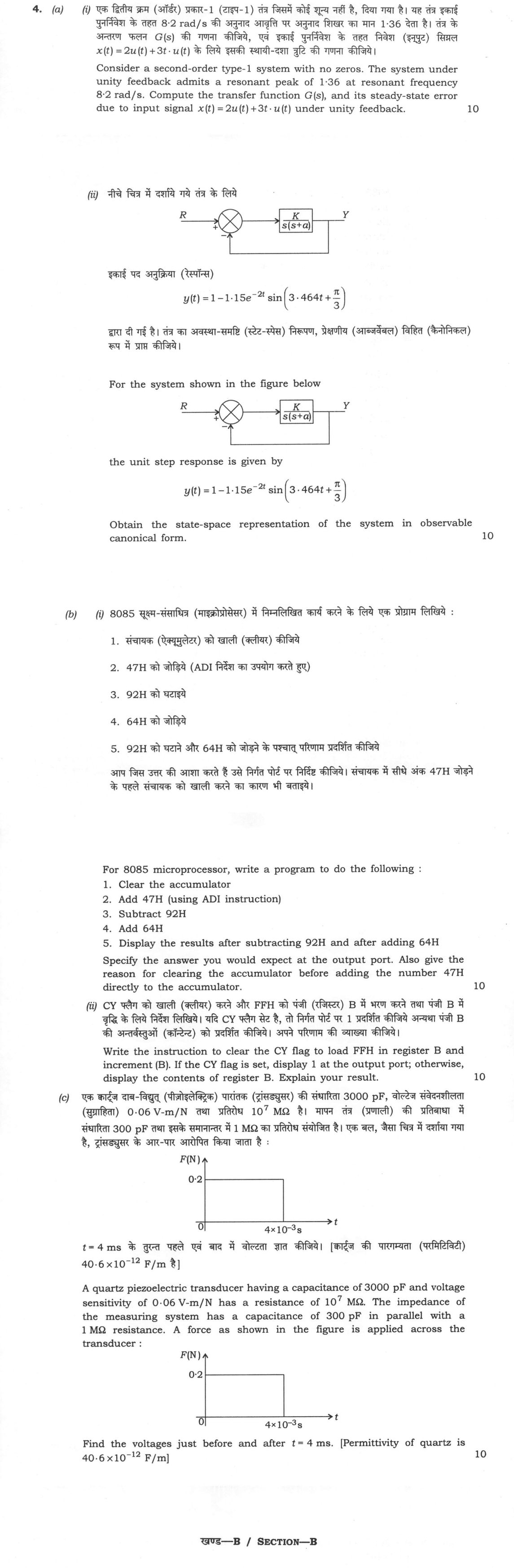
The figure this question refers to, in words
The question paper is a scan and the diagram did not survive as text. This is the figure as read from the original page — every component, value and label — so the question can be worked from the text below.
(a) Block diagram of a unity feedback control system. Input signal R enters a summing junction (circle with a cross) at the left. The summing junction has a plus sign on the path from R and a minus sign on the feedback path from the bottom. The output of the summing junction goes to a forward-path block labeled K / (s(s+a)). The output of this block is the system output Y. A feedback line connects Y back to the minus input of the summing junction.
(c) A graph of force F in newtons versus time t in seconds. The vertical axis is labelled F(N) with a marked value of 0.2. The horizontal axis is labelled t with a marked value of 4x10^-3 s. The waveform is a rectangular pulse: F = 0 for t < 0, F = 0.2 N constant from t = 0 to t = 4x10^-3 s, and F = 0 for t > 4x10^-3 s.
Model answer
Written by UPSC Answer Check against this question's marking rubric, to the expected length. UPSC does not publish answers for Mains — this is one way to score well, not an official key.
(a)(i) For a type-1 second-order no-zero plant, take G(s)=K/[s(s+a)]. Under unity feedback, T(s)=K/(s²+a s+K)=ω_n²/(s²+2ζω_n s+ω_n²), so K=ω_n² and a=2ζω_n. Given Mr=1.36=1/[2ζ√(1−ζ²)] and ω_r=8.2=ω_n√(1−2ζ²). Solving, ζ²=0.16113, ζ=0.4014, √(1−2ζ²)=0.82325. Thus ω_n=8.2/0.82325=9.960 rad/s. K=ω_n²=99.21, a=2ζω_n=7.996. So G(s)=99.21/[s(s+7.996)].
For x(t)=2u(t)+3t u(t), R(s)=2/s+3/s². Since the system is type 1, step error is zero. The velocity error constant is Kv=lim s→0 sG(s)=K/a=99.21/7.996=12.41 s⁻¹. Ramp error = A/Kv=3/12.41=0.2418. Hence e_ss=0.2418.
(a)(ii) Given y(t)=1−1.15 e^(−2t) sin(3.464t+π/3). Compare with a standard second-order step response. Here 3.464=2√3, so ζω_n=2 and ω_d=√(ω_n²−ζ²ω_n²)=2√3. Thus ω_n²=16, ζ=0.5. The closed-loop transfer function is T(s)=16/(s²+4s+16). Compare with H(s)=(b₀+b₁s)/(s²+a₁s+a₀): a₁=4, a₀=16, b₁=0, b₀=16. Using standard observable canonical form, A=[[0, −16], [1, −4]], B=[[16], [0]], C=[0, 1], D=[0]. Therefore ẋ₁=−16x₂+16u ẋ₂=x₁−4x₂ y=x₂. State-space representation: A=[[0, −16], [1, −4]], B=[[16], [0]], C=[0, 1], D=[0].
(b)(i) Assume output port address 01H. ``text XRA A ; clear A and CY ADI 47H ; A=47H SUI 92H ; A=B5H, CY=1 OUT 01H ; display B5H ADI 64H ; A=19H, CY=1 OUT 01H ; display 19H HLT `` Expected output: after subtracting 92H, port receives B5H; after adding 64H, port receives 19H. Numerically, 47H−92H=−4BH=B5H in 8-bit two’s complement; then B5H+64H=119H, so A=19H with carry CY=1. The accumulator is cleared before ADI because ADI adds the immediate data to the existing accumulator contents. If A were not zero, the result would contain the previous data. XRA A clears A and also clears CY.
(b)(ii) ``text XRA A ; clear CY flag MVI B, FFH ; B=FFH INR B ; B=00H, CY unchanged JC ONE MOV A, B OUT 01H HLT ONE: MVI A, 01H OUT 01H HLT `` In 8085, INR does not affect the CY flag. Since CY was cleared to 0, incrementing FFH to 00H leaves CY=0. Hence the JC instruction is not taken, and the contents of B, i.e. 00H, are displayed at the output port. If CY had been set, the program would display 01H.
(c) Charge sensitivity: d=εg=(40.6×10⁻¹²)(0.06)=2.436×10⁻¹² C/N. For F=0.2 N, generated charge q=dF=(2.436×10⁻¹²)(0.2)=4.872×10⁻¹³ C. Total capacitance: C=C_t+C_m=3000 pF+300 pF=3300 pF=3.3×10⁻⁹ F. Initial voltage due to the step force: V₀=q/C=4.872×10⁻¹³/3.3×10⁻⁹=1.476×10⁻⁴ V=0.1476 mV. Total resistance: R=R_t∥R_m≈1 MΩ=10⁶ Ω, since R_t=10⁷ MΩ=10¹³ Ω is much larger. Time constant: τ=RC=(10⁶)(3.3×10⁻⁹)=3.3×10⁻³ s=3.3 ms. During 0<t<4 ms, voltage decays as V(t)=V₀e^(−t/τ). Just before t=4 ms: V(4⁻)=V₀e^(−4/3.3)=0.1476 e^(−1.212)=0.0439 mV. Just after t=4 ms, the force falls to zero, removing charge q. Hence voltage changes instantaneously by −q/C=−V₀: V(4⁺)=V(4⁻)−V₀=0.0439−0.1476=−0.1037 mV. Thus V(4⁻)≈0.0439 mV and V(4⁺)≈−0.1037 mV.
What "Solve" is asking you to do
Choose the method, then carry it through to a final answer. Identifying what kind of problem this is and why that method applies is the first thing marked; a correct figure arrived at invisibly earns almost nothing.
Structure that answers it
Given data and what is required → method chosen, with the reason it applies → set-up (equation, circuit, free body, trial balance) → working, step by step → answer with units and any condition of validity
Where marks are lost
Doing the middle steps mentally and writing only the result. In mathematics papers, a further loss comes from giving a decimal where the exact value in surds or fractions was wanted, or from skipping the justification a part explicitly asks for.
How this answer will be evaluated
Approach
(a(i)) calculate: given > formula > substitution > result with units > interpretation | (a(ii)) derive: given > assumptions > stepwise derivation > result > check | (b(i)) describe: define > structure or process in order > labelled diagram > significance | (b(ii)) describe: define > structure or process in order > labelled diagram > significance | (c) calculate: given > formula > substitution > result with units > interpretation Full marks: Complete derivations with correct formulas, proper units, and clear explanations of all steps.
Key points expected
- Identify system as Type-1 second order
- Relate resonant peak Mr to damping ratio ζ
- Relate resonant frequency ωr to natural frequency ωn
- Calculate steady-state error for ramp input
- Determine transfer function from given step response
- Identify system order and coefficients
- Construct A, B, C, D matrices in observable form
- Correctly map transfer function to state-space
Evaluation rubric
Each sub-part is marked on its own, against the marks and word limit printed on the paper.
- (a(i)) Transfer function G(s) and steady-state error for step and ramp inputs. 10 marks
calculate— given → formula → substitution → result with units → interpretation
Must cover
- Identify system as Type-1 second order
- Relate resonant peak Mr to damping ratio ζ
- Relate resonant frequency ωr to natural frequency ωn
- Calculate steady-state error for ramp input
Loses marks
- Confusing ωr with ωn
- Incorrect steady-state error formula for Type-1
Earns more
- Explicit calculation of ωn and ζ
- Correct form of G(s) = ωn²/s(s+2ζωn)
- Separate error calculation for step and ramp
Extra mark
- Verification of system stability
- (a(ii)) State-space representation in observable canonical form. 10 marks
derive— given → assumptions → stepwise derivation → result → check
Must cover
- Determine transfer function from given step response
- Identify system order and coefficients
- Construct A, B, C, D matrices in observable form
- Correctly map transfer function to state-space
Loses marks
- Using controllable instead of observable form
- Incorrect extraction of coefficients from response
Earns more
- Clear derivation of transfer function from y(t)
- Proper identification of characteristic equation
- Correct observable canonical form structure
Extra mark
- Verification via state transition matrix
- (b(i)) 8085 assembly program with expected output and accumulator clearing reason. 10 marks
describe— define → structure or process in order → labelled diagram → significance
Must cover
- Correct sequence of 8085 instructions
- Proper use of ADI for 47H addition
- Display results after each operation
- Explain why accumulator is cleared first
Loses marks
- Incorrect instruction sequence
- Missing accumulator clearing explanation
Earns more
- Correct hex arithmetic with carry handling
- Proper output port addressing
- Clear explanation of accumulator clearing
Extra mark
- Commented code structure
- (b(ii)) Instruction sequence for CY flag handling with conditional display. 10 marks
describe— define → structure or process in order → labelled diagram → significance
Must cover
- Clear CY flag instruction
- Load FFH into register B
- Increment register B with carry handling
- Conditional display based on CY flag
Loses marks
- Incorrect flag manipulation
- Missing conditional logic
Earns more
- Correct use of STC/CLC instructions
- Proper conditional branching logic
- Clear explanation of result
Extra mark
- Alternative implementation approach
- (c) Voltages just before and after t = 4 ms for piezoelectric transducer. 10 marks
calculate— given → formula → substitution → result with units → interpretation
Must cover
- Equivalent circuit with parallel capacitances
- Calculate initial voltage from force and sensitivity
- Apply RC discharge equation for t = 4 ms
- Calculate voltage just before and after 4 ms
Loses marks
- Ignoring parallel capacitance effects
- Incorrect time constant calculation
Earns more
- Correct parallel capacitance calculation
- Proper time constant determination
- Clear distinction between before and after states
Extra mark
- Circuit diagram with labeled components
Practice this exact question
Write your answer and it is marked point by point against the model answer above — what you covered, what you missed, what you got wrong.
Evaluate my answer →More from Electrical Engineering 2025 Paper II
- Q1 (a) The block diagram of a system is as shown below : Evaluate the overall transfer funct…
- Q2 (a) An LTI system with the following state-space representation is given : ẋ = [0 1] x +…
- Q3 (a) (i) Sketch the approximate root locus plot for a time-delay system approximated by th…
- Q4 (a) (i) Consider a second-order type-1 system with no zeros. The system under unity feedb…
- Q5 (a) Given a second-order linear time-invariant system G(s) with a relative degree of 2. G…
- Q6 (a) Determine the sending-end voltage, current, power factor of a single-phase, 50 Hz, 76…
- Q7 (a) Two generators are connected in parallel to the low-voltage side of a 3-phase, Δ-Y tr…