Paper II — Q2
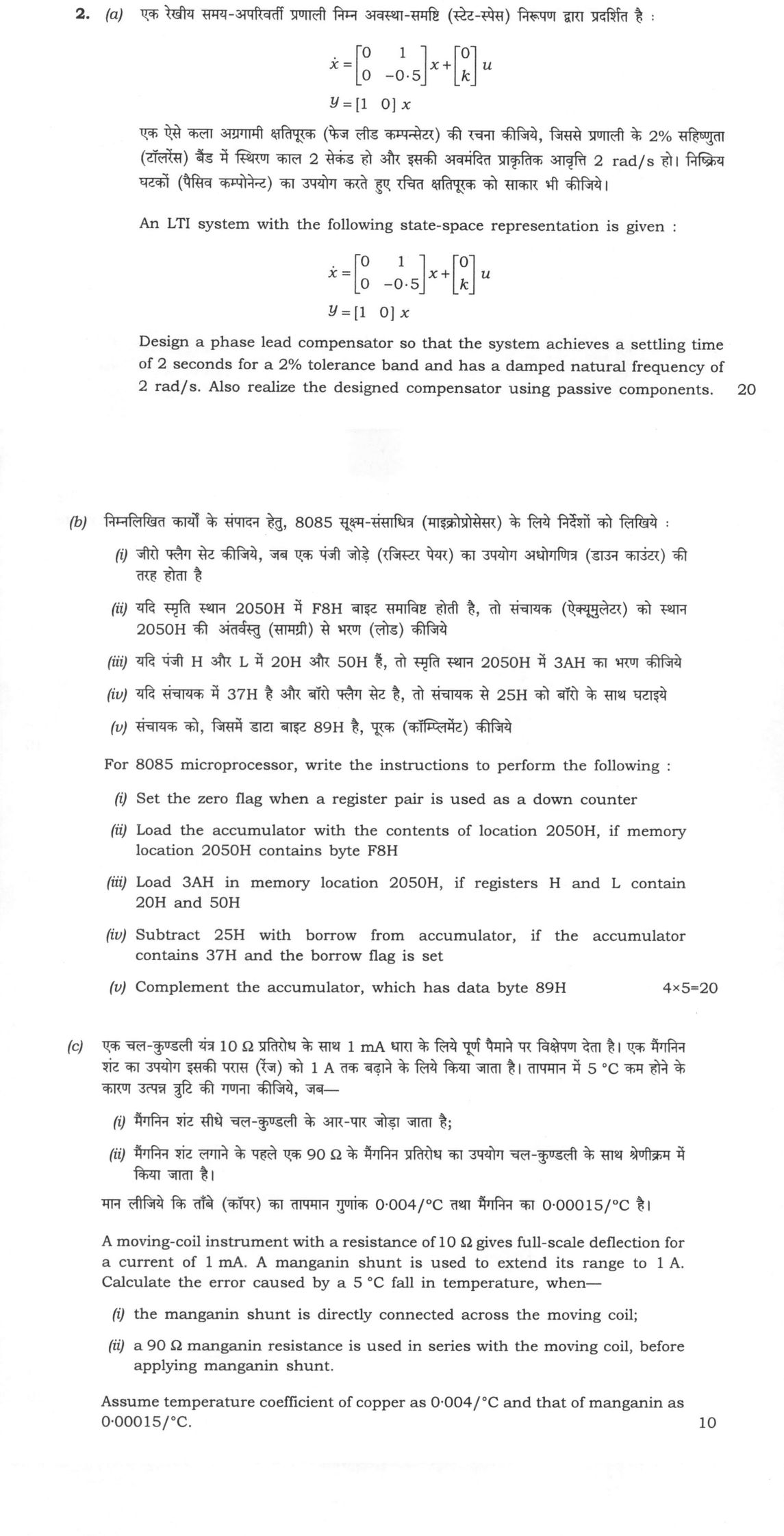
(a) An LTI system with the following state-space representation is given : ẋ = [0 1] x + [0] u [0 -0.5] [k] y = [1 0]…
An LTI system with the following state-space representation is given : ẋ = [0 1] x + [0] u [0 -0.5] [k] y = [1 0] x Design a phase lead compensator so that the system achieves a settling time of 2 seconds for a 2% tolerance band and has a damped natural frequency of 2 rad/s. Also realize the designed compensator using passive components. 20 marks
For 8085 microprocessor, write the instructions to perform the following : Set the zero flag when a register pair is used as a down counter
Load the accumulator with the contents of location 2050H, if memory location 2050H contains byte F8H
Load 3AH in memory location 2050H, if registers H and L contain 20H and 50H
Subtract 25H with borrow from accumulator, if the accumulator contains 37H and the borrow flag is set
Complement the accumulator, which has data byte 89H 4×5=20
A moving-coil instrument with a resistance of 10 Ω gives full-scale deflection for a current of 1 mA. A manganin shunt is used to extend its range to 1 A. Calculate the error caused by a 5 °C fall in temperature, when— the manganin shunt is directly connected across the moving coil;
a 90 Ω manganin resistance is used in series with the moving coil, before applying manganin shunt. Assume temperature coefficient of copper as 0·004/°C and that of manganin as 0·00015/°C. 10 marks
हिंदी में प्रश्न पढ़ें
एक रैखिक समय-अपरिवर्ती प्रणाली निम्न अवस्था-समष्टि (स्टेट-स्पेस) निरूपण द्वारा प्रदर्शित है : ẋ = [0 1] x + [0] u [0 -0.5] [k] y = [1 0] x एक ऐसे कला अग्रगामी क्षतिपूरक (फेज लीड कम्पेनसेटर) की रचना कीजिये, जिससे प्रणाली के 2% सहिष्णुता (टॉलरेंस) बैंड में स्थिरण काल 2 सेकंड हो और इसकी अवमंदित प्राकृतिक आवृत्ति 2 rad/s हो। निष्क्रिय घटकों (पैसिव कम्पोनेंट) का उपयोग करते हुए रचित क्षतिपूरक को साकार भी कीजिये। 20
निम्नलिखित कार्यों के संपादन हेतु, 8085 सूक्ष्म-संसाधित्र (माइक्रोप्रोसर) के लिये निर्देशों को लिखिये : जीरो फ्लैग सेट कीजिये, जब एक पंजी जोड़े (रजिस्टर पेयर) का उपयोग अधोगामित्र (डाउन काउंटर) की तरह होता है
यदि स्मृति स्थान 2050H में F8H बाइट समाविष्ट होती है, तो संचायक (एक्युमुलेटर) को स्थान 2050H की अंतर्वस्तु (सामग्री) से भरण (लोड) कीजिये
यदि पंजी H और L में 20H और 50H हैं, तो स्मृति स्थान 2050H में 3AH का भरण कीजिये
यदि संचायक में 37H है और बोरो फ्लैग सेट है, तो संचायक से 25H को बोरो के साथ घटाइये
संचायक को, जिसमें डाटा बाइट 89H है, पूरक (कॉम्प्लीमेंट) कीजिये 4×5=20
एक चल-कुण्डली यंत्र 10 Ω प्रतिरोध के साथ 1 mA धारा के लिये पूर्ण पैमाने पर विचेषण देता है। एक मैंगनिन शंट का उपयोग इसकी परास (रेंज) को 1 A तक बढ़ाने के लिये किया जाता है। तापमान में 5 °C कम होने के कारण उत्पन्न त्रुटि की गणना कीजिये, जब— मैंगनिन शंट सीधे चल-कुण्डली के आर-पार जोड़ा जाता है;
मैंगनिन शंट लगाने के पहले एक 90 Ω के मैंगनिन प्रतिरोध का उपयोग चल-कुण्डली के साथ श्रेणीक्रम में किया जाता है। मान लीजिये कि ताँबे (कॉपर) का तापमान गुणांक 0·004/°C तथा मैंगनिन का 0·00015/°C है। 10
Model answer
Written by UPSC Answer Check against this question's marking rubric, to the expected length. UPSC does not publish answers for Mains — this is one way to score well, not an official key.
(a) The plant transfer function is G(s) = C(sI − A)⁻¹B = k/[s(s + 0.5)].
For a 2% settling time, Ts = 4/(ζωₙ) = 2 s, so ζωₙ = 2 rad/s. Given ω_d = 2 rad/s, we have ωₙ = √((ζωₙ)² + ω_d²) = √(4 + 4) = 2√2 rad/s, and ζ = (ζωₙ)/ωₙ = 1/√2. Desired characteristic equation: s² + 2ζωₙ s + ωₙ² = s² + 4s + 8 = 0. Desired closed-loop poles: s = −2 ± j2.
Let the phase-lead compensator be G_c(s) = K_c (s + z)/(s + p), with p > z. Choose z = 0.5 to cancel the plant pole at −0.5. Then the loop transfer function is L(s) = G_c(s) G(s) = K_c k/[s(s + p)]. The closed-loop characteristic equation is s² + p s + K_c k = 0. Comparing with s² + 4s + 8 = 0 gives p = 4 and K_c k = 8, so K_c = 8/k. Thus the designed compensator is G_c(s) = (8/k)(s + 0.5)/(s + 4).
For passive realization, the lead network (s + 0.5)/(s + 4) is realized by an RC circuit: input to output through R1 || C, and output to ground through R2. Its transfer function is H(s) = (s + 1/(R1 C))/(s + 1/((R1||R2) C)). Set 1/(R1 C) = 0.5 and 1/((R1||R2) C) = 4. Then R1 C = 2 s and (R1||R2) C = 0.25 s. This gives R2/(R1 + R2) = 0.125, so R1 = 7 R2. Choose C = 1 μF, then R1 = 2 MΩ and R2 = 2/7 MΩ = 285.7 kΩ. The required gain K_c = 8/k can be provided by a resistive attenuator if 8/k ≤ 1 (i.e., k ≥ 8); otherwise an active amplifier is needed. If the plant gain is k = 8, then K_c = 1 and the passive network alone realizes the compensator.
(b)(i) Use register pair BC as a down counter and set the zero flag when it reaches zero: DCX B MOV A, B ORA C JNZ LOOP At BC = 0000H, ORA C sets Z = 1.
(b)(ii) LDA 2050H. Since [2050H] = F8H, after execution A = F8H.
(b)(iii) H = 20H, L = 50H, so HL = 2050H. MVI M, 3AH. This stores 3AH at memory location 2050H.
(b)(iv) SBI 25H. A = 37H, CY = 1 (borrow set). A ← A − 25H − CY = 37H − 25H − 1 = 11H. Thus A = 11H.
(b)(v) CMA. A = 89H = 10001001₂. Complement = 01110110₂ = 76H. Thus A = 76H.
(c)(i) Direct shunt. R_m = 10 Ω, I_m = 1 mA = 0.001 A, I = 1 A. n = I/I_m = 1000. R_sh = R_m/(n − 1) = 10/999 Ω. At ΔT = −5 °C: R_m′ = 10[1 + 0.004(−5)] = 9.8 Ω. R_sh′ = (10/999)[1 + 0.00015(−5)] = (10/999)(0.99925) = 9.9925/999 Ω. Current through meter at full-scale I = 1 A: I_m′ = 1 × R_sh′/(R_m′ + R_sh′) = (9.9925/999)/(9.8 + 9.9925/999) = 9.9925/9800.1925 = 0.00101962 A. Error = (I_m′ − I_m)/I_m × 100 = (0.00101962 − 0.001)/0.001 × 100 = 1.962%. The reading is high by 1.962%.
(c)(ii) 90 Ω manganin in series with moving coil. Branch resistance R_br = 10 + 90 = 100 Ω. R_sh = R_br/(n − 1) = 100/999 Ω. At ΔT = −5 °C: R_m′ = 9.8 Ω. R_s′ = 90[1 + 0.00015(−5)] = 89.9325 Ω. R_br′ = 9.8 + 89.9325 = 99.7325 Ω. R_sh′ = (100/999)(0.99925) = 99.925/999 Ω. I_m′ = 1 × R_sh′/(R_br′ + R_sh′) = (99.925/999)/(99.7325 + 99.925/999) = 99.925/99732.6925 = 0.00100193 A. Error = (I_m′ − I_m)/I_m × 100 = (0.00100193 − 0.001)/0.001 × 100 = 0.193%. The reading is high by 0.193%.
What "Design" is asking you to do
Produce a specification that meets the given brief and demonstrate that it does. In civil and electrical papers the design is incomplete until it is expressed in buildable numbers — diameter, spacing, section, component value — and checked back against every limit stated.
Structure that answers it
Requirements and permissible values listed → code clause or design basis adopted → proportioning calculations → the specification in final dimensions → check against each requirement → sketch
Where marks are lost
Stopping at a required area or a required value without converting it into the bar size, spacing or component actually provided. The provided-against-required comparison and the serviceability or stability check are separately marked and routinely left out.
How this answer will be evaluated
Approach
Framework: null. (a) derive: given > assumptions > stepwise derivation > result > check | (b(i)) enumerate: list the items in order > one line each > no commentary | (b(ii)) enumerate: list the items in order > one line each > no commentary | (b(iii)) enumerate: list the items in order > one line each > no commentary | (b(iv)) enumerate: list the items in order > one line each > no commentary | (b(v)) enumerate: list the items in order > one line each > no commentary | (c) calculate: given > formula > substitution > result with units > interpretation Full marks: Complete derivations with correct formulas, proper 8085 syntax, and accurate calculations with clear circuit diagrams.
Key points expected
- Derive open-loop transfer function from state-space model
- Calculate required damping ratio and natural frequency from specs
- Determine compensator parameters (alpha, T) using root locus
- Provide passive RC circuit realization of the compensator
- Use DCR instruction for register pair decrement
- Check zero flag after decrement operation
- Use conditional jump based on memory content comparison
- Load accumulator only if condition is met
Evaluation rubric
Each sub-part is marked on its own, against the marks and word limit printed on the paper.
- (a) Design phase lead compensator for specified transient response and realize it with passive components. 20 marks
derive— given → assumptions → stepwise derivation → result → check
Must cover
- Derive open-loop transfer function from state-space model
- Calculate required damping ratio and natural frequency from specs
- Determine compensator parameters (alpha, T) using root locus
- Provide passive RC circuit realization of the compensator
Loses marks
- Incorrect calculation of damping ratio from settling time
- Missing passive component values for realization
- Failure to verify final closed-loop pole locations
Earns more
- Root locus plot showing desired pole location
- Verification of final closed-loop poles
- Bode plot showing phase margin improvement
Extra mark
- Sensitivity analysis of the designed system
- Comparison with uncompensated system response
- (b(i)) Write 8085 instruction to set zero flag when register pair is used as down counter. 4 marks
enumerate— list the items in order → one line each → no commentary
Must cover
- Use DCR instruction for register pair decrement
- Check zero flag after decrement operation
Loses marks
- Using wrong instruction that doesn't affect zero flag
- Incorrect register pair syntax
Earns more
- Correct syntax for 8085 assembly language
- Comment explaining the flag setting mechanism
Extra mark
- Example of using this in a loop counter
- (b(ii)) Write 8085 instruction to load accumulator from 2050H if it contains F8H. 4 marks
enumerate— list the items in order → one line each → no commentary
Must cover
- Use conditional jump based on memory content comparison
- Load accumulator only if condition is met
Loses marks
- Loading accumulator unconditionally
- Incorrect memory address syntax
Earns more
- Correct use of CMP instruction for comparison
- Proper conditional jump (JZ or JNZ) usage
Extra mark
- Alternative implementation using different flag checks
- (b(iii)) Write 8085 instruction to load 3AH to 2050H if H=20H and L=50H. 4 marks
enumerate— list the items in order → one line each → no commentary
Must cover
- Compare H register with 20H
- Compare L register with 50H
- Store 3AH to 2050H only if both conditions met
Loses marks
- Missing one of the two register comparisons
- Storing value unconditionally
Earns more
- Correct use of conditional jumps for both comparisons
- Proper memory store instruction (STAX or MVI M)
Extra mark
- Efficient implementation using single comparison where possible
- (b(iv)) Write 8085 instruction to subtract 25H with borrow if A=37H and borrow flag set. 4 marks
enumerate— list the items in order → one line each → no commentary
Must cover
- Check accumulator value equals 37H
- Check borrow flag is set
- Perform SBB 25H only if both conditions met
Loses marks
- Using SUB instead of SBB
- Missing borrow flag check
Earns more
- Correct use of SBB instruction for subtract with borrow
- Proper conditional jump based on both conditions
Extra mark
- Alternative implementation using different flag checks
- (b(v)) Write 8085 instruction to complement accumulator containing 89H. 4 marks
enumerate— list the items in order → one line each → no commentary
Must cover
- Use CMA instruction to complement accumulator
- Verify accumulator contains 89H before complementing
Loses marks
- Using wrong instruction for complementation
- Incorrect accumulator value check
Earns more
- Correct syntax for CMA instruction
- Optional check of accumulator value before operation
Extra mark
- Showing the result after complementation (76H)
- (c) Calculate error caused by 5°C temperature fall in moving-coil instrument with manganin shunt. 10 marks
calculate— given → formula → substitution → result with units → interpretation
Must cover
- Calculate shunt resistance for 1A range
- Determine resistance changes for copper and manganin at 5°C fall
- Calculate new current division and resulting error
- Compare both cases: direct shunt and series resistance
Loses marks
- Incorrect shunt resistance calculation
- Wrong sign for temperature coefficient application
- Missing one of the two cases
Earns more
- Correct application of temperature coefficient formula
- Clear circuit diagrams for both configurations
- Percentage error calculation
Extra mark
- Discussion of why manganin is preferred for shunts
- Sensitivity analysis to temperature variations
Practice this exact question
Write your answer and it is marked point by point against the model answer above — what you covered, what you missed, what you got wrong.
Evaluate my answer →More from Electrical Engineering 2025 Paper II
- Q1 (a) The block diagram of a system is as shown below : Evaluate the overall transfer funct…
- Q2 (a) An LTI system with the following state-space representation is given : ẋ = [0 1] x +…
- Q3 (a) (i) Sketch the approximate root locus plot for a time-delay system approximated by th…
- Q4 (a) (i) Consider a second-order type-1 system with no zeros. The system under unity feedb…
- Q5 (a) Given a second-order linear time-invariant system G(s) with a relative degree of 2. G…