Paper II — Q5
(a) Given a second-order linear time-invariant system G(s) with a relative degree of 2. G(s) admits a zero steady-state error for…
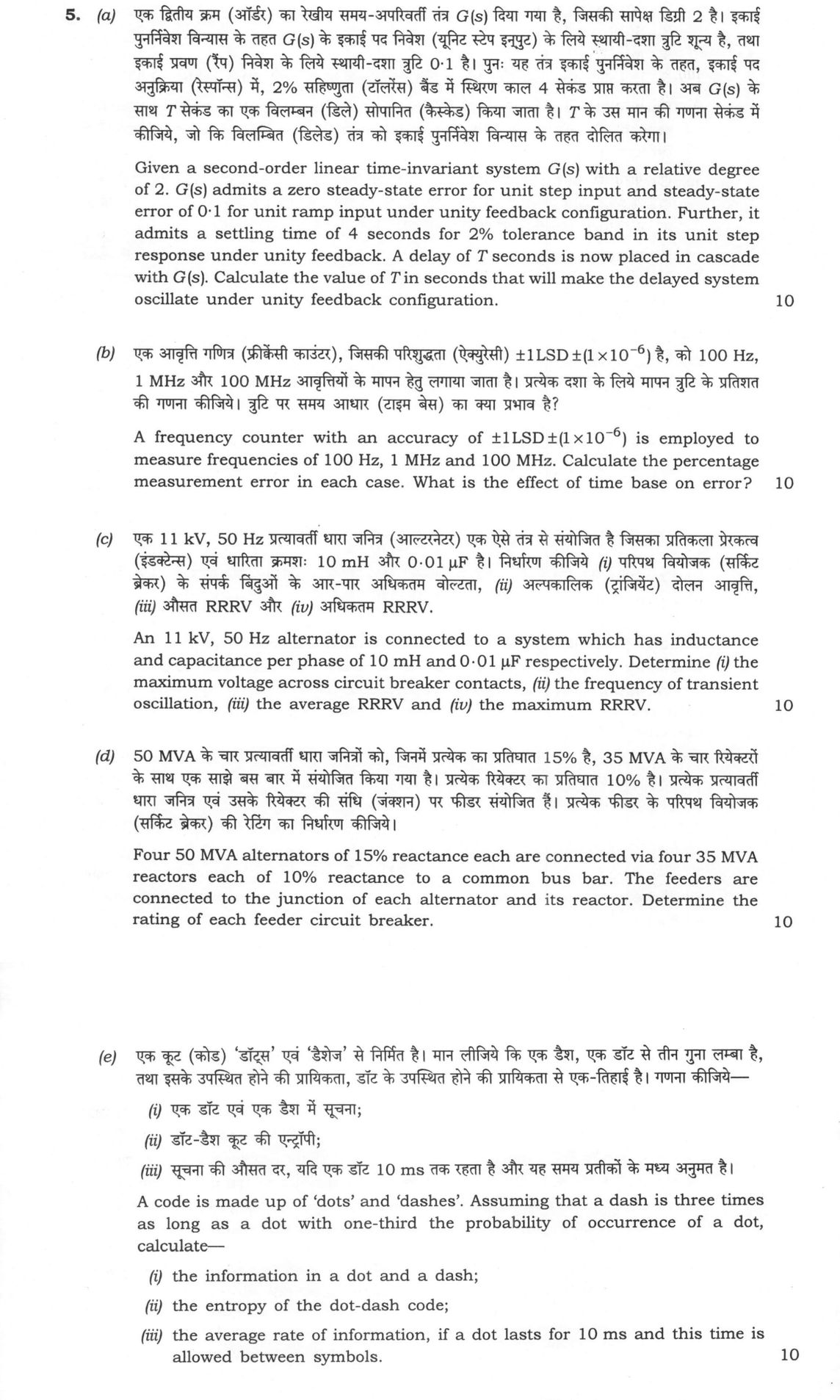
Given a second-order linear time-invariant system G(s) with a relative degree of 2. G(s) admits a zero steady-state error for unit step input and steady-state error of 0·1 for unit ramp input under unity feedback configuration. Further, it admits a settling time of 4 seconds for 2% tolerance band in its unit step response under unity feedback. A delay of T seconds is now placed in cascade with G(s). Calculate the value of T in seconds that will make the delayed system oscillate under unity feedback configuration. 10 marks
A frequency counter with an accuracy of ±1LSD ±(1×10⁻⁶) is employed to measure frequencies of 100 Hz, 1 MHz and 100 MHz. Calculate the percentage measurement error in each case. What is the effect of time base on error? 10 marks
An 11 kV, 50 Hz alternator is connected to a system which has inductance and capacitance per phase of 10 mH and 0·01 µF respectively. Determine (i) the maximum voltage across circuit breaker contacts, (ii) the frequency of transient oscillation, (iii) the average RRRV and (iv) the maximum RRRV. 10 marks
Four 50 MVA alternators of 15% reactance each are connected via four 35 MVA reactors each of 10% reactance to a common bus bar. The feeders are connected to the junction of each alternator and its reactor. Determine the rating of each feeder circuit breaker. 10 marks
A code is made up of 'dots' and 'dashes'. Assuming that a dash is three times as long as a dot with one-third the probability of occurrence of a dot, calculate— (i) the information in a dot and a dash; (ii) the entropy of the dot-dash code; (iii) the average rate of information, if a dot lasts for 10 ms and this time is allowed between symbols. 10 marks
हिंदी में प्रश्न पढ़ें
एक द्वितीय क्रम (ऑर्डर) का रैखीय समय-अपरिवर्ती तंत्र G(s) दिया गया है, जिसकी सापेक्ष डिग्री 2 है। इकाई पुनर्निवेश विन्यास के तहत G(s) के इकाई पद निवेश (यूनिट स्टेप इनपुट) के लिये स्थायी-दशा त्रुटि शून्य है, तथा इकाई प्रवण (रैप) निवेश के लिये स्थायी-दशा त्रुटि 0·1 है। पुनः यह तंत्र इकाई पुनर्निवेश के तहत, इकाई पद अनुक्रिया (रेस्पांस) में, 2% सहिष्णुता (टॉलरेंस) बैंड में स्थिरण काल 4 सेकंड प्राप्त करता है। अब G(s) के साथ T सेकंड का एक विलम्बन (डिले) सोपानित (कैस्केड) किया जाता है। T के उस मान की गणना सेकंड में कीजिये, जो कि विलम्बित (डिलेड) तंत्र को इकाई पुनर्निवेश विन्यास के तहत दोलित करेगा। 10 अंक
एक आवृत्ति गणित्र (फ्रीक्वेंसी काउंटर), जिसकी परिशुद्धता (एक्युरेसी) ±1LSD ±(1×10⁻⁶) है, को 100 Hz, 1 MHz और 100 MHz आवृत्तियों के मापन हेतु लगाया जाता है। प्रत्येक दशा के लिये मापन त्रुटि के प्रतिशत की गणना कीजिये। त्रुटि पर समय आधार (टाइम बेस) का क्या प्रभाव है? 10 अंक
एक 11 kV, 50 Hz प्रत्यावर्ती धारा जनित्र (आल्टरनेटर) एक ऐसे तंत्र से संयोजित है जिसका प्रतिफल प्रेरकत्व (इंडक्टेंस) एवं धारिता क्रमशः: 10 mH और 0·01 µF है। निर्धारण कीजिये (i) परिपथ विचोजक (सर्किट ब्रेकर) के संपर्क बिंदुओं के आर-पार अधिकतम वोल्टता, (ii) अल्पकालिक (ट्रांजियेंट) दोलन आवृत्ति, (iii) औसत RRRV और (iv) अधिकतम RRRV। 10 अंक
50 MVA के चार प्रत्यावर्ती धारा जनित्रों को, जिनमें प्रत्येक का प्रतिघात 15% है, 35 MVA के चार रिएक्टरों के साथ एक साझे बस बार में संयोजित किया गया है। प्रत्येक रिएक्टर का प्रतिघात 10% है। प्रत्येक प्रत्यावर्ती धारा जनित्र एवं उसके रिएक्टर की संधि (जंक्शन) पर फीडर संयोजित हैं। प्रत्येक फीडर के परिपथ विचोजक (सर्किट ब्रेकर) की रेटिंग का निर्धारण कीजिये। 10 अंक
एक कूट (कोड) 'डॉट्स' एवं 'डैशेज' से निर्मित है। मान लीजिये कि एक डैश, एक डॉट से तीन गुना लम्बा है, तथा इसके उपस्थित होने की प्रायिकता, डॉट के उपस्थित होने की प्रायिकता से एक-तिहाई है। गणना कीजिये— (i) एक डॉट एवं एक डैश में सूचना; (ii) डॉट-डैश कूट की एन्ट्रॉपी; (iii) सूचना की औसत दर, यदि एक डॉट 10 ms तक रहता है और यह समय प्रतीकों के मध्य अनुमत है। 10 अंक
Model answer
Written by UPSC Answer Check against this question's marking rubric, to the expected length. UPSC does not publish answers for Mains — this is one way to score well, not an official key.
(a) For a unity-feedback system to have zero steady-state error to a step, the open-loop transfer function must be type 1. Since G(s) is second order and has relative degree 2, write G(s)=K/[s(s+a)], a>0. The closed-loop transfer function is T(s)=G/(1+G)=K/(s²+a s+K). The characteristic equation is s²+a s+K=0, so ωₙ=√K and ζ=a/(2√K). Hence ζωₙ=a/2. For an underdamped second-order step response, the 2% settling time is tₛ≈4/(ζωₙ). Given tₛ=4 s, 4=4/(a/2)=8/a, so a=2 s⁻¹. The unit-ramp steady-state error is eₛₛ=1/Kv, where Kv=lim s→0 sG(s)=K/a. Given eₛₛ=0.1, K/a=10, so K=10a=20 s⁻². Therefore G(s)=20/[s(s+2)].
With a delay, the loop transfer function is L(s)=exp(-sT)G(s). Sustained oscillation requires L(jω)=-1. The magnitude condition is |G(jω)|=1. Now |G(jω)|=20/[ω√(ω²+4)], so 20/[ω√(ω²+4)]=1. Let x=ω². Then x(x+4)=400, i.e. x²+4x-400=0. The positive root is x=-2+2√101, so ω=√(2√101-2) rad/s≈4.2544 rad/s. The phase of G(jω) is ∠G(jω)=-π/2-arctan(ω/2). The phase condition is ∠G(jω)-ωT=-π (mod 2π). The smallest positive delay is obtained from ωT=π/2-arctan(ω/2)=arctan(2/ω). Thus T=arctan(2/√(2√101-2))/√(2√101-2) s. Numerically, arctan(2/ω)=arctan(0.4701)≈0.4394 rad, so T=0.4394/4.2544≈0.1033 s. At this delay, the loop transfer has magnitude 1 and phase -π, so the closed-loop characteristic has a pair of roots on the imaginary axis. This is the first positive delay for which oscillation occurs. T≈0.1033 s.
(b) A frequency counter measures N cycles in a gate time τ, so f=N/τ. A ±1 LSD error is a ±1 count error, giving ±1/τ Hz. For the usual 1 s gate, this is ±1 Hz. The time-base accuracy ±1×10⁻⁶ is a fractional error, so it contributes ±f×10⁻⁶ Hz. Taking worst-case addition, the absolute error is ±(1+f×10⁻⁶) Hz and the percentage error is (1/f+10⁻⁶)×100%.
- f=100 Hz: absolute error=±(1+0.0001) Hz=±1.0001 Hz; percentage error=±1.0001%.
- f=1 MHz=10⁶ Hz: absolute error=±(1+1) Hz=±2 Hz; percentage error=±0.0002%.
- f=100 MHz=10⁸ Hz: absolute error=±(1+100) Hz=±101 Hz; percentage error=±0.000101%.
If the gate time is τ s, replace 1 Hz by 1/τ Hz in the count term. These are worst-case percentage errors, not rms statistical errors. The time-base error is proportional to the measured frequency, so its absolute value increases with frequency while its percentage remains ±0.0001%. The count error is fixed for a fixed gate, so its percentage decreases as frequency increases. A better time base reduces the fractional part; a longer gate reduces the count-error part.
(c) The 11 kV alternator rating is line-to-line. The phase rms voltage is 11000/√3 V. The peak phase voltage is Vₘ=√2×11000/√3=11000√(2/3) V≈8981.5 V.
(i) For the ideal undamped LC recovery transient, the maximum voltage across the circuit-breaker contacts is taken as 2Vₘ. Thus Vmax=2×11000√(2/3)=22000√(2/3) V≈17.96 kV.
(ii) L=10 mH=0.01 H and C=0.01 µF=1×10⁻⁸ F. The transient angular frequency is ωₙ=1/√(LC)=1/√(0.01×1×10⁻⁸)=1/√(1×10⁻¹⁰)=1×10⁵ rad/s. The frequency is fₙ=ωₙ/(2π)=10⁵/(2π) Hz≈15.915 kHz. The 50 Hz fundamental does not set this transient frequency; the LC network does.
(iii) For the standard undamped recovery voltage v(t)=Vₘ(1-cos ωₙt), the maximum is 2Vₘ at t=π/ωₙ. The average RRRV is the rise 2Vₘ divided by this time, (2Vₘ)/(π/ωₙ)=(2/π)Vₘωₙ. Substituting values, average RRRV=(2/π)×11000√(2/3)×10⁵ V/s≈5.717×10⁸ V/s=0.5717 kV/µs.
(iv) The maximum RRRV is the maximum slope of v(t)=Vₘ(1-cos ωₙt), i.e. Vₘωₙ sin ωₙt, so its maximum is Vₘωₙ. Thus maximum RRRV=11000√(2/3)×10⁵ V/s≈8.981×10⁸ V/s=0.898 kV/µs. These RRRV values are undamped estimates; circuit resistance would lower them.
(d) Use 50 MVA as the common base. The alternator reactance is Xa=0.15 pu. The reactor is rated 35 MVA, 10%, so on the 50 MVA base its reactance is Xr=0.10×50/35=1/7 pu≈0.142857 pu. Consider a fault at the feeder connected to the junction of one alternator and its reactor. The local alternator contributes through Xa. Each of the three remote alternators contributes through its own Xa+Xr to the common bus, and then through the local reactor Xr to the fault. One remote branch is Xa+Xr=3/20+1/7=41/140 pu. Three such branches in parallel give 41/420 pu. Adding the local reactor gives 41/420+1/7=101/420 pu. With all alternator emfs shorted for the Thevenin impedance, the Thevenin reactance at the fault is the parallel combination of the local alternator and this remote path: Xth=(3/20)∥(101/420). Since 3/20=63/420, Xth=(63×101)/(420×164)=303/3280 pu≈0.09238 pu. The symmetrical fault MVA is Sfault=50/Xth=50×3280/303=164000/303 MVA≈541.25 MVA. Each feeder circuit breaker rating≈541.3 MVA at the bus voltage. If a standard breaker rating is to be selected, choose the next standard value, for example 600 MVA. If the bus voltage is V kV, the corresponding current rating is 541.25/(√3 V) kA.
(e) Let Pdot be the probability of a dot. The probability of a dash is one-third of that, so Pdash=Pdot/3. Since Pdot+Pdash=1, Pdot+Pdot/3=1, giving Pdot=3/4 and Pdash=1/4.
(i) The information in a dot is Idot=-log₂(3/4)=log₂(4/3)≈0.4150 bit. The information in a dash is Idash=-log₂(1/4)=2 bit.
(ii) The entropy is H=(3/4)log₂(4/3)+(1/4)×2. Since log₂(4/3)=2-log₂3, H=(3/4)(2-log₂3)+1/2=2-(3/4)log₂3≈0.8113 bit/symbol.
(iii) A dot lasts 10 ms and a dash lasts 3×10=30 ms. The same 10 ms is allowed between symbols, so a dot occupies 10+10=20 ms and a dash occupies 30+10=40 ms. The average time per symbol is (3/4)×20+(1/4)×40=25 ms=0.025 s. The average rate of information is H/0.025=40[2-(3/4)log₂3]=80-30log₂3≈32.45 bit/s.
What "Calculate" is asking you to do
Apply the standard formula or schedule to data the question has already supplied — a table of readings, cost records, a balance sheet — and produce the number. The method is rarely in doubt; the marks sit in the named intermediate quantities, each of which has to appear as a labelled line.
Structure that answers it
Data as given → formula or standard treatment, named → substitution → each intermediate, labelled → result with units
Where marks are lost
Omitting an intermediate the marking scheme pays for separately, or rounding at an intermediate line so the final figure drifts. In commerce and accountancy, any figure in a statement that no numbered working note supports is treated as unearned.
How this answer will be evaluated
Approach
(a) calculate: given > formula > substitution > result with units > interpretation | (b) calculate: given > formula > substitution > result with units > interpretation | (c) calculate: given > formula > substitution > result with units > interpretation | (d) calculate: given > formula > substitution > result with units > interpretation | (e) calculate: given > formula > substitution > result with units > interpretation Full marks: All parts solved with correct formulas, clear steps, and accurate final values.
Key points expected
- Determine G(s) from steady-state error and settling time
- Formulate closed-loop characteristic equation with delay e^-Ts
- Apply Routh-Hurwitz criterion to auxiliary equation
- Solve for T using the marginal stability condition
- Calculate absolute error for each frequency
- Compute percentage error relative to measured value
- Explain the effect of time base on error
- Calculate natural frequency of transient oscillation
Evaluation rubric
Each sub-part is marked on its own, against the marks and word limit printed on the paper.
- (a) Value of delay T that causes oscillation in the unity feedback system. 10 marks
calculate— given → formula → substitution → result with units → interpretation
Must cover
- Determine G(s) from steady-state error and settling time
- Formulate closed-loop characteristic equation with delay e^-Ts
- Apply Routh-Hurwitz criterion to auxiliary equation
- Solve for T using the marginal stability condition
Loses marks
- Ignoring the delay term in characteristic equation
- Incorrect steady-state error constants
Earns more
- Explicit calculation of damping ratio and natural frequency
- Correct identification of imaginary axis roots
Extra mark
- Sketch of root locus showing delay effect
- (b) Percentage measurement error for 100 Hz, 1 MHz, and 100 MHz. 10 marks
calculate— given → formula → substitution → result with units → interpretation
Must cover
- Calculate absolute error for each frequency
- Compute percentage error relative to measured value
- Explain the effect of time base on error
Loses marks
- Confusing absolute error with percentage error
- Ignoring the ±1LSD component
Earns more
- Comparison of error magnitude across frequencies
- Discussion of quantization error vs time base error
Extra mark
- Table summarizing errors for all three frequencies
- (c) Maximum voltage, oscillation frequency, average RRRV, and maximum RRRV. 10 marks
calculate— given → formula → substitution → result with units → interpretation
Must cover
- Calculate natural frequency of transient oscillation
- Determine maximum voltage across breaker contacts
- Calculate average RRRV using standard formula
- Calculate maximum RRRV using standard formula
Loses marks
- Using line values instead of phase values
- Incorrect formula for RRRV
Earns more
- Correct use of per-phase values
- Clear distinction between average and maximum RRRV
Extra mark
- Sketch of transient voltage waveform
- (d) Rating of each feeder circuit breaker. 10 marks
calculate— given → formula → substitution → result with units → interpretation
Must cover
- Calculate total fault current from all alternators
- Determine current contribution from each alternator
- Calculate breaker rating based on fault current
Loses marks
- Ignoring the reactor impedance
- Incorrect calculation of total fault current
Earns more
- Use of per-unit system for calculations
- Clear identification of fault location
Extra mark
- Single-line diagram of the system
- (e) Information in dot/dash, entropy, and average rate of information. 10 marks
calculate— given → formula → substitution → result with units → interpretation
Must cover
- Calculate information content of dot and dash
- Compute entropy of the dot-dash code
- Determine average rate of information
Loses marks
- Confusing information with entropy
- Incorrect calculation of average rate
Earns more
- Correct use of probability values
- Clear distinction between information and entropy
Extra mark
- Table showing information content for each symbol
Practice this exact question
Write your answer and it is marked point by point against the model answer above — what you covered, what you missed, what you got wrong.
Evaluate my answer →More from Electrical Engineering 2025 Paper II
- Q2 (a) An LTI system with the following state-space representation is given : ẋ = [0 1] x +…
- Q3 (a) (i) Sketch the approximate root locus plot for a time-delay system approximated by th…
- Q4 (a) (i) Consider a second-order type-1 system with no zeros. The system under unity feedb…
- Q5 (a) Given a second-order linear time-invariant system G(s) with a relative degree of 2. G…
- Q6 (a) Determine the sending-end voltage, current, power factor of a single-phase, 50 Hz, 76…
- Q7 (a) Two generators are connected in parallel to the low-voltage side of a 3-phase, Δ-Y tr…
- Q8 (a) The figure below shows the single-line diagram of a generator connected through paral…