Paper II — Q6
(a) Determine the sending-end voltage, current, power factor of a single-phase, 50 Hz, 76·2 kV transmission line delivering a…
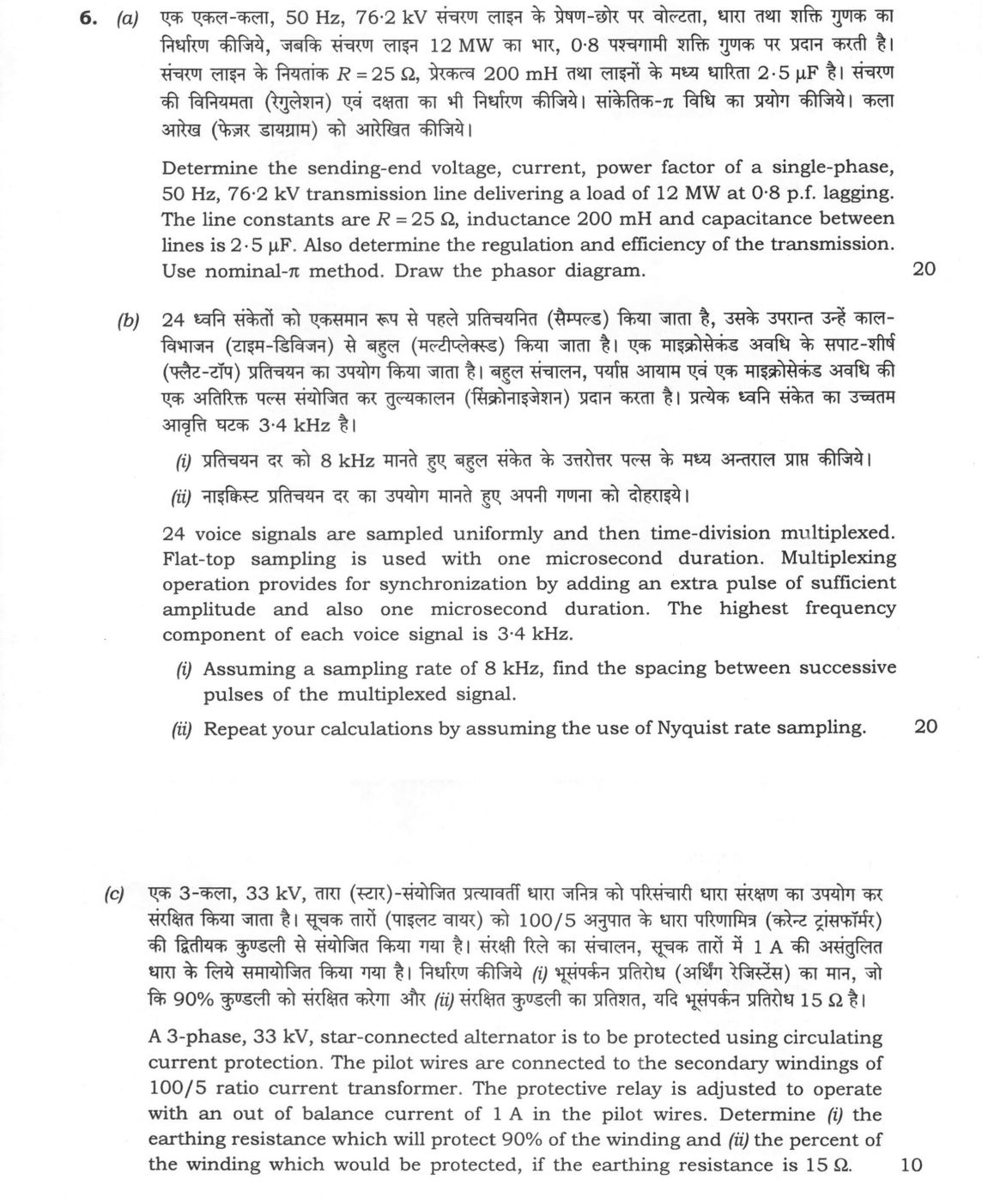
Determine the sending-end voltage, current, power factor of a single-phase, 50 Hz, 76·2 kV transmission line delivering a load of 12 MW at 0·8 p.f. lagging. The line constants are R = 25 Ω, inductance 200 mH and capacitance between lines is 2·5 μF. Also determine the regulation and efficiency of the transmission. Use nominal-π method. Draw the phasor diagram. 20 marks
24 voice signals are sampled uniformly and then time-division multiplexed. Flat-top sampling is used with one microsecond duration. Multiplexing operation provides for synchronization by adding an extra pulse of sufficient amplitude and also one microsecond duration. The highest frequency component of each voice signal is 3·4 kHz. (i) Assuming a sampling rate of 8 kHz, find the spacing between successive pulses of the multiplexed signal. (ii) Repeat your calculations by assuming the use of Nyquist rate sampling. 20 marks
A 3-phase, 33 kV, star-connected alternator is to be protected using circulating current protection. The pilot wires are connected to the secondary windings of 100/5 ratio current transformer. The protective relay is adjusted to operate with an out of balance current of 1 A in the pilot wires. Determine (i) the earthing resistance which will protect 90% of the winding and (ii) the percent of the winding which would be protected, if the earthing resistance is 15 Ω. 10 marks
हिंदी में प्रश्न पढ़ें
एक एकल-कला, 50 Hz, 76·2 kV संचरण लाइन के प्रेषण-छोर पर वोल्टता, धारा तथा शक्ति गुणक का निर्धारण कीजिये, जबकि संचरण लाइन 12 MW का भार, 0·8 पश्चगामी शक्ति गुणक पर प्रदान करती है। संचरण लाइन के नियतांक R = 25 Ω, प्रेरकत्व 200 mH तथा लाइनों के मध्य धारिता 2·5 μF है। संचरण की विनियमता (रियुलेशन) एवं दक्षता का भी निर्धारण कीजिये। सांकेतिक-π विधि का प्रयोग कीजिये। कला आरेख (फेजर डायग्राम) को आरेखित कीजिये। 20 अंक
24 ध्वनि संकेतों को एकसमान रूप से पहले प्रतिचयनित (सैम्पल्ड) किया जाता है, उसके उपरान्त उन्हें काल-विभाजन (टाइम-डिविजन) से बहुल (मल्टीप्लेक्स्ड) किया जाता है। एक माइक्रोसेकंड अवधि के समतल-शीर्ष (फ्लैट-टॉप) प्रतिचयन का उपयोग किया जाता है। बहुल संचालन, पर्याप्त आयाम एवं एक माइक्रोसेकंड अवधि की एक अतिरिक्त पल्स संयोजित कर तुल्यकालन (सिंक्रोनाइजेशन) प्रदान करता है। प्रत्येक ध्वनि संकेत का उच्चतम आवृत्ति घटक 3·4 kHz है। (i) प्रतिचयन दर को 8 kHz मानते हुए बहुल संकेत के उत्तरोत्तर पल्स के मध्य अन्तराल प्राप्त कीजिये। (ii) नाइक्विस्ट प्रतिचयन दर का उपयोग मानते हुए अपनी गणना को दोहराइये। 20 अंक
एक 3-कला, 33 kV, तारा (स्टार)-संयोजित प्रत्यावर्ती धारा जनित्र को परिसंचारी धारा संरक्षण का उपयोग कर संरक्षित किया जाता है। सूचक तारों (पाइलट वायर) को 100/5 अनुपात के धारा परिणामित्र (करेंट ट्रांसफॉर्मर) की द्वितीयक कुंडली से संयोजित किया गया है। संरक्षी रिले का संचालन, सूचक तारों में 1 A की असंतुलित धारा के लिये समायोजित किया गया है। निर्धारण कीजिये (i) भूसंपर्कन प्रतिरोध (अर्थिंग रेजिस्टेंस) का मान, जो कि 90% कुंडली को संरक्षित करेगा और (ii) संरक्षित कुंडली का प्रतिशत, यदि भूसंपर्कन प्रतिरोध 15 Ω है। 10 अंक
Model answer
Written by UPSC Answer Check against this question's marking rubric, to the expected length. UPSC does not publish answers for Mains — this is one way to score well, not an official key.
(a) Take receiving-end voltage as reference: V_R = 76.2 kV ∠0° = 76200 V. Load: P = 12 MW, p.f. = 0.8 lagging, so φ_R = cos⁻¹ 0.8 = 36.87°. I_R = P/(V_R cos φ_R) = 12×10⁶/(76200×0.8) = 196.85 A. I_R = 196.85∠−36.87° = 157.48 − j118.11 A.
Line constants: R = 25 Ω, X_L = 2π×50×0.2 = 62.8319 Ω. Z = 25 + j62.8319 Ω. C = 2.5 μF, Y = j2π×50×2.5×10⁻⁶ = j0.000785398 S, so Y/2 = j0.000392699 S.
By nominal-π method, receiving-end capacitor current: I_C_R = V_R(Y/2) = j29.9237 A. Series line current: I_line = I_R + I_C_R = 157.480 − j88.187 A. I_line Z = 9477.93 + j7690.12 V. V_S = V_R + I_line Z = 85677.93 + j7690.12 V. |V_S| = 86022.36 V ≈ 86.022 kV.
Sending-end capacitor current: I_C_S = V_S(Y/2) = −3.0199 + j33.6456 A. I_S = I_line + I_C_S = 154.460 − j54.541 A. |I_S| = 163.807 A.
Angle of V_S = 5.13°, angle of I_S = −19.45°. Sending-end power-factor angle = 5.13° − (−19.45°) = 24.58°. Sending-end p.f. = cos 24.58° = 0.909 lagging.
For regulation, the no-load receiving voltage with the same sending voltage is V_R(no load) = |V_S|/|A|, where A = 1 + ZY/2. ZY/2 = −0.024674 + j0.0098175, so |A| = 0.975375. V_R(no load) = 86022.36/0.975375 = 88194.1 V. Regulation = (88194.1 − 76200)/76200 × 100 = 15.74%.
Copper loss = |I_line|²R = (180.491)²×25 = 814423 W = 0.8144 MW. Efficiency = 12/(12 + 0.8144) × 100 = 93.65%.
Phasor diagram (described): Take V_R along reference. I_R lags V_R by 36.87°. I_C_R leads V_R by 90°. I_line = I_R + I_C_R. V_S = V_R + I_lineZ, leading V_R by 5.13°. I_C_S leads V_S by 90°, and I_S = I_line + I_C_S lags V_S by 24.58°.
(b) Number of pulses per frame including synchronizing pulse = 24 + 1 = 25. Pulse duration τ = 1 μs.
(i) Sampling rate = 8 kHz. T_s = 1/8000 = 125 μs. Slot width = T_s/25 = 125/25 = 5 μs. Clear spacing between successive pulses = slot width − τ = 5 − 1 = 4 μs. Leading-edge-to-leading-edge spacing = 5 μs.
(ii) Nyquist rate = 2×3.4 kHz = 6.8 kHz. T_s = 1/6800 = 147.0588 μs. Slot width = 147.0588/25 = 5.88235 μs. Clear spacing = 5.88235 − 1 = 4.88235 μs. Leading-edge-to-leading-edge spacing = 5.88235 μs.
(c) CT ratio = 100/5 = 20. Relay operating current = 1 A in pilot wires. Primary out-of-balance current I_th = 1×20 = 20 A.
Phase voltage V_ph = 33000/√3 = 19052.56 V. For a fault at fraction α from the neutral end, I_f = αV_ph/R_e, neglecting winding impedance and fault resistance.
(i) To protect 90% of winding, the 10% nearest neutral may remain unprotected, so α = 0.10. R_e = αV_ph/I_th = 0.10×19052.56/20. R_e = 95.26 Ω (or less, to protect at least 90%).
(ii) If R_e = 15 Ω, α = I_thR_e/V_ph = 20×15/19052.56 = 0.01575. Unprotected winding near neutral = 1.57%. Protected winding = 100 − 1.57 = 98.43%.
What "Solve" is asking you to do
Choose the method, then carry it through to a final answer. Identifying what kind of problem this is and why that method applies is the first thing marked; a correct figure arrived at invisibly earns almost nothing.
Structure that answers it
Given data and what is required → method chosen, with the reason it applies → set-up (equation, circuit, free body, trial balance) → working, step by step → answer with units and any condition of validity
Where marks are lost
Doing the middle steps mentally and writing only the result. In mathematics papers, a further loss comes from giving a decimal where the exact value in surds or fractions was wanted, or from skipping the justification a part explicitly asks for.
How this answer will be evaluated
Approach
(a) calculate: given > formula > substitution > result with units > interpretation | (b(i)) calculate: given > formula > substitution > result with units > interpretation | (b(ii)) calculate: given > formula > substitution > result with units > interpretation | (c) calculate: given > formula > substitution > result with units > interpretation Full marks: Complete equivalent circuits, accurate calculations with units, phasor diagrams, and clear interpretation of results.
Key points expected
- Draw nominal-π equivalent circuit with marked polarities
- Calculate series impedance Z and shunt admittance Y
- Compute sending-end voltage, current, and power factor
- Calculate voltage regulation and transmission efficiency
- Calculate total number of pulses in frame
- Determine frame duration from sampling rate
- Compute pulse spacing including sync pulse
- Show calculation of time per pulse slot
Evaluation rubric
Each sub-part is marked on its own, against the marks and word limit printed on the paper.
- (a) Determine sending-end parameters, regulation, and efficiency using nominal-π method. 20 marks
calculate— given → formula → substitution → result with units → interpretation
Must cover
- Draw nominal-π equivalent circuit with marked polarities
- Calculate series impedance Z and shunt admittance Y
- Compute sending-end voltage, current, and power factor
- Calculate voltage regulation and transmission efficiency
Loses marks
- Formula application without equivalent circuit
- Sign errors in phasor calculations
- Missing units in final answers
Earns more
- Draw accurate phasor diagram
- Show step-by-step complex number calculations
- State all assumptions clearly
- Include units in all intermediate steps
Extra mark
- Provide graphical verification of results
- Compare with long line exact solution
- (b(i)) Find spacing between successive pulses at 8 kHz sampling rate.
calculate— given → formula → substitution → result with units → interpretation
Must cover
- Calculate total number of pulses in frame
- Determine frame duration from sampling rate
- Compute pulse spacing including sync pulse
- Show calculation of time per pulse slot
Loses marks
- Forgetting to include synchronization pulse
- Incorrect frame duration calculation
- Missing units in final answer
Earns more
- Draw timing diagram of multiplexed signal
- Show calculation of guard time if applicable
- State assumptions about pulse duration
Extra mark
- Calculate bandwidth of multiplexed signal
- Compare with theoretical minimum spacing
- (b(ii)) Repeat calculations using Nyquist rate sampling.
calculate— given → formula → substitution → result with units → interpretation
Must cover
- Determine Nyquist rate from highest frequency
- Recalculate frame duration at Nyquist rate
- Compute new pulse spacing
- Compare with part (i) result
Loses marks
- Incorrect Nyquist rate calculation
- Failing to recalculate all parameters
- No comparison with part (i)
Earns more
- Show Nyquist rate calculation explicitly
- Provide comparative table of results
- Discuss implications of different sampling rates
Extra mark
- Calculate bandwidth savings with Nyquist rate
- Discuss practical considerations for sampling rate choice
- (c) Determine earthing resistance for 90% protection and protected percentage for 15Ω resistance. 10 marks
calculate— given → formula → substitution → result with units → interpretation
Must cover
- Draw circulating current protection circuit diagram
- Calculate primary current corresponding to 1A pilot current
- Determine earthing resistance for 90% winding protection
- Calculate protected percentage for 15Ω earthing resistance
Loses marks
- Incorrect CT ratio application
- Missing circuit diagram
- Confusing primary and secondary currents
Earns more
- Show CT ratio conversion calculations
- Draw phasor diagram for fault conditions
- State assumptions about fault location
- Include all units in calculations
Extra mark
- Discuss sensitivity of protection scheme
- Calculate minimum fault current for relay operation
Practice this exact question
Write your answer and it is marked point by point against the model answer above — what you covered, what you missed, what you got wrong.
Evaluate my answer →More from Electrical Engineering 2025 Paper II
- Q3 (a) (i) Sketch the approximate root locus plot for a time-delay system approximated by th…
- Q4 (a) (i) Consider a second-order type-1 system with no zeros. The system under unity feedb…
- Q5 (a) Given a second-order linear time-invariant system G(s) with a relative degree of 2. G…
- Q6 (a) Determine the sending-end voltage, current, power factor of a single-phase, 50 Hz, 76…
- Q7 (a) Two generators are connected in parallel to the low-voltage side of a 3-phase, Δ-Y tr…
- Q8 (a) The figure below shows the single-line diagram of a generator connected through paral…