GS Paper II — Q11
The jurisdiction of the Central Bureau of Investigation (CBI) regarding lodging an FIR and conducting probe within a particular…
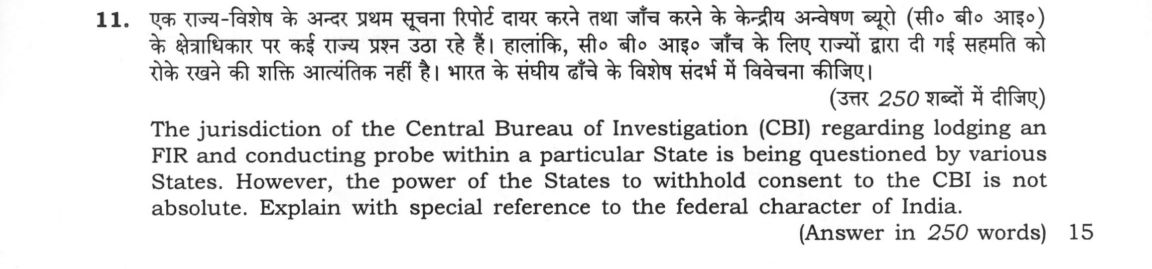
The jurisdiction of the Central Bureau of Investigation (CBI) regarding lodging an FIR and conducting probe within a particular State is being questioned by various States. However, the power of the States to withhold consent to the CBI is not absolute. Explain with special reference to the federal character of India. (Answer in 250 words) 15 marks
हिंदी में प्रश्न पढ़ें
एक राज्य-विशेष के अंदर प्रथम सूचना रिपोर्ट दायर करने तथा जांच करने के केंद्रीय अन्वेषण ब्यूरो (सी० बी० आई०) के क्षेत्राधिकार पर कई राज्य प्रश्न उठा रहे हैं। हालांकि, सी० बी० आई० जांच के लिए राज्यों द्वारा दी गई सहमति को रोके रखने की शक्ति आत्यंतिक नहीं है। भारत के संघीय ढांचे के विशेष संदर्भ में विवेचना कीजिए। (उत्तर 250 शब्दों में दीजिए)
Model answer
Written by UPSC Answer Check against this question's marking rubric, to the 250-word length. UPSC does not publish answers for Mains — this is one way to score well, not an official key.
The CBI derives powers from the Delhi Special Police Establishment Act, 1946. Under Section 6, its jurisdiction in a State extends only to the extent the State Government consents, so state consent is a federal check on a central investigating agency. However, consent is not absolute. The Supreme Court or a High Court can, under Articles 32 and 226, direct the CBI to investigate, and the CBI can register its own FIRs in Union Territories; directions show that a State cannot use consent as a shield against court-directed accountability. Matters involving central government employees or inter-state/international ramifications may make CBI registration appropriate, but they do not create automatic exemption from consent; they strengthen the case for Union involvement or court direction.
The federal tension arises because police is Entry 2 of the State List, while the CBI falls under Entry 8, 'Central Bureau of Intelligence and Investigation', of the Union List. State withdrawals of consent by Maharashtra, Punjab, West Bengal and Jharkhand reflect competitive federalism, but India’s cooperative federalism requires a common anti-corruption mechanism, especially where central laws, public funds and inter-state commerce are affected. Article 355 obliges the Union to protect States against internal disturbance, and independent CBI functioning, affirmed in Vineet Narain (1997) and Nirmal Singh Kahlon (2009), supports corruption-free governance in concurrent and central subjects.
Thus, state consent is a federal safeguard, not a veto. A balanced approach should preserve CBI autonomy with federal sensitivity, through Lokpal-linked safeguards or a constitutional status, ensuring accountability without undermining federalism.
What "Explain" is asking you to do
Make the working of something clear — what sets it off, what follows from what, and what it produces. Explain is the Commission's mechanism word: it dominates the technical papers and the “explain why” stems, where the marks sit in the causal chain and not in the label.
Structure that answers it
State what it is → the initiating condition → the chain of cause, step by step → an instance where it plays out → what the chain produces
Where marks are lost
Describing what something looks like instead of why it works that way. Naming the stages without linking them reads as description too.
How this answer will be evaluated
Approach
Framework: Principle > Institution or Article > Problem with example > Realistic reform. explain: definition/context > points in order > small example > short close Full marks: Precise legal basis (35A CrPC/Art 351) with deep analysis of federalism and consent limits.
Key points expected
- Cite Section 35A CrPC and Article 351 for CBI powers
- Explain the 'consent' requirement for State jurisdiction
- Analyze the 'federal character' of India (Union-State balance)
- Justify why State power to withhold consent is not absolute
Evaluation rubric
Each sub-part is marked on its own, against the marks and word limit printed on the paper.
- The answer Explain the CBI-State jurisdiction conflict and the limits of State consent within India's federal structure. 15 marks · 250 words
explain— definition/context → points in order → small example → short close
Must cover
- Cite Section 35A CrPC and Article 351 for CBI powers
- Explain the 'consent' requirement for State jurisdiction
- Analyze the 'federal character' of India (Union-State balance)
- Justify why State power to withhold consent is not absolute
Loses marks
- Reciting Articles without explaining the federal conflict
- Ignoring the 'not absolute' aspect of State consent
- Activist tone or lack of balanced judgment
Earns more
- Reference to Supreme Court judgments on CBI jurisdiction
- Discussion of the 'unitary bias' in Indian federalism
- Mention of the CBI Act, 1963
- Balanced view on State autonomy vs. Central oversight
Extra mark
- Cite specific landmark SC judgment (e.g., State of UP v. CBI)
- Reference to 2nd ARC or Law Commission recommendations
Practice this exact question
Write your answer and it is marked point by point against the model answer above — what you covered, what you missed, what you got wrong.
Evaluate my answer →More from General Studies 2021 GS Paper II
- Q8 Can the vicious cycle of gender inequality, poverty and malnutrition be broken through mi…
- Q9 "If the last few decades were of Asia's growth story, the next few are expected to be of…
- Q10 "The USA is facing an existential threat in the form of a China, that is much more challe…
- Q11 The jurisdiction of the Central Bureau of Investigation (CBI) regarding lodging an FIR an…
- Q12 Though the Human Rights Commissions have contributed immensely to the protection of human…
- Q13 Analyze the distinguishing features of the notion of Right to Equality in the Constitutio…
- Q14 Explain the constitutional provisions under which Legislative Councils are established. R…