GS Paper II — Q12
Though the Human Rights Commissions have contributed immensely to the protection of human rights in India, yet they have failed…
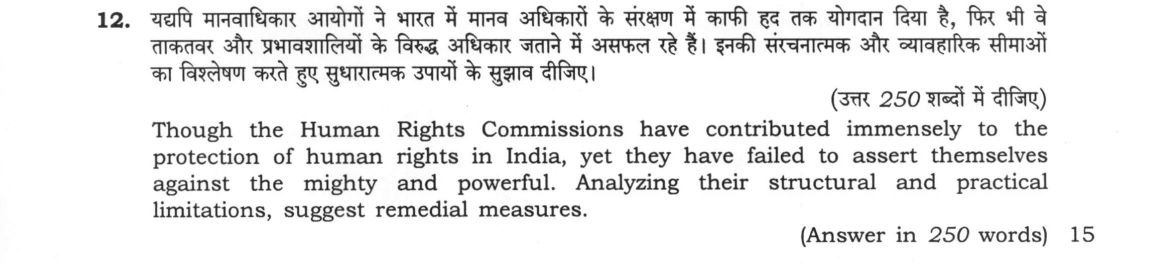
Though the Human Rights Commissions have contributed immensely to the protection of human rights in India, yet they have failed to assert themselves against the mighty and powerful. Analyzing their structural and practical limitations, suggest remedial measures. (Answer in 250 words) 15 marks
हिंदी में प्रश्न पढ़ें
यद्यपि मानवाधिकार आयोगों ने भारत में मानव अधिकारों के संरक्षण में काफी हद तक योगदान दिया है, फिर भी वे ताकतवर और प्रभावशालियों के विरुद्ध अधिकार जताने में असफल रहे हैं। इनकी संरचनात्मक और व्यावहारिक सीमाओं का विश्लेषण करते हुए सुधारात्मक उपायों के सुझाव दीजिए। (उत्तर 250 शब्दों में दीजिए)
Model answer
Written by UPSC Answer Check against this question's marking rubric, to the 250-word length. UPSC does not publish answers for Mains — this is one way to score well, not an official key.
Established under the Protection of Human Rights Act (PHRA), 1993, the National Human Rights Commission (NHRC) and State Human Rights Commissions (SHRCs) have significantly advanced civil liberties. However, their capacity to assert authority against influential state machinery and powerful entities remains constrained by interconnected structural and practical deficits.
Structural Limitations
- Recommendatory Mandate: Under Section 18 of the PHRA, findings are merely advisory. Lacking contempt powers or direct enforcement mechanisms, commissions are often reduced to "toothless tigers."
- Composition and Autonomy: The statutory selection heavily prioritises retired judges, resulting in limited civil society diversity and gender representation. Furthermore, heavy budgetary and staffing dependence on governments curtails functional autonomy.
- Investigative Dependency: Lacking an independent investigation cadre, commissions rely on police officers on deputation, creating an inherent conflict of interest when probing state-sponsored excesses.
Practical Limitations and Failures
- Systemic Non-Compliance: State agencies frequently delay or ignore recommendations, particularly in cases involving custodial deaths, encounter killings, and communal violence where high-ranking officials are implicated.
- Operational Bottlenecks: Mounting pendency of cases, delayed inquiries, and inadequate post-recommendation follow-up mechanisms undermine timely justice for vulnerable victims.
Remedial Measures
- Empowering Enforcement: Recommendations must be made quasi-binding, accompanied by statutory contempt powers and a mandated 30-day time limit for governments to submit Action Taken Reports.
- Independent Cadre: Form an autonomous investigative and forensic wing completely insulated from state police departments.
- Proactive Engagement: Strengthen suo motu inquiry powers and mandate NHRC/SHRC intervention as standing parties in human rights-related Public Interest Litigations (PILs).
While conceived as watchdogs rather than bloodhounds, human rights commissions must be fortified with institutional teeth, robust autonomy, and cooperative federalism to effectively hold power accountable.
What "Analyse" is asking you to do
Break the subject into its working parts and show how they act on each other. The marks are in the interconnections — which factor drives which, and what the resulting structure explains — not in the inventory of factors.
Structure that answers it
Define the whole → separate it into its parts → show which part drives which → what that interaction produces → what the structure implies
Where marks are lost
A flat list of causes with no account of which drives which. An answer of neatly separated headings, each self-contained, scores as description.
How this answer will be evaluated
Approach
Framework: GS2 Governance: Institutions, Mandate, Powers, Challenges, Reforms. suggest: the problem in one line > implementable measures > who acts > conclusion Full marks: Identifies specific structural/practical limitations and suggests concrete, implementable reforms.
Key points expected
- Identify structural limitations (e.g., composition, lack of enforcement power)
- Identify practical limitations (e.g., delays, lack of resources, political pressure)
- Suggest specific remedial measures for structural issues
- Suggest specific remedial measures for practical issues
Evaluation rubric
Each sub-part is marked on its own, against the marks and word limit printed on the paper.
- The answer Analyze structural/practical limitations of Human Rights Commissions and suggest remedial measures. 15 marks · 250 words
suggest— the problem in one line → implementable measures → who acts → conclusion
Must cover
- Identify structural limitations (e.g., composition, lack of enforcement power)
- Identify practical limitations (e.g., delays, lack of resources, political pressure)
- Suggest specific remedial measures for structural issues
- Suggest specific remedial measures for practical issues
Loses marks
- Reciting the Act without analyzing limitations
- Vague suggestions without specific implementation details
- Failing to address the 'mighty and powerful' aspect
Earns more
- Mention specific examples of failure against 'mighty and powerful'
- Reference specific provisions of the Protection of Human Rights Act
- Discuss the role of the National Human Rights Commission (NHRC)
- Mention the role of the State Human Rights Commissions (SHRCs)
Extra mark
- Cite a specific Supreme Court judgment on NHRC powers
- Reference a specific Law Commission report on Human Rights
Practice this exact question
Write your answer and it is marked point by point against the model answer above — what you covered, what you missed, what you got wrong.
Evaluate my answer →More from General Studies 2021 GS Paper II
- Q9 "If the last few decades were of Asia's growth story, the next few are expected to be of…
- Q10 "The USA is facing an existential threat in the form of a China, that is much more challe…
- Q11 The jurisdiction of the Central Bureau of Investigation (CBI) regarding lodging an FIR an…
- Q12 Though the Human Rights Commissions have contributed immensely to the protection of human…
- Q13 Analyze the distinguishing features of the notion of Right to Equality in the Constitutio…
- Q14 Explain the constitutional provisions under which Legislative Councils are established. R…
- Q15 Do Department-related Parliamentary Standing Committees keep the administration on its to…