GS Paper II — Q8
Can the vicious cycle of gender inequality, poverty and malnutrition be broken through microfinancing of women SHGs? Explain with…
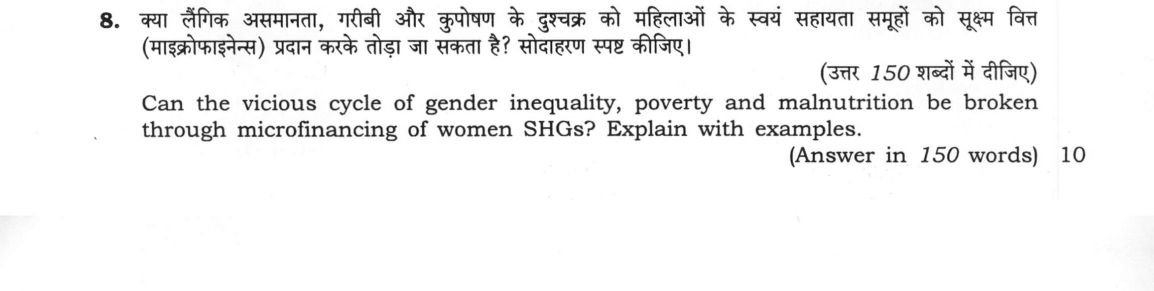
Can the vicious cycle of gender inequality, poverty and malnutrition be broken through microfinancing of women SHGs? Explain with examples. (Answer in 150 words) 10 marks
हिंदी में प्रश्न पढ़ें
क्या लैंगिक असमानता, गरीबी और कुपोषण के दुष्चक्र को महिलाओं के स्वयं सहायता समूहों को सूक्ष्म वित्त (माइक्रोफाइनेंस) प्रदान करके तोड़ा जा सकता है? सोदाहरण स्पष्ट कीजिए। (उत्तर 150 शब्दों में दीजिए)
Model answer
Written by UPSC Answer Check against this question's marking rubric, to the 150-word length. UPSC does not publish answers for Mains — this is one way to score well, not an official key.
Gender inequality restricts women's economic agency, entrenching household poverty and driving maternal and child malnutrition, which cyclically reinforces gender disadvantage. Microfinancing women Self-Help Groups (SHGs) disrupts this nexus through distinct causal pathways:
Economic Empowerment: Microcredit through DAY-NRLM and the SHG-Bank Linkage Programme finances income-generating livelihoods and asset creation, breaking income poverty and reducing financial dependency.
Intra-Household Bargaining Power: Access to and control over credit enhances women’s decision-making authority. Women channel a higher share of earnings toward dietary diversity, child healthcare, and sanitation, directly improving nutritional outcomes.
Social Capital and Collective Action: SHGs foster solidarity to challenge patriarchal norms, curb domestic violence, and secure public entitlements like PDS and ICDS. Kerala’s Kudumbashree exemplifies this by linking microcredit with community kitchens and nutri-gardens to eradicate hunger.
Limitations and Enabling Conditions: Microfinance is often constrained by patriarchal loan diversion, coercive repayment pressures, and consumption debt traps. To sustainably break the vicious cycle, credit access must be complemented by financial literacy, market linkages, and responsive public health systems.
What "Explain" is asking you to do
Make the working of something clear — what sets it off, what follows from what, and what it produces. Explain is the Commission's mechanism word: it dominates the technical papers and the “explain why” stems, where the marks sit in the causal chain and not in the label.
Structure that answers it
State what it is → the initiating condition → the chain of cause, step by step → an instance where it plays out → what the chain produces
Where marks are lost
Describing what something looks like instead of why it works that way. Naming the stages without linking them reads as description too.
How this answer will be evaluated
Approach
Framework: GS2 Social Justice / Economic Development. explain: definition/context > points in order > small example > short close Full marks: Clearly articulates the cycle and provides a logical, example-backed argument for how SHGs break it.
Key points expected
- Define the vicious cycle of gender inequality, poverty, and malnutrition
- Explain the mechanism of SHG microfinancing (credit, savings, collective action)
- Link financial empowerment to specific improvements in nutrition and health
- Provide at least one concrete example of an SHG intervention or outcome
Evaluation rubric
Each sub-part is marked on its own, against the marks and word limit printed on the paper.
- The answer Demonstrate how SHG microfinancing disrupts the gender-poverty-malnutrition cycle. 10 marks · 150 words
explain— definition/context → points in order → small example → short close
Must cover
- Define the vicious cycle of gender inequality, poverty, and malnutrition
- Explain the mechanism of SHG microfinancing (credit, savings, collective action)
- Link financial empowerment to specific improvements in nutrition and health
- Provide at least one concrete example of an SHG intervention or outcome
Loses marks
- Reciting general benefits of microfinance without linking to the specific cycle
- Failing to address the 'malnutrition' component of the question
- Vague generalities without specific examples or mechanisms
Earns more
- Mention specific government schemes (e.g., NRLM, MGNREGA linkage)
- Discuss the role of women's agency in household resource allocation
- Reference the 'trickle-down' effect on children's health and education
- Mention the social capital aspect of SHGs beyond just finance
Extra mark
- Cite specific data on SHG impact on stunting or anemia rates
- Reference a specific state-level success story (e.g., Andhra Pradesh model)
Practice this exact question
Write your answer and it is marked point by point against the model answer above — what you covered, what you missed, what you got wrong.
Evaluate my answer →More from General Studies 2021 GS Paper II
- Q5 "Pressure groups play a vital role in influencing public policy making in India." Explain…
- Q6 "Besides being a moral imperative of a Welfare State, primary health structure is a neces…
- Q7 'Earn while you learn' scheme needs to be strengthened to make vocational education and s…
- Q8 Can the vicious cycle of gender inequality, poverty and malnutrition be broken through mi…
- Q9 "If the last few decades were of Asia's growth story, the next few are expected to be of…
- Q10 "The USA is facing an existential threat in the form of a China, that is much more challe…
- Q11 The jurisdiction of the Central Bureau of Investigation (CBI) regarding lodging an FIR an…