GS Paper II — Q14
Explain the constitutional provisions under which Legislative Councils are established. Review the working and current status of…
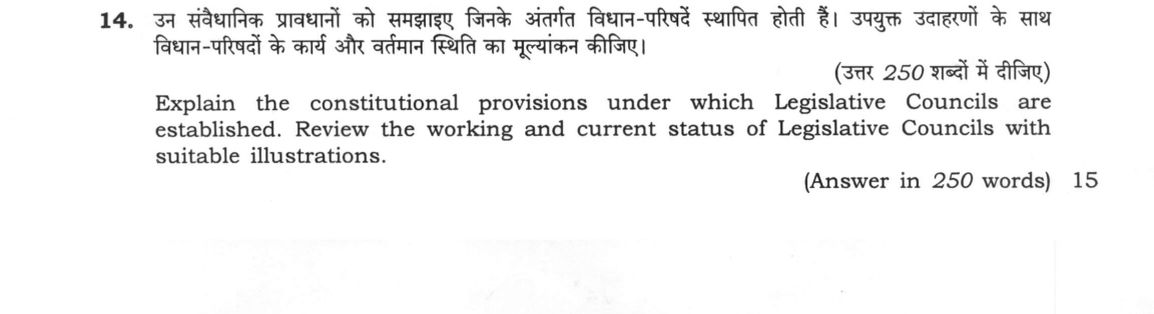
Explain the constitutional provisions under which Legislative Councils are established. Review the working and current status of Legislative Councils with suitable illustrations. (Answer in 250 words) 15 marks
हिंदी में प्रश्न पढ़ें
उन संवैधानिक प्रावधानों को समझाइए जिनके अंतर्गत विधान-परिषदें स्थापित होती हैं। उपयुक्त उदाहरणों के साथ विधान-परिषदों के कार्य और वर्तमान स्थिति का मूल्यांकन कीजिए। (उत्तर 250 शब्दों में दीजिए)
Model answer
Written by UPSC Answer Check against this question's marking rubric, to the 250-word length. UPSC does not publish answers for Mains — this is one way to score well, not an official key.
Legislative Councils embody the bicameral principle, giving deliberative review to state legislation. Under Article 169, Parliament may by law create or abolish a Council for a State, but only on a resolution passed by the State Assembly by a special majority and supported by at least half its total membership. Article 171 fixes composition: total members not less than one-third and not more than one-half of the Assembly, but not less than 40; provided that where the Assembly has not more than 60 members, the Council must have at least 30.
Their working is mixed. They can delay ordinary bills for up to six months, and money bills for 14 days, acting as a check on hasty legislation and allowing scrutiny of complex issues. They also give voice to minorities, educational and professional interests. Yet critics call them elite clubs, with limited public accountability and occasional obstruction.
Currently, five States have Councils: Uttar Pradesh, Bihar, Maharashtra, Karnataka and Telangana. Andhra Pradesh abolished its Council in 1985, revived it in 2007 and abolished it again in 2020. Tamil Nadu and Punjab abolished theirs earlier. Proposals are pending in Rajasthan, West Bengal and Madhya Pradesh, where the Assembly passed a resolution in 2020; Odisha’s proposal was withdrawn in 2019.
The review suggests that Councils are not obsolete but need reform rather than abolition: clearer mandates, transparency and better electoral colleges. In cooperative federalism, they can strengthen deliberation, but only if they are seen as accountable, not merely elite.
What "Review" is asking you to do
Track something across its life and report where it has reached — what it was meant to do, what has happened since, what is still outstanding. Review attaches to institutions and commitments, so the answer is a present-state verdict supported by the record.
Structure that answers it
Scope and period → the original intent → what has happened since → what remains undone → present-state verdict
Where marks are lost
Writing a history when the question wants a present-state verdict, or stopping at what was promised without saying what has actually been delivered.
How this answer will be evaluated
Approach
Framework: GS2 Paper 2: Constitutional Provisions & Institutional Analysis. explain: definition/context > points in order > small example > short close Full marks: Precise Articles, clear composition logic, and a critical review of current status with examples.
Key points expected
- Cite Articles 171-172 for establishment and composition
- Explain the 1/3rd elected and 1/3rd nominated composition
- Review working: role in legislation and review of bills
- Current status: list of states with LCs (e.g., UP, Bihar)
Evaluation rubric
Each sub-part is marked on its own, against the marks and word limit printed on the paper.
- The answer Constitutional basis of LCs, their functional role, and current status with examples. 15 marks · 250 words
explain— definition/context → points in order → small example → short close
Must cover
- Cite Articles 171-172 for establishment and composition
- Explain the 1/3rd elected and 1/3rd nominated composition
- Review working: role in legislation and review of bills
- Current status: list of states with LCs (e.g., UP, Bihar)
Loses marks
- Reciting Articles without explaining the mechanism
- Confusing LC with Rajya Sabha composition
- Failing to provide a specific state example
Earns more
- Mention 12th/16th Amendment Act context
- Discuss the 'Upper House' function in federalism
- Reference the 2nd ARC recommendation on LCs
- Mention the 10-year tenure of members
Extra mark
- Cite a specific Supreme Court judgment on LC powers
- Mention the 1986/1987 abolition in specific states
Practice this exact question
Write your answer and it is marked point by point against the model answer above — what you covered, what you missed, what you got wrong.
Evaluate my answer →More from General Studies 2021 GS Paper II
- Q11 The jurisdiction of the Central Bureau of Investigation (CBI) regarding lodging an FIR an…
- Q12 Though the Human Rights Commissions have contributed immensely to the protection of human…
- Q13 Analyze the distinguishing features of the notion of Right to Equality in the Constitutio…
- Q14 Explain the constitutional provisions under which Legislative Councils are established. R…
- Q15 Do Department-related Parliamentary Standing Committees keep the administration on its to…
- Q16 Has digital illiteracy, particularly in rural areas, coupled with lack of Information and…
- Q17 "Though women in post-Independent India have excelled in various fields, the social attit…