GS Paper II — Q17
"Though women in post-Independent India have excelled in various fields, the social attitude towards women and feminist movement…
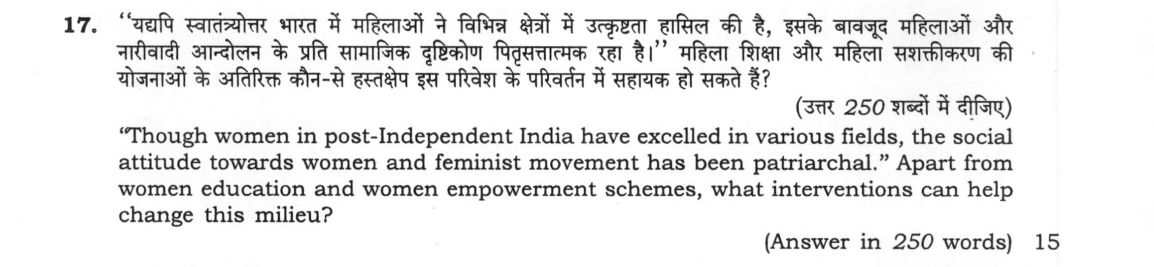
"Though women in post-Independent India have excelled in various fields, the social attitude towards women and feminist movement has been patriarchal." Apart from women education and women empowerment schemes, what interventions can help change this milieu? (Answer in 250 words) 15 marks
हिंदी में प्रश्न पढ़ें
"यद्यपि स्वातंत्र्योत्तर भारत में महिलाओं ने विभिन्न क्षेत्रों में उत्कृष्टता हासिल की है, इसके बावजूद महिलाओं और नारीवादी आंदोलन के प्रति सामाजिक दृष्टिकोण पितृसत्तात्मक रहा है।" महिला शिक्षा और महिला सशक्तिकरण की योजनाओं के अतिरिक्त कौन-से हस्तक्षेप इस परिवेश के परिवर्तन में सहायक हो सकते हैं? (उत्तर 250 शब्दों में दीजिए)
Model answer
Written by UPSC Answer Check against this question's marking rubric, to the 250-word length. UPSC does not publish answers for Mains — this is one way to score well, not an official key.
From space science and corporate leadership to Olympic podiums and political governance, Indian women have scaled unprecedented heights post-Independence. However, deeply entrenched patriarchal mindsets continue to view female autonomy and feminist assertion through a lens of resistance. Altering this cultural milieu requires structural interventions beyond conventional literacy and welfare schemes.
Legal-Institutional Reforms: Ensure the robust enforcement of the Protection of Women from Domestic Violence (PWDV) Act 2005 and the Criminal Law (Amendment) Act 2013 by operationalising dedicated fast-track special courts for swift justice. Institutionalise mandatory, recurring gender-sensitisation training for the judiciary, police forces, and administrative apparatus to eliminate systemic bias during grievance redressal.
Socio-Cultural Interventions: Mobilise grassroots community networks and faith leaders to dismantle regressive customs, drawing from Kerala’s Kudumbashree model of engaging imams and local clergy to speak against domestic abuse. Launch institutionalised male-allyship programmes across schools and workplaces. Enforce progressive media representation through updated Central Board of Film Certification (CBFC) guidelines and Advertising Standards Council of India (ASCI) codes to curb everyday misogyny and victim-blaming.
Economic Measures: Introduce conditional cash transfers indexed to gender-equitable household milestones, formally measure and recognise unpaid care work in national accounting frameworks, and strengthen Section 149 of the Companies Act to ensure substantive, gender-balanced boardrooms rather than token representation.
Technological Solutions: Deploy AI-driven grievance redressal and automated safety networks, scaling models like Uttar Pradesh’s Women Power Line (1090). Leverage blockchain-enabled land and property registration systems to create tamper-proof digital titles, directly preventing customary inheritance denial against daughters and widows.
Transforming India’s patriarchal milieu demands shifting from patronising welfare to systemic, structural accountability, thereby securing substantive gender equality as envisioned under Article 15 of the Constitution.
What "Suggest" is asking you to do
Propose measures that attach to the causes the question has just had you identify. Each should name who acts, on what, and why it would work; a measure with no actor behind it is a wish rather than a suggestion.
Structure that answers it
The problem in one line → measure 1 with the cause it addresses → measure 2 → measure 3 → how it would be implemented and what it requires
Where marks are lost
Prescriptions that would fit any question on any subject — awareness campaigns, capacity building, better coordination. The examiner checks whether each measure is traceable to a cause the answer itself named.
How this answer will be evaluated
Approach
Framework: GS2 Social Justice / Gender. suggest: the problem in one line > implementable measures > who acts > conclusion Full marks: Comprehensive, specific interventions with examples and legal references.
Key points expected
- Interventions targeting social norms and cultural practices
- Role of media, literature, and public discourse
- Involvement of men and boys in gender equality
- Legal and institutional mechanisms for social change
Evaluation rubric
Each sub-part is marked on its own, against the marks and word limit printed on the paper.
- The answer Interventions to change patriarchal social attitudes beyond education and empowerment schemes. 15 marks · 250 words
suggest— the problem in one line → implementable measures → who acts → conclusion
Must cover
- Interventions targeting social norms and cultural practices
- Role of media, literature, and public discourse
- Involvement of men and boys in gender equality
- Legal and institutional mechanisms for social change
Loses marks
- Focusing only on education and empowerment schemes
- Lack of specific, implementable interventions
- Ignoring the role of men and boys in changing attitudes
Earns more
- Specific examples of successful interventions
- Reference to constitutional provisions on gender equality
- Mention of grassroots movements and community engagement
- Discussion of workplace policies and corporate responsibility
Extra mark
- Citing specific Supreme Court judgments on gender equality
- Referencing 2nd ARC or Law Commission recommendations
Practice this exact question
Write your answer and it is marked point by point against the model answer above — what you covered, what you missed, what you got wrong.
Evaluate my answer →More from General Studies 2021 GS Paper II
- Q14 Explain the constitutional provisions under which Legislative Councils are established. R…
- Q15 Do Department-related Parliamentary Standing Committees keep the administration on its to…
- Q16 Has digital illiteracy, particularly in rural areas, coupled with lack of Information and…
- Q17 "Though women in post-Independent India have excelled in various fields, the social attit…
- Q18 Can Civil Society and Non-Governmental Organizations present an alternative model of publ…
- Q19 Critically examine the aims and objectives of SCO. What importance does it hold for India…
- Q20 The newly tri-nation partnership AUKUS is aimed at countering China's ambitions in the In…