GS Paper II — Q11
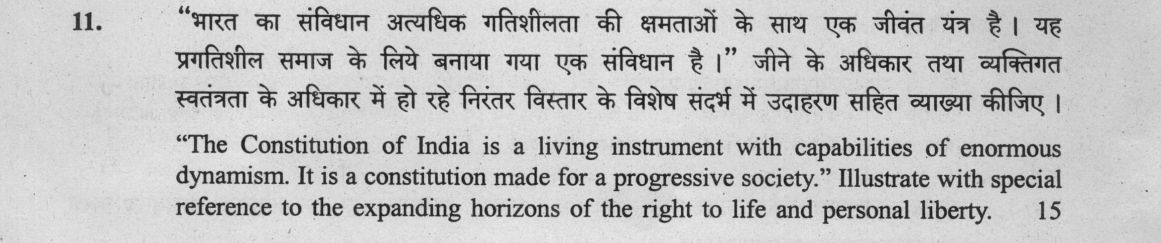
"The Constitution of India is a living instrument with capabilities of enormous dynamism. It is a constitution made for a…
"The Constitution of India is a living instrument with capabilities of enormous dynamism. It is a constitution made for a progressive society." Illustrate with special reference to the expanding horizons of the right to life and personal liberty. (Answer in 250 words) 15 marks
हिंदी में प्रश्न पढ़ें
"भारत का संविधान अत्यधिक गतिशीलता की क्षमताओं के साथ एक जीवंत यंत्र है। यह प्रगतिशील समाज के लिये बनाया गया एक संविधान है।" जीने के अधिकार तथा व्यक्तिगत स्वतंत्रता के अधिकार में हो रहे निरंतर विस्तार के विशेष संदर्भ में उदाहरण सहित व्याख्या कीजिए। (250 शब्दों में उत्तर) 15 marks
Model answer
Written by UPSC Answer Check against this question's marking rubric, to the 250-word length. UPSC does not publish answers for Mains — this is one way to score well, not an official key.
The Constitution of India functions as a living document because its normative framework adapts organically to evolving societal needs through creative judicial interpretation, without depending solely on formal constitutional amendments.
From Animal Existence to Human Dignity This dynamism is most vividly illustrated in the expansion of Article 21. Initially interpreted narrowly in A.K. Gopalan (1950) as mere protection against physical restraint, the Supreme Court radically redefined it in Maneka Gandhi (1978). The Court infused substantive "due process" into "procedure established by law," holding that life does not mean mere animal existence, but living with human dignity.
Expanding Horizons of Article 21 Through transformative constitutionalism, the judiciary derived essential unenumerated rights to reflect the aspirations of a progressive society:
- Livelihood and Shelter: In Olga Tellis (1985), the Court recognized the right to livelihood as inextricably linked to life, while Chameli Singh (1996) recognized the right to shelter.
- Health and Emergency Aid: In Parmanand Katara (1989), the Court mandated that preserving life transcends procedural formalities, ensuring immediate medical assistance to injured persons.
- Clean Environment: In Subhash Kumar (1991), the right to pollution-free water and air was recognized as fundamental to human survival.
- Privacy and Autonomy: In K.S. Puttaswamy (2017), the Court declared informational privacy and personal autonomy fundamental in a digital era.
Limitations and Way Forward While the judiciary has acted as a catalyst for progressive change, significant limitations persist. Chronic judicial pendency, executive non-compliance, and wide implementation gaps often render these expansive rights theoretical for marginalized citizens. To fully realize this living instrument, dynamic judicial interpretation must be matched by robust executive execution and administrative accountability.
What "Illustrate" is asking you to do
Carry the point with concrete cases rather than assert it, so the examples do the work of proving it. In the technical papers illustrate is often literal — a labelled diagram, a map, a graph — and an answer without the figure has not complied with the instruction.
Structure that answers it
The point stated → example 1 with the feature it demonstrates → example 2 → example 3 or the required diagram → what the set of examples establishes
Where marks are lost
Examples named and then abandoned. A case listed without the sentence showing what it demonstrates is marked as recall of information, not as illustration.
How this answer will be evaluated
Approach
Framework: GS2 Constitutional Law & Governance. explain: definition/context > points in order > small example > short close Full marks: Deep analysis of Art 21 evolution with 3+ landmark cases and clear link to dynamism.
Key points expected
- Define 'living instrument' as a dynamic, evolving document.
- Cite Maneka Gandhi v. Union of India (1978) as the pivot.
- List specific expanded rights (e.g., environment, privacy, dignity).
- Conclude with the Constitution's role in a progressive society.
Evaluation rubric
Each sub-part is marked on its own, against the marks and word limit printed on the paper.
- The answer Demonstrate constitutional dynamism via the expansion of Article 21 (Right to Life). 15 marks · 250 words
explain— definition/context → points in order → small example → short close
Must cover
- Define 'living instrument' as a dynamic, evolving document.
- Cite Maneka Gandhi v. Union of India (1978) as the pivot.
- List specific expanded rights (e.g., environment, privacy, dignity).
- Conclude with the Constitution's role in a progressive society.
Loses marks
- Reciting Article 21 text without explaining its evolution.
- Focusing on other Articles (e.g., 19) instead of 21.
- Ending without a forward-looking conclusion on progress.
Earns more
- Mention 'due process' vs 'procedure established by law'.
- Reference K.S. Puttaswamy (Right to Privacy) judgment.
- Link expansion to 'constitutional morality'.
- Mention Article 32 (Writs) as the enforcement mechanism.
Extra mark
- Cite Vishaka Guidelines (1997) for workplace safety.
- Reference 2nd ARC recommendations on fundamental rights.
Practice this exact question
Write your answer and it is marked point by point against the model answer above — what you covered, what you missed, what you got wrong.
Evaluate my answer →More from General Studies 2023 GS Paper II
- Q8 e-governance, as a critical tool of governance, has ushered in effectiveness, transparenc…
- Q9 'Virus of Conflict is affecting the functioning of the SCO' In the light of the above sta…
- Q10 Indian diaspora has scaled new heights in the West. Describe its economic and political b…
- Q11 "The Constitution of India is a living instrument with capabilities of enormous dynamism.…
- Q12 Explain the constitutional perspectives of Gender Justice with the help of relevant Const…
- Q13 Account for the legal and political factors responsible for the reduced frequency of usin…
- Q14 Discuss the contribution of civil society groups for women's effective and meaningful par…