GS Paper II — Q18
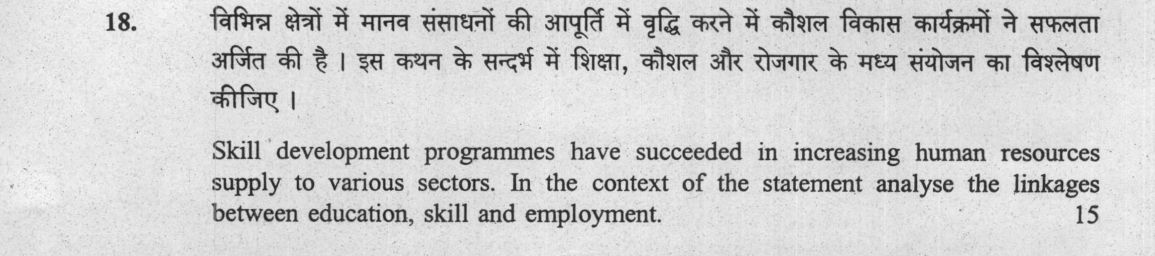
Skill development programmes have succeeded in increasing human resources supply to various sectors. In the context of the…
Skill development programmes have succeeded in increasing human resources supply to various sectors. In the context of the statement analyse the linkages between education, skill and employment. (Answer in 250 words) 15 marks
हिंदी में प्रश्न पढ़ें
विभिन्न क्षेत्रों में मानव संसाधनों की आपूर्ति में वृद्धि करने में कौशल विकास कार्यक्रमों ने सफलता अर्जित की है। इस कथन के संदर्भ में शिक्षा, कौशल और रोजगार के मध्य संयोजन का विश्लेषण कीजिए। (250 शब्दों में उत्तर) 15 marks
Model answer
Written by UPSC Answer Check against this question's marking rubric, to the 250-word length. UPSC does not publish answers for Mains — this is one way to score well, not an official key.
Initiatives like the Pradhan Mantri Kaushal Vikas Yojana (PMKVY), National Apprenticeship Promotion Scheme (NAPS), and National Skill Development Corporation (NSDC) programmes have substantially expanded the certified labour supply. However, this quantitative expansion has not organically translated into quality employment, revealing critical gaps across the education-skill-employment triad.
Education-Skill Linkage Formal education in India has traditionally suffered from an overemphasis on rote learning, detaching academic curricula from dynamic market needs. While the National Skills Qualifications Framework (NSQF) was instituted to bridge this divide by integrating vocational education with mainstream schooling, implementation deficits and the entrenched social hierarchy favouring pure academic degrees continue to impede vocational integration.
Skill-Employment Linkage A pronounced disconnect persists between vocational training certifications and sectoral labour absorption. With the informal sector absorbing over 85% of the workforce, certified trainees often encounter low wage premiums and job insecurity. Training modules frequently do not align with evolving industry demands, resulting in low placement rates and limited career progression.
Education-Employment Linkage India faces a persistent graduate unemployment paradox, where higher educational attainment often correlates with higher unemployment rates. Credential inflation, combined with poor foundational and analytical training, renders graduates unemployable without extensive retraining, underscoring the absence of institutional lifelong learning frameworks.
Constraints in Supply-Demand Transition The expansion of skilling supply fails to generate proportional employment gains due to macroeconomic demand deficits, regional industrial imbalances, and aspirational mismatches where youth avoid low-tier manual jobs.
Way Forward Sustained employment generation requires an integrated ecosystem: operationalising vocational integration under the National Education Policy (NEP) 2020, embedding degree-linked apprenticeship programmes, deepening industry-academia curricula design, and empowering District Skill Committees for decentralised, market-led skill planning.
What "Analyse" is asking you to do
Break the subject into its working parts and show how they act on each other. The marks are in the interconnections — which factor drives which, and what the resulting structure explains — not in the inventory of factors.
Structure that answers it
Define the whole → separate it into its parts → show which part drives which → what that interaction produces → what the structure implies
Where marks are lost
A flat list of causes with no account of which drives which. An answer of neatly separated headings, each self-contained, scores as description.
How this answer will be evaluated
Approach
Framework: GS2 Social Justice / Employment. analyse: intro > causes > effects > stakeholders/linkages > way forward Full marks: Clear distinction between education/skills, strong linkage analysis, specific policy examples, and a forward-looking conclusion.
Key points expected
- Define the distinct roles of education vs. skill development
- Explain how skill development bridges the education-employment gap
- Identify the 'skill mismatch' or structural unemployment problem
- Provide a way forward for policy alignment
Evaluation rubric
Each sub-part is marked on its own, against the marks and word limit printed on the paper.
- The answer Examine the interdependence of education, skill development, and employment generation. 15 marks · 250 words
analyse— intro → causes → effects → stakeholders/linkages → way forward
Must cover
- Define the distinct roles of education vs. skill development
- Explain how skill development bridges the education-employment gap
- Identify the 'skill mismatch' or structural unemployment problem
- Provide a way forward for policy alignment
Loses marks
- Reciting definitions without establishing linkages
- Treating education and skill development as identical
- Ending without a policy reform or way forward
Earns more
- Mention specific schemes (e.g., NSDC, PMKVY, Skill India)
- Reference the National Education Policy (NEP) 2020
- Discuss the role of industry-academia partnerships
- Cite data on youth unemployment or skill gaps
Extra mark
- Reference 2nd ARC or Law Commission recommendations on employment
- Cite a specific Supreme Court judgment on right to work
Practice this exact question
Write your answer and it is marked point by point against the model answer above — what you covered, what you missed, what you got wrong.
Evaluate my answer →More from General Studies 2023 GS Paper II
- Q15 Explain the significance of the 101st Constitutional Amendment Act. To what extent does i…
- Q16 Explain the structure of the Parliamentary Committee system. How far have the financial c…
- Q17 "Development and welfare schemes for the vulnerable, by its nature, are discriminatory in…
- Q18 Skill development programmes have succeeded in increasing human resources supply to vario…
- Q19 'The expansion and strengthening of NATO and a stronger US-Europe strategic partnership w…
- Q20 'Sea is an important Component of the Cosmos' Discuss in the light of the above statement…