GS Paper II — Q8
e-governance, as a critical tool of governance, has ushered in effectiveness, transparency and accountability in governments…
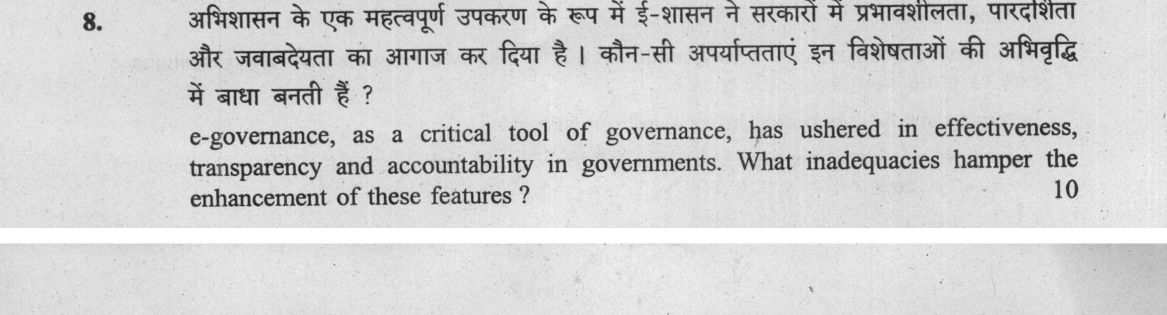
e-governance, as a critical tool of governance, has ushered in effectiveness, transparency and accountability in governments. What inadequacies hamper the enhancement of these features? (Answer in 150 words) 10 marks
हिंदी में प्रश्न पढ़ें
अभिशासन के एक महत्वपूर्ण उपकरण के रूप में ई-शासन ने सरकारों में प्रभावशीलता, पारदर्शिता और जवाबदेही का आगाज कर दिया है। कौन-सी अपर्याप्तताएं इन विशेषताओं की अभिवृद्धि में बाधा बनती हैं? (150 शब्दों में उत्तर) 10 marks
Model answer
Written by UPSC Answer Check against this question's marking rubric, to the 150-word length. UPSC does not publish answers for Mains — this is one way to score well, not an official key.
While e-governance platforms like DBT and DigiLocker have improved transparency and curtailed leakages, several systemic inadequacies hamper their full potential:
Digital Divide and Literacy Gaps: Pronounced rural-urban and gender disparities prevent marginalized groups from accessing online portals, converting digital delivery into points of welfare exclusion.
Infrastructural Bottlenecks: Patchy last-mile connectivity, recurring server downtimes, and growing cybersecurity vulnerabilities disrupt continuous service delivery and erode public trust.
Institutional Silos and Inertia: Databases across departments lack interoperability, while administrative resistance to process re-engineering often replicates traditional red-tapism on digital interfaces.
Legal and Regulatory Lags: Nascent data protection enforcement under the DPDP Act, 2023, coupled with weak cybercrime prosecution frameworks, leaves citizen data vulnerable.
Accountability Deficits: Algorithmic opacity and technical errors obscure administrative responsibility, making it difficult to pinpoint liability for service denials.
Design Gaps: Complex, non-vernacular user interfaces and poorly integrated grievance redressal systems distance non-expert citizens.
Bridging these gaps requires investing in resilient digital public infrastructure, legal enforcement, and vernacular capacity building to achieve genuinely citizen-centric governance.
What "Explain" is asking you to do
Make the working of something clear — what sets it off, what follows from what, and what it produces. Explain is the Commission's mechanism word: it dominates the technical papers and the “explain why” stems, where the marks sit in the causal chain and not in the label.
Structure that answers it
State what it is → the initiating condition → the chain of cause, step by step → an instance where it plays out → what the chain produces
Where marks are lost
Describing what something looks like instead of why it works that way. Naming the stages without linking them reads as description too.
How this answer will be evaluated
Approach
Framework: GS2 Governance. challenges: 3-4 challenges > solutions mapped to them > conclusion Full marks: Identifies 4+ specific structural/technical challenges with examples and suggests realistic reforms.
Key points expected
- Digital divide and lack of last-mile connectivity
- Data security, privacy, and cyber-security threats
- Bureaucratic resistance to change and lack of digital literacy
- Fragmented systems and lack of interoperability
Evaluation rubric
Each sub-part is marked on its own, against the marks and word limit printed on the paper.
- The answer Identify specific inadequacies that prevent e-governance from achieving effectiveness, transparency, and accountability. 10 marks · 150 words
challenges— 3-4 challenges → solutions mapped to them → conclusion
Must cover
- Digital divide and lack of last-mile connectivity
- Data security, privacy, and cyber-security threats
- Bureaucratic resistance to change and lack of digital literacy
- Fragmented systems and lack of interoperability
Loses marks
- Reciting general benefits of e-governance instead of problems
- Vague statements without specific examples
- Ignoring the 'transparency' or 'accountability' aspect
Earns more
- High cost of implementation and maintenance
- Lack of robust legal framework for digital rights
- Exclusion of marginalized groups (gender, caste, disability)
Extra mark
- Cite specific schemes (e.g., UMANG, DigiLocker) as examples
- Reference 2nd ARC or Law Commission recommendations
Practice this exact question
Write your answer and it is marked point by point against the model answer above — what you covered, what you missed, what you got wrong.
Evaluate my answer →More from General Studies 2023 GS Paper II
- Q5 Discuss the role of Presiding Officers of state legislatures in maintaining order and imp…
- Q6 The crucial aspect of development process has been the inadequate attention paid to Human…
- Q7 Discuss the role of the Competition Commission of India in containing the abuse of domina…
- Q8 e-governance, as a critical tool of governance, has ushered in effectiveness, transparenc…
- Q9 'Virus of Conflict is affecting the functioning of the SCO' In the light of the above sta…
- Q10 Indian diaspora has scaled new heights in the West. Describe its economic and political b…
- Q11 "The Constitution of India is a living instrument with capabilities of enormous dynamism.…