GS Paper II — Q15
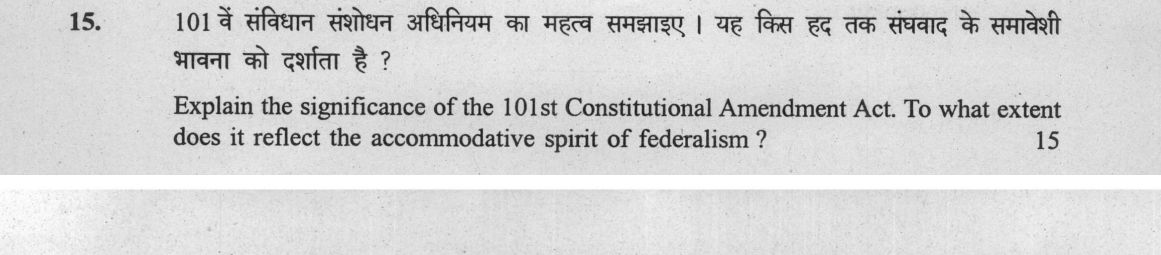
Explain the significance of the 101st Constitutional Amendment Act. To what extent does it reflect the accommodative spirit of…
Explain the significance of the 101st Constitutional Amendment Act. To what extent does it reflect the accommodative spirit of federalism? (Answer in 250 words) 15 marks
हिंदी में प्रश्न पढ़ें
101 वें संविधान संशोधन अधिनियम का महत्व समझाइए। यह किस हद तक संघवाद के समावेशी भावना को दर्शाता है? (250 शब्दों में उत्तर) 15 marks
Model answer
Written by UPSC Answer Check against this question's marking rubric, to the 250-word length. UPSC does not publish answers for Mains — this is one way to score well, not an official key.
The 101st Constitutional Amendment Act, 2016, was the enabling instrument for GST. By inserting Article 246A, it gave Parliament and State Legislatures concurrent power to legislate on GST on supplies, and by inserting Article 279A it created the GST Council. The Council, chaired by the Union Finance Minister with State Finance Ministers, embodies cooperative federalism: the Union holds one-third voting weight and States two-thirds, each State’s vote weighted by its share in combined GST.
Its significance is economic as much as constitutional. It made “One Nation, One Tax” possible, removed cascading tax-on-tax, enlarged the tax base, and encouraged formalisation by simplifying compliance and input-credit flow.
The amendment’s federal character is accommodative but limited. States accepted a shared tax base and Council recommendations, reducing unilateral fiscal autonomy; in return, Article 269 provided a five-year compensation guarantee for revenue loss, and Article 279A(11) envisaged a dispute-resolution framework, though it has not yet been operationalised. Asymmetry is addressed only partially: the Council may recommend special provisions for special category States under Article 279A(4)(g), but it did not create a separate special-category status, and manufacturing States may still feel disadvantaged relative to consuming States. In Union of India v. Mohit Minerals (2022), the Supreme Court observed that GST Council recommendations are not automatically binding, but require legislative action and due regard to federal principles. Thus, the 101st Amendment strengthened cooperative federalism by institutionalising consultation, but it remains an accommodative rather than fully symmetrical settlement.
What "Explain" is asking you to do
Make the working of something clear — what sets it off, what follows from what, and what it produces. Explain is the Commission's mechanism word: it dominates the technical papers and the “explain why” stems, where the marks sit in the causal chain and not in the label.
Structure that answers it
State what it is → the initiating condition → the chain of cause, step by step → an instance where it plays out → what the chain produces
Where marks are lost
Describing what something looks like instead of why it works that way. Naming the stages without linking them reads as description too.
How this answer will be evaluated
Approach
Framework: GS2 Polity: Constitutional Amendments & Federalism. explain: definition/context > points in order > small example > short close Full marks: Precise legal analysis of Art 269A/279A with strong argument on cooperative federalism.
Key points expected
- Mention insertion of Article 269A and 271A
- Explain creation of GST Council (Art 279A)
- Discuss shift from 'cooperative' to 'cooperative' federalism
- Address the 'accommodative spirit' via consensus mechanism
Evaluation rubric
Each sub-part is marked on its own, against the marks and word limit printed on the paper.
- The answer Define the 101st Amendment's impact on GST and evaluate its federalist implications. 15 marks · 250 words
explain— definition/context → points in order → small example → short close
Must cover
- Mention insertion of Article 269A and 271A
- Explain creation of GST Council (Art 279A)
- Discuss shift from 'cooperative' to 'cooperative' federalism
- Address the 'accommodative spirit' via consensus mechanism
Loses marks
- Reciting Article text without explaining significance
- Ignoring the 'accommodative spirit' aspect of federalism
- Failing to link the amendment to the GST structure
Earns more
- Reference to 18th Finance Commission recommendations
- Mention of 42nd Amendment (GST) context
- Discussion on 'One Nation One Market' vs state autonomy
- Reference to 101st Amendment Act, 2016
Extra mark
- Cite Supreme Court judgment on GST Council powers
- Mention specific 18th Finance Commission report details
Practice this exact question
Write your answer and it is marked point by point against the model answer above — what you covered, what you missed, what you got wrong.
Evaluate my answer →More from General Studies 2023 GS Paper II
- Q12 Explain the constitutional perspectives of Gender Justice with the help of relevant Const…
- Q13 Account for the legal and political factors responsible for the reduced frequency of usin…
- Q14 Discuss the contribution of civil society groups for women's effective and meaningful par…
- Q15 Explain the significance of the 101st Constitutional Amendment Act. To what extent does i…
- Q16 Explain the structure of the Parliamentary Committee system. How far have the financial c…
- Q17 "Development and welfare schemes for the vulnerable, by its nature, are discriminatory in…
- Q18 Skill development programmes have succeeded in increasing human resources supply to vario…