GS Paper II — Q19
'The expansion and strengthening of NATO and a stronger US-Europe strategic partnership works well for India.' What is your…
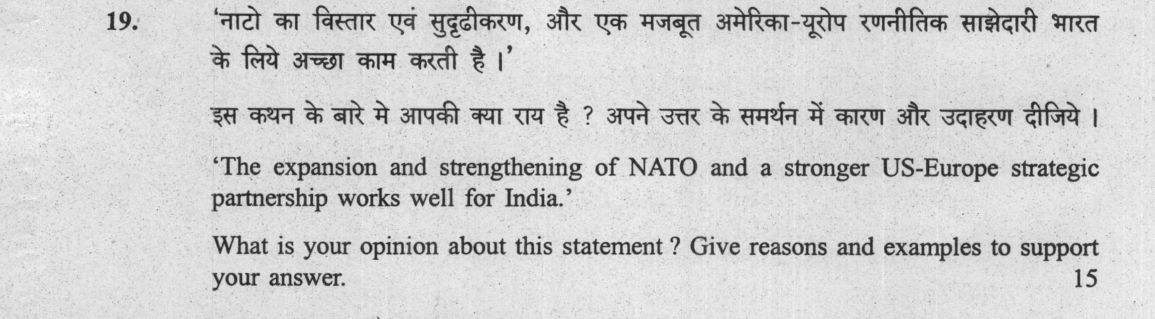
'The expansion and strengthening of NATO and a stronger US-Europe strategic partnership works well for India.' What is your opinion about this statement? Give reasons and examples to support your answer. (Answer in 250 words) 15 marks
हिंदी में प्रश्न पढ़ें
'नाटो का विस्तार एवं सुदृढ़ीकरण, और एक मजबूत अमेरिका-यूरोप रणनीतिक साझेदारी भारत के लिये अच्छा काम करती है।' इस कथन के बारे में आपकी क्या राय है? अपने उत्तर के समर्थन में कारण और उदाहरण दीजिए। (250 शब्दों में उत्तर) 15 marks
Model answer
Written by UPSC Answer Check against this question's marking rubric, to the 250-word length. UPSC does not publish answers for Mains — this is one way to score well, not an official key.
NATO’s eastward expansion, exemplified by the accession of Finland and Sweden (2023–24), alongside a revitalised US-Europe partnership, fundamentally reshapes global power distribution. Evaluating its impact on India reveals a balance of strategic gains and geopolitical friction.
Strategic Opportunities for India
A consolidated Transatlantic alliance assists India in counterbalancing China’s assertiveness. It facilitates deeper integration with Western security architectures, boosting access to advanced defence technologies (such as through the US-India iCET framework) and enhancing operational interoperability via joint military drills like Yudh Abhyas and the expanded Malabar exercises. Furthermore, coordinated US-Europe focus on maritime security reinforces India’s vision for a free, open, and rules-based Indo-Pacific.
Geopolitical Costs and Complexities
Conversely, NATO’s expansion creates significant security vulnerabilities for New Delhi. The resulting isolation of Moscow deepens the Russia-China strategic axis, risking disruptions to India’s critical defence supply chains and military hardware maintenance. Additionally, a prolonged European conflict threatens to distract Western diplomatic, financial, and military bandwidth away from the Indo-Pacific theatre. Transatlantic divergences on China policy—with European nations leaning toward nuanced economic de-risking while the US pursues strategic decoupling—also complicate India’s long-term strategic calculations.
Impact on Multi-Alignment
This hardening of global blocs tests India’s strategic autonomy. India is forced to navigate heightened diplomatic friction while balancing its commitments between Western groupings like the QUAD and Eurasian platforms such as BRICS and the Shanghai Cooperation Organisation (SCO).
Verdict
The strengthening of NATO and the US-Europe partnership is a double-edged sword. While it elevates India’s technological capabilities and maritime deterrence against China, it constrains diplomatic flexibility in continental Eurasia. India’s national interest is best served not by bloc alignment, but by leveraging this partnership while actively safeguarding its strategic autonomy through multi-alignment.
What "Evaluate" is asking you to do
Judge how well something has performed against the standard it set for itself — its stated aim, mandate or promise — and commit to a verdict. Name the yardstick before you judge; an unanchored judgement reads as opinion.
Structure that answers it
Name the yardstick — stated aim, mandate or benchmark → performance against it → shortfall against it → why the gap exists → verdict
Where marks are lost
Presenting both sides and then declining to decide, or delivering a verdict against a standard you never stated, which makes it look arbitrary.
How this answer will be evaluated
Approach
Framework: GS2 International Relations. comment: context > arguments both sides > judgment > close Full marks: Clear opinion with strong, specific examples and strategic analysis.
Key points expected
- Clear opinion on the statement
- Reasons supporting the opinion
- Specific examples of US-Europe partnership
- Linkage to India's strategic interests
Evaluation rubric
Each sub-part is marked on its own, against the marks and word limit printed on the paper.
- The answer Opinion on the statement with reasons and examples supporting the view. 15 marks · 250 words
comment— context → arguments both sides → judgment → close
Must cover
- Clear opinion on the statement
- Reasons supporting the opinion
- Specific examples of US-Europe partnership
- Linkage to India's strategic interests
Loses marks
- Reciting general facts without opinion
- Ignoring the 'US-Europe' aspect
- No specific examples provided
Earns more
- Mention of specific defense deals
- Reference to Indo-Pacific strategy
- Discussion of technology transfer
- Balanced view on India's autonomy
Extra mark
- Citation of specific joint exercises
- Reference to specific defense agreements
Practice this exact question
Write your answer and it is marked point by point against the model answer above — what you covered, what you missed, what you got wrong.
Evaluate my answer →More from General Studies 2023 GS Paper II
- Q16 Explain the structure of the Parliamentary Committee system. How far have the financial c…
- Q17 "Development and welfare schemes for the vulnerable, by its nature, are discriminatory in…
- Q18 Skill development programmes have succeeded in increasing human resources supply to vario…
- Q19 'The expansion and strengthening of NATO and a stronger US-Europe strategic partnership w…
- Q20 'Sea is an important Component of the Cosmos' Discuss in the light of the above statement…