GS Paper II — Q15
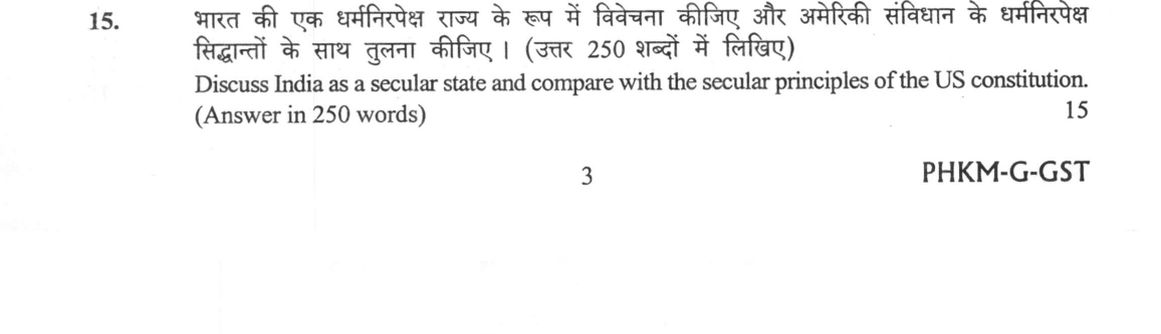
Discuss India as a secular state and compare with the secular principles of the US constitution. (Answer in 250 words) 15
हिंदी में प्रश्न पढ़ें
भारत की एक धर्मनिरपेक्ष राज्य के रूप में विवेचना कीजिए और अमेरिकी संविधान के धर्मनिरपेक्ष सिद्धांतों के साथ तुलना कीजिए। (उत्तर 250 शब्दों में लिखिए)
Model answer
Written by UPSC Answer Check against this question's marking rubric, to the 250-word length. UPSC does not publish answers for Mains — this is one way to score well, not an official key.
India’s secularism is “positive” or principled distance, not a wall of separation. The Preamble (42nd Amendment), Articles 25–28, 30 and 44 guarantee freedom of conscience, non-discrimination, minority educational rights and a uniform civil code; S.R. Bommai makes secularism part of the basic structure. Articles 25(2) and 26 let the state regulate religious institutions and intervene for reform, as in Sabarimala and Ismail Faruqui; Navtej Singh Johar extends constitutional morality to individual liberty, not religious practice.
US secularism is “negative”, reflecting Jefferson’s wall of separation. The First Amendment’s Establishment and Free Exercise Clauses, incorporated through the 14th Amendment, keep government out of religious establishment. Free exercise is not absolute; neutral, generally applicable laws may burden religion (Employment Division v. Smith). The Establishment Clause bars government endorsement, but aid to religious schools is not categorically banned: Engel v. Vitale struck down school prayer, Lemon v. Kurtzman struck down certain aid schemes, while Everson and Zelman permit some aid/vouchers; Lemon was later narrowed/abandoned in Kennedy v. Bremerton. Masterpiece Cakeshop turned on hostility, not blanket free-exercise protection.
Thus India permits state-funded madrasas and personal laws, with anti-conversion laws, while the US emphasises individual liberty and restricts state endorsement, though some religious aid survives. Article 30(2) only bars discriminatory aid to minority institutions, not a positive funding right. India’s model accommodates group diversity; the US prioritises individual conscience. Both seek neutrality, but India’s is interventionist and pluralist, America’s more formal and individualist. A balanced approach must preserve pluralism while strengthening equality and individual rights.
What "Discuss" is asking you to do
Lay the issue out from more than one side — how it arose, what is claimed for it, what is held against it, and where it now stands. UPSC attaches discuss to broad topics with several live dimensions, so coverage of the dimensions earns more than the strength of your opinion.
Structure that answers it
Set the issue up → the case as it is made → the case against → the dimension both sides leave out → where the balance now lies
Where marks are lost
Listing facts with no thread between them, or arguing one side throughout and calling it a discussion.
How this answer will be evaluated
Approach
Framework: GS2 Constitutional Principles & Comparative Governance. compare: paired headings or table > key differences > significance > conclusion Full marks: Clear distinction between 'principled distance' and 'wall of separation' with specific legal examples.
Key points expected
- Define India's secularism as 'principled distance' (Article 25-28).
- Define US secularism as 'wall of separation' (1st Amendment).
- Contrast state intervention in religious affairs (e.g., temple management).
- Contrast state funding of religious institutions (e.g., minority schools).
Evaluation rubric
Each sub-part is marked on its own, against the marks and word limit printed on the paper.
- The answer Contrast India's 'principled distance' with the US 'wall of separation' model. 15 marks · 250 words
compare— paired headings or table → key differences → significance → conclusion
Must cover
- Define India's secularism as 'principled distance' (Article 25-28).
- Define US secularism as 'wall of separation' (1st Amendment).
- Contrast state intervention in religious affairs (e.g., temple management).
- Contrast state funding of religious institutions (e.g., minority schools).
Loses marks
- Reciting Articles without explaining the principle.
- Treating secularism as mere 'non-interference' in both cases.
- Failing to provide a comparative conclusion.
Earns more
- Cite Article 25-28 for Indian framework.
- Cite 1st Amendment for US framework.
- Mention 'equal respect' vs 'strict neutrality' distinction.
- Reference specific examples like Haj subsidy or church tax.
Extra mark
- Cite Supreme Court judgment (e.g., Ismail Faruqui case).
- Reference 2nd ARC or Law Commission on secularism.
Practice this exact question
Write your answer and it is marked point by point against the model answer above — what you covered, what you missed, what you got wrong.
Evaluate my answer →More from General Studies 2024 GS Paper II
- Q12 Right to privacy is intrinsic to life and personal liberty and is inherently protected un…
- Q13 What changes has the Union Government recently introduced in the domain of Centre-State r…
- Q14 Explain the reasons for the growth of public interest litigation in India. As a result of…
- Q15 Discuss India as a secular state and compare with the secular principles of the US consti…
- Q16 The Citizens' charter has been a landmark initiative in ensuring citizen-centric administ…
- Q17 In a crucial domain like the public healthcare system the Indian State should play a vita…
- Q18 e-governance is not just about the routine application of digital technology in service d…