GS Paper II — Q18
e-governance is not just about the routine application of digital technology in service delivery process. It is as much about…
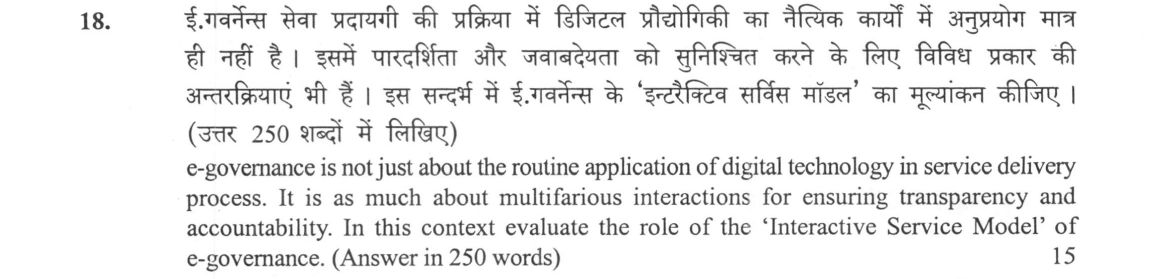
e-governance is not just about the routine application of digital technology in service delivery process. It is as much about multifarious interactions for ensuring transparency and accountability. In this context evaluate the role of the 'Interactive Service Model' of e-governance. (Answer in 250 words) 15 marks
हिंदी में प्रश्न पढ़ें
ई-गवर्नेंस सेवा प्रदायगी की प्रक्रिया में डिजिटल प्रौद्योगी का नैतिक कार्यों में अनुप्रयोग मात्र ही नहीं है। इसमें पारदर्शिता और जवाबदेयता को सुनिश्चित करने के लिए विविध प्रकार की अन्तरक्रियाएँ भी हैं। इस सन्दर्भ में ई-गवर्नेंस के 'इन्टरैक्टिव सर्विस मॉडल' का मूल्यांकन कीजिए। (उत्तर 250 शब्दों में लिखिए)
Model answer
Written by UPSC Answer Check against this question's marking rubric, to the 250-word length. UPSC does not publish answers for Mains — this is one way to score well, not an official key.
The Interactive Service Model marks an evolutionary leap from unidirectional digital dissemination (G2C push) to dynamic, bidirectional engagement between the state and citizens. While routine digitization merely automates transaction processes, the interactive model democratizes governance by embedding citizens at the center of decision-making, oversight, and policy evaluation.
Role in Ensuring Transparency and Accountability
Citizen Empowerment and Co-creation: Participatory platforms like MyGov facilitate collaborative governance, crowdsourcing inputs for draft bills and policy formulations, thereby reducing bureaucratic opacity.
Responsive Grievance Redressal: Two-way digital loops through centralized mechanisms like CPGRAMS and the Swachhata App enforce administrative accountability. Real-time ticket tracking, escalation matrices, and citizen feedback ratings reduce information asymmetry and curb administrative complacency.
Proactive Social Audits: State initiatives like Rajasthan’s Jan Soochna Portal provide granular, searchable public data, shifting the onus from citizens demanding information under RTI to the state proactively answering public scrutiny.
Critical Limitations
Digital Divide and Exclusion: Structural gaps in digital literacy, rural broadband connectivity, and gender access prevent marginalized communities from utilizing interactive platforms, creating an elite-skewed feedback loop.
Participatory Tokenism: Interactive consultations often lack statutory obligation; inputs gathered on platforms like MyGov are frequently advisory without mandatory justification for their rejection.
Digital Façade over Structural Reform: High statistical disposal rates on grievance portals often mask superficial closures on the ground without resolving systemic administrative failure.
Verdict
The Interactive Service Model successfully challenges bureaucratic paternalism. However, for it to achieve substantive transformation rather than remain a digital façade, interaction must be backed by institutionalized accountability, grievance re-opening mechanisms, and universal digital access.
What "Evaluate" is asking you to do
Judge how well something has performed against the standard it set for itself — its stated aim, mandate or promise — and commit to a verdict. Name the yardstick before you judge; an unanchored judgement reads as opinion.
Structure that answers it
Name the yardstick — stated aim, mandate or benchmark → performance against it → shortfall against it → why the gap exists → verdict
Where marks are lost
Presenting both sides and then declining to decide, or delivering a verdict against a standard you never stated, which makes it look arbitrary.
How this answer will be evaluated
Approach
Framework: GS2 Governance. evaluate: criteria > evidence > balanced judgment Full marks: Critically evaluates the model's impact on transparency/accountability with specific examples.
Key points expected
- Define Interactive Service Model (two-way citizen-state interaction).
- Link model to transparency (e.g., RTI, open data).
- Link model to accountability (e.g., grievance redressal, feedback).
- Provide balanced judgment on its effectiveness/limits.
Evaluation rubric
Each sub-part is marked on its own, against the marks and word limit printed on the paper.
- The answer Assess the role of the Interactive Service Model in ensuring transparency and accountability. 15 marks · 250 words
evaluate— criteria → evidence → balanced judgment
Must cover
- Define Interactive Service Model (two-way citizen-state interaction).
- Link model to transparency (e.g., RTI, open data).
- Link model to accountability (e.g., grievance redressal, feedback).
- Provide balanced judgment on its effectiveness/limits.
Loses marks
- Treating e-governance as only 'service delivery' (one-way).
- Reciting features without evaluating their impact.
- Ignoring the 'accountability' aspect of the prompt.
Earns more
- Mention specific platforms (CPGRAMS, MyGov, e-District).
- Discuss 'Digital Divide' as a barrier to interaction.
- Reference 'Citizen-centric' vs 'Government-centric' shift.
- Mention data privacy/security concerns in interaction.
Extra mark
- Cite 2nd ARC or Law Commission on e-governance.
- Reference specific Supreme Court judgment on digital rights.
Practice this exact question
Write your answer and it is marked point by point against the model answer above — what you covered, what you missed, what you got wrong.
Evaluate my answer →More from General Studies 2024 GS Paper II
- Q15 Discuss India as a secular state and compare with the secular principles of the US consti…
- Q16 The Citizens' charter has been a landmark initiative in ensuring citizen-centric administ…
- Q17 In a crucial domain like the public healthcare system the Indian State should play a vita…
- Q18 e-governance is not just about the routine application of digital technology in service d…
- Q19 'Terrorism has become a significant threat to global peace and security.' Evaluate the ef…
- Q20 Discuss the geopolitical and geostrategic importance of Maldives for India with a focus o…