GS Paper II — Q17
In a crucial domain like the public healthcare system the Indian State should play a vital role to contain the adverse impact of…
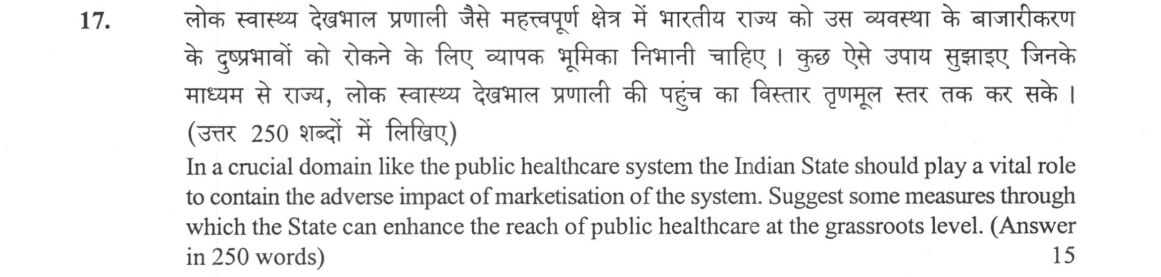
In a crucial domain like the public healthcare system the Indian State should play a vital role to contain the adverse impact of marketisation of the system. Suggest some measures through which the State can enhance the reach of public healthcare at the grassroots level. (Answer in 250 words) 15 marks
हिंदी में प्रश्न पढ़ें
लोक स्वास्थ्य देखभाल प्रणाली जैसे महत्त्वपूर्ण क्षेत्र में भारतीय राज्य को उस व्यवस्था के बाजारीकरण के दुष्प्रभावों को रोकने के लिए व्यापक भूमिका निभानी चाहिए। कुछ ऐसे उपाय सुझाइए जिनके माध्यम से राज्य, लोक स्वास्थ्य देखभाल प्रणाली की पहुँच का विस्तार तृणमूल स्तर तक कर सके। (उत्तर 250 शब्दों में लिखिए)
Model answer
Written by UPSC Answer Check against this question's marking rubric, to the 250-word length. UPSC does not publish answers for Mains — this is one way to score well, not an official key.
The marketisation of healthcare has driven severe urban-rural asymmetries and corporatised tertiary care, resulting in catastrophic out-of-pocket expenditure (OOPE) that accounts for nearly half of India's total health spending. To counter these market distortions and ensure equitable access, the State must aggressively expand public healthcare at the grassroots level.
Human Resource Reforms at Primary Level Strengthen Sub-Centres and Primary Health Centres (PHCs) by regularising National Health Mission (NHM) contractual staff and providing hardship allowances and academic quotas to incentivise rural postings. Formalise task-shifting protocols to empower ASHAs and ANMs with diagnostic tools and community-level management of non-communicable diseases.
Decentralised Drug and Diagnostic Supply Adopt the Tamil Nadu Medical Services Corporation (TNMSC) model of centralised, automated procurement with decentralised distribution to eliminate stock-outs. Expand Jan Aushadhi Kendras to the Gram Panchayat level to provide zero-cost generic medicines and point-of-care diagnostics.
Technology-Enabled Last-Mile Access Scale digital infrastructure through e-Sanjeevani telemedicine hubs at Ayushman Arogya Mandirs, linking rural patients directly with specialists. Mainstream drone delivery of critical drugs, antivenoms, and vaccines in remote tribal terrains, scaling up ICMR’s pilot projects in Manipur and Arunachal Pradesh.
Inter-Sectoral Convergence Integrate clinical outreach with preventive determinants like clean drinking water, sanitation (Swachh Bharat), and nutrition (POSHAN Abhiyaan). Models like Delhi's Mohalla Clinics and Rajasthan’s upgraded Arogya Mandirs showcase how urban-rural decentralised clinics can deliver comprehensive primary care.
Community Accountability and Governance Democratise local health administration by revitalising Rogi Kalyan Samitis, institutionalising mandatory social audits under the NHM, and establishing block-level citizen grievance redressal mechanisms.
A coordinated governance framework linking Central financing, State administrative capacity, and Panchayati Raj Institutions is essential to transform healthcare from a market commodity into a guaranteed fundamental right under Article 21.
What "Suggest" is asking you to do
Propose measures that attach to the causes the question has just had you identify. Each should name who acts, on what, and why it would work; a measure with no actor behind it is a wish rather than a suggestion.
Structure that answers it
The problem in one line → measure 1 with the cause it addresses → measure 2 → measure 3 → how it would be implemented and what it requires
Where marks are lost
Prescriptions that would fit any question on any subject — awareness campaigns, capacity building, better coordination. The examiner checks whether each measure is traceable to a cause the answer itself named.
How this answer will be evaluated
Approach
Framework: GS2 Governance & Public Policy. suggest: the problem in one line > implementable measures > who acts > conclusion Full marks: Specific, implementable measures addressing both marketisation and grassroots reach with institutional clarity.
Key points expected
- Measures to contain marketisation of healthcare
- Specific actions for grassroots level reach
- Role of State in public healthcare delivery
- Institutional or policy reforms for accessibility
Evaluation rubric
Each sub-part is marked on its own, against the marks and word limit printed on the paper.
- The answer Implementable measures to enhance grassroots reach of public healthcare. 15 marks · 250 words
suggest— the problem in one line → implementable measures → who acts → conclusion
Must cover
- Measures to contain marketisation of healthcare
- Specific actions for grassroots level reach
- Role of State in public healthcare delivery
- Institutional or policy reforms for accessibility
Loses marks
- Reciting articles without policy application
- Vague generalities without specific measures
- Ignoring the marketisation aspect of the question
Earns more
- Mention of specific schemes (Ayushman Bharat, NHM)
- Reference to constitutional provisions (Article 47)
- Discussion of public-private partnership models
- Focus on primary healthcare infrastructure
Extra mark
- Citing 2nd ARC or Law Commission recommendations
- Referencing Supreme Court judgments on right to health
Practice this exact question
Write your answer and it is marked point by point against the model answer above — what you covered, what you missed, what you got wrong.
Evaluate my answer →More from General Studies 2024 GS Paper II
- Q14 Explain the reasons for the growth of public interest litigation in India. As a result of…
- Q15 Discuss India as a secular state and compare with the secular principles of the US consti…
- Q16 The Citizens' charter has been a landmark initiative in ensuring citizen-centric administ…
- Q17 In a crucial domain like the public healthcare system the Indian State should play a vita…
- Q18 e-governance is not just about the routine application of digital technology in service d…
- Q19 'Terrorism has become a significant threat to global peace and security.' Evaluate the ef…
- Q20 Discuss the geopolitical and geostrategic importance of Maldives for India with a focus o…