GS Paper II — Q16
The Citizens' charter has been a landmark initiative in ensuring citizen-centric administration. But it is yet to reach its full…
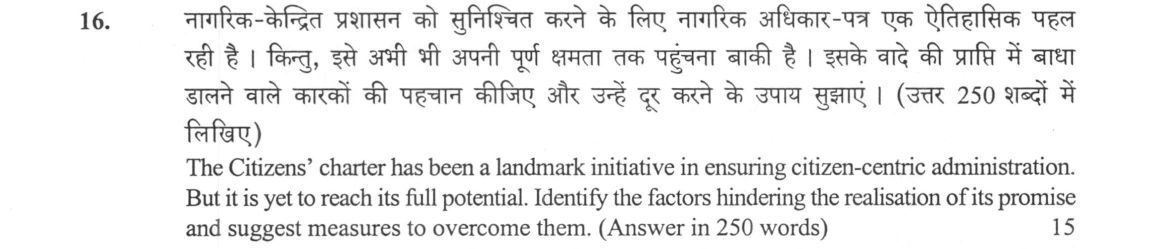
The Citizens' charter has been a landmark initiative in ensuring citizen-centric administration. But it is yet to reach its full potential. Identify the factors hindering the realisation of its promise and suggest measures to overcome them. (Answer in 250 words) 15 marks
हिंदी में प्रश्न पढ़ें
नागरिक-केंद्रित प्रशासन को सुनिश्चित करने के लिए नागरिक अधिकार-पत्र एक ऐतिहासिक पहल रही है। किन्तु, इसे अभी भी अपनी पूर्ण क्षमता तक पहुँचना बाकी है। इसके वादे की प्राप्ति में बाधा डालने वाले कारकों की पहचान कीजिए और उन्हें दूर करने के उपाय सुझाइए। (उत्तर 250 शब्दों में लिखिए)
Model answer
Written by UPSC Answer Check against this question's marking rubric, to the 250-word length. UPSC does not publish answers for Mains — this is one way to score well, not an official key.
The Citizen’s Charter represents a voluntary commitment by public authorities to deliver services with defined standards, transparency, and accountability, operationalising the core tenets of citizen-centric governance. However, structural and operational deficits prevent it from achieving its intended outcomes.
Factors Hindering Its Realisation
First, the lack of legal enforceability makes charters non-justiciable, meaning there are no statutory penalty mechanisms for delays or non-compliance. Second, inadequate citizen awareness and poor frontline staff training have reduced charters to a symbolic, tokenistic compliance exercise. Third, a centralized, one-size-fits-all approach ignores local ground realities, lacking service-specific customization and consultative inputs from end-users. Finally, the absence of independent grievance redressal bodies and institutionalized monitoring mechanisms leaves citizens without effective recourse against service defaults.
Measures to Overcome the Bottlenecks
- Legislative Backing: Provide statutory status to charters, as recommended by the 2nd Administrative Reforms Commission (ARC), drawing from state-level Right to Public Services legislations with mandatory pecuniary penalties for non-compliance.
- Institutionalise Sevottam: Universalise the Department of Administrative Reforms and Public Grievances (DARPG) Sevottam framework across all ministries to benchmark service standards, capacity building, and grievance handling.
- Participatory Formulation and Social Audits: Co-design localized charters with civil society organisations and institutionalise regular social audits to assess performance ground-up.
- Digital Integration: Deploy real-time digital dashboards linked with CPGRAMS and DARPG’s National e-Governance Service Delivery Assessment (NeSDA) metrics for automated tracking of service delivery commitments.
Transforming the Citizen’s Charter into an effective governance tool requires combining statutory enforceability and digital oversight with an administrative shift from bureaucratic discretion to citizen-first service delivery.
What "Suggest" is asking you to do
Propose measures that attach to the causes the question has just had you identify. Each should name who acts, on what, and why it would work; a measure with no actor behind it is a wish rather than a suggestion.
Structure that answers it
The problem in one line → measure 1 with the cause it addresses → measure 2 → measure 3 → how it would be implemented and what it requires
Where marks are lost
Prescriptions that would fit any question on any subject — awareness campaigns, capacity building, better coordination. The examiner checks whether each measure is traceable to a cause the answer itself named.
How this answer will be evaluated
Approach
Framework: GS2 Governance: Citizen-Centric Administration & Service Delivery. challenges: 3-4 challenges > solutions mapped to them > conclusion Full marks: Identifies 3-4 specific hindering factors with concrete examples, maps each to a realistic measure, cites 2nd ARC or SC judgment, concludes with implementation path.
Key points expected
- Identify 3-4 specific factors hindering Charter realization
- Suggest measures mapped to identified hindering factors
- Link factors to citizen-centric administration failure
- Conclude with realistic reform or implementation path
Evaluation rubric
Each sub-part is marked on its own, against the marks and word limit printed on the paper.
- The answer Identify factors hindering Citizens' Charter promise and suggest measures to overcome them. 15 marks · 250 words
challenges— 3-4 challenges → solutions mapped to them → conclusion
Must cover
- Identify 3-4 specific factors hindering Charter realization
- Suggest measures mapped to identified hindering factors
- Link factors to citizen-centric administration failure
- Conclude with realistic reform or implementation path
Loses marks
- Reciting Charter principles without analysis
- Listing factors without corresponding measures
- Ending without concrete reform suggestion
Earns more
- Cite specific Charter implementation failures
- Reference 2nd ARC or Law Commission
- Mention specific Supreme Court judgments
- Use concrete examples of service delivery
Extra mark
- Cite specific 2nd ARC recommendation
- Reference specific Supreme Court judgment
Practice this exact question
Write your answer and it is marked point by point against the model answer above — what you covered, what you missed, what you got wrong.
Evaluate my answer →More from General Studies 2024 GS Paper II
- Q13 What changes has the Union Government recently introduced in the domain of Centre-State r…
- Q14 Explain the reasons for the growth of public interest litigation in India. As a result of…
- Q15 Discuss India as a secular state and compare with the secular principles of the US consti…
- Q16 The Citizens' charter has been a landmark initiative in ensuring citizen-centric administ…
- Q17 In a crucial domain like the public healthcare system the Indian State should play a vita…
- Q18 e-governance is not just about the routine application of digital technology in service d…
- Q19 'Terrorism has become a significant threat to global peace and security.' Evaluate the ef…