GS Paper II — Q20
Discuss the geopolitical and geostrategic importance of Maldives for India with a focus on global trade and energy flows. Further…
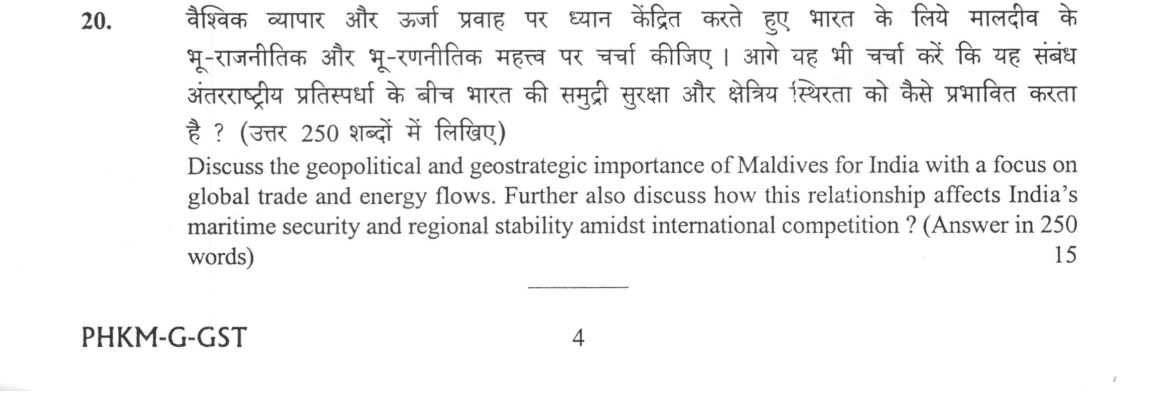
Discuss the geopolitical and geostrategic importance of Maldives for India with a focus on global trade and energy flows. Further also discuss how this relationship affects India's maritime security and regional stability amidst international competition ? (Answer in 250 words) 15 marks
हिंदी में प्रश्न पढ़ें
वैश्विक व्यापार और ऊर्जा प्रवाह पर ध्यान केन्द्रित करते हुए भारत के लिये मालदीव के भू-राजनीतिक और भू-रणनीतिक महत्त्व पर चर्चा कीजिए। आगे यह भी चर्चा करें कि यह सम्बन्ध अन्तर्राष्ट्रीय प्रतिस्पर्धा के बीच भारत की समुद्री सुरक्षा और क्षेत्रीय स्थिरता को कैसे प्रभावित करता है ? (उत्तर 250 शब्दों में लिखिए)
Model answer
Written by UPSC Answer Check against this question's marking rubric, to the 250-word length. UPSC does not publish answers for Mains — this is one way to score well, not an official key.
Maldives, spanning roughly 0°–7°N, lies close to the 8°N Eight Degree Channel and the wider 8–10°N sea lanes; with the 1.5° Channel, it lies in the Indian Ocean’s critical sea-lane network. The Indian Ocean region—often cited as carrying about half of India’s trade and 80% of its energy imports—also handles major global flows, including Persian Gulf–East Asia, Suez-bound, East African and Asian oil and LNG shipments. Thus, Male’s stability affects the security of sea lanes on which India and global commerce depend.
Geopolitically, China’s debt-trap diplomacy, Hambantota precedent, Indian Ocean militarization and dual-use infrastructure raise concerns that the Maldives could become a ‘string of pearls’ node. India’s response is anchored in SAGAR and neighbourhood-first policy: Operation Cactus in 1988, assistance during the 2014 water crisis, COVID-19 vaccines, capacity building and the Greater Male Connectivity Project. Yet Male’s hedging—China FTA (2017), ties with Saudi Arabia and Turkey, and oscillations from Yameen’s China tilt to Solih’s India First and India Out episodes—tests India’s exclusive influence and SAARC dynamics.
For maritime security, India’s Coastal Radar Chain, Dornier aircraft deployment, information fusion centre and joint patrolling agreements improve domain awareness and credible deterrence. But international competition can convert local politics into strategic vulnerability. A way forward is to combine long-term non-coercive development partnership, institutional maritime cooperation and inclusive sustained multilateral engagement, respecting Maldivian sovereignty while ensuring that global trade and energy flows remain open, critical infrastructure is protected, freedom of navigation is protected, and the region stays stable and resilient.
What "Discuss" is asking you to do
Lay the issue out from more than one side — how it arose, what is claimed for it, what is held against it, and where it now stands. UPSC attaches discuss to broad topics with several live dimensions, so coverage of the dimensions earns more than the strength of your opinion.
Structure that answers it
Set the issue up → the case as it is made → the case against → the dimension both sides leave out → where the balance now lies
Where marks are lost
Listing facts with no thread between them, or arguing one side throughout and calling it a discussion.
How this answer will be evaluated
Approach
Framework: GS2 International Relations. discuss: intro > 3-4 dimensions > example > balanced close Full marks: Links trade/energy flows to security; analyzes competition; balanced close.
Key points expected
- Geopolitical importance: Chokepoint control (Maldives Strait)
- Geostrategic importance: Energy security (Qatar/UAE pipelines)
- Impact on India's maritime security (SAGAR/Neighbourhood First)
- Regional stability amidst international competition (China/US)
Evaluation rubric
Each sub-part is marked on its own, against the marks and word limit printed on the paper.
- The answer Analyze Maldives' strategic value to India via trade/energy and its impact on maritime security. 15 marks · 250 words
discuss— intro → 3-4 dimensions → example → balanced close
Must cover
- Geopolitical importance: Chokepoint control (Maldives Strait)
- Geostrategic importance: Energy security (Qatar/UAE pipelines)
- Impact on India's maritime security (SAGAR/Neighbourhood First)
- Regional stability amidst international competition (China/US)
Loses marks
- Reciting general geography without strategic analysis
- Ignoring the 'international competition' aspect
- Failing to link trade/energy flows to security
Earns more
- Mention of 'Neighbourhood First' policy
- Reference to 'SAGAR' doctrine
- Specific mention of Maldives Strait as a chokepoint
- Reference to India-Maldives Free Trade Agreement (FTA)
Extra mark
- Mention of specific Indian aid (e.g., Hiranandani Hospital)
- Reference to specific Chinese infrastructure projects (e.g., airport)
Practice this exact question
Write your answer and it is marked point by point against the model answer above — what you covered, what you missed, what you got wrong.
Evaluate my answer →More from General Studies 2024 GS Paper II
- Q17 In a crucial domain like the public healthcare system the Indian State should play a vita…
- Q18 e-governance is not just about the routine application of digital technology in service d…
- Q19 'Terrorism has become a significant threat to global peace and security.' Evaluate the ef…
- Q20 Discuss the geopolitical and geostrategic importance of Maldives for India with a focus o…