GS Paper II — Q8
The Doctrine of Democratic Governance makes it necessary that the public perception of the integrity and commitment of civil…
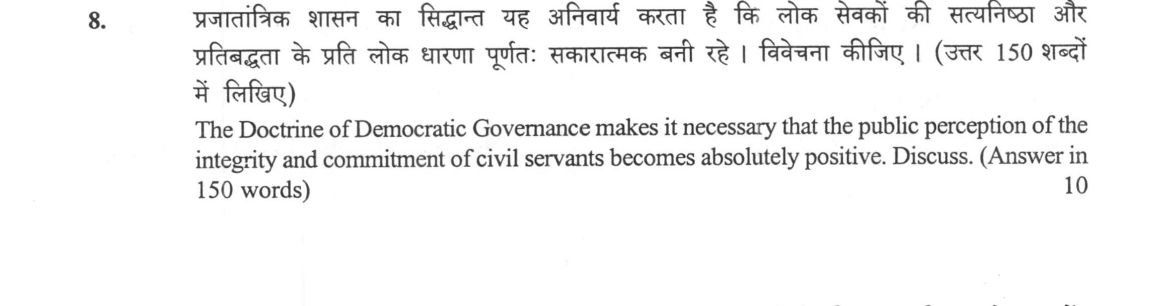
The Doctrine of Democratic Governance makes it necessary that the public perception of the integrity and commitment of civil servants becomes absolutely positive. Discuss. (Answer in 150 words) 10 marks
हिंदी में प्रश्न पढ़ें
प्रजातांत्रिक शासन का सिद्धांत यह अनिवार्य करता है कि लोक सेवकों की सत्यनिष्ठा और प्रतिबद्धता के प्रति लोक धारणा पूर्णतः सकारात्मक बनी रहे। विवेचना कीजिए। (उत्तर 150 शब्दों में लिखिए)
Model answer
Written by UPSC Answer Check against this question's marking rubric, to the 150-word length. UPSC does not publish answers for Mains — this is one way to score well, not an official key.
The Doctrine of Democratic Governance is rooted in popular sovereignty, where accountability, transparency, and public trust form foundational pillars. Because civil servants are the visible face of the state, public perception of their integrity and commitment directly shapes the legitimacy of democratic institutions, drives voluntary citizen compliance, and ensures effective policy implementation. In governance, subjective public perception often functions as objective reality.
However, cultivating an "absolutely positive" perception faces severe challenges: bureaucratic politicisation, corruption scandals, rigid red tape, emerging concerns regarding digital surveillance, and the persistent gap between policy promises and grassroots delivery.
To rebuild trust, institutional mechanisms such as the Right to Information (RTI) Act, Citizen’s Charters, Social Audits, direct-benefit e-governance, and the Lokpal have been instituted to enforce probity and enhance institutional autonomy.
Crucially, perception cannot substitute for substance; superficial "perception management" or public relations exercises without systemic reform invite public cynicism. Realising true democratic governance requires entrenching substantive ethical integrity—through civil service reforms and 2nd ARC recommendations—ensuring that demonstrated impartiality naturally generates enduring public trust.
What "Discuss" is asking you to do
Lay the issue out from more than one side — how it arose, what is claimed for it, what is held against it, and where it now stands. UPSC attaches discuss to broad topics with several live dimensions, so coverage of the dimensions earns more than the strength of your opinion.
Structure that answers it
Set the issue up → the case as it is made → the case against → the dimension both sides leave out → where the balance now lies
Where marks are lost
Listing facts with no thread between them, or arguing one side throughout and calling it a discussion.
How this answer will be evaluated
Approach
Framework: GS2 Paper 2: Governance. discuss: intro > 3-4 dimensions > example > balanced close Full marks: Links democratic theory to administrative ethics with specific reforms and examples.
Key points expected
- Define democratic governance's reliance on public trust
- Explain why integrity is a constitutional necessity
- Identify causes of negative public perception
- Suggest measures to restore positive perception
Evaluation rubric
Each sub-part is marked on its own, against the marks and word limit printed on the paper.
- The answer Analyze the link between democratic governance and public trust in civil servants. 10 marks · 150 words
discuss— intro → 3-4 dimensions → example → balanced close
Must cover
- Define democratic governance's reliance on public trust
- Explain why integrity is a constitutional necessity
- Identify causes of negative public perception
- Suggest measures to restore positive perception
Loses marks
- Reciting Articles without connecting to public perception
- Focusing only on recruitment without addressing conduct
- Ending without a concrete reform or way forward
Earns more
- Mention 2nd ARC recommendations on ethics
- Cite specific examples of integrity failures
- Reference RTI or Lokpal as accountability tools
- Discuss the role of media in shaping perception
Extra mark
- Cite a specific Supreme Court judgment on civil service ethics
- Reference a specific Law Commission report on administrative reform
Practice this exact question
Write your answer and it is marked point by point against the model answer above — what you covered, what you missed, what you got wrong.
Evaluate my answer →More from General Studies 2024 GS Paper II
- Q5 Analyse the role of local bodies in providing good governance at local level and bring ou…
- Q6 Public charitable trusts have the potential to make India's development more inclusive as…
- Q7 Poverty and malnutrition create a vicious cycle, adversely affecting human capital format…
- Q8 The Doctrine of Democratic Governance makes it necessary that the public perception of th…
- Q9 'The West is fostering India as an alternative to reduce dependence on China's supply cha…
- Q10 Critically analyse India's evolving diplomatic, economic and strategic relations with the…
- Q11 What are the aims and objects of recently passed and enforced, The Public Examination (Pr…