GS Paper II — Q19
'Terrorism has become a significant threat to global peace and security.' Evaluate the effectiveness of the United Nations…
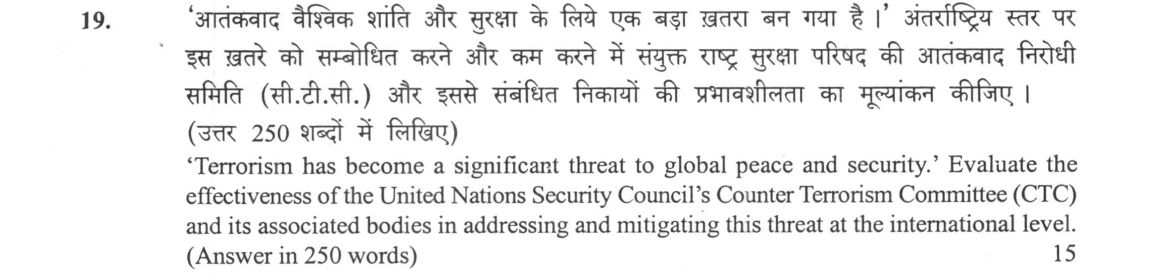
'Terrorism has become a significant threat to global peace and security.' Evaluate the effectiveness of the United Nations Security Council's Counter Terrorism Committee (CTC) and its associated bodies in addressing and mitigating this threat at the international level. (Answer in 250 words) 15 marks
हिंदी में प्रश्न पढ़ें
'आतंकवाद वैश्विक शान्ति और सुरक्षा के लिए एक बड़ा खतरा बन गया है।' अन्तर्राष्ट्रीय स्तर पर इस खतरे को सम्बोधित करने और कम करने में संयुक्त राष्ट्र सुरक्षा परिषद की आतंकवाद निरोधी समिति (सी.टी.सी.) और इससे सम्बन्धित निकायों की प्रभावशीलता का मूल्यांकन कीजिए। (उत्तर 250 शब्दों में लिखिए)
Model answer
Written by UPSC Answer Check against this question's marking rubric, to the 250-word length. UPSC does not publish answers for Mains — this is one way to score well, not an official key.
Established under UNSC Resolution 1373 (2001) following 9/11, the Counter-Terrorism Committee (CTC) monitors state compliance with counter-terror obligations, evolving through resolutions 1624 (countering incitement), 2178 (foreign terrorist fighters), and 2396 (border security and biometrics).
Institutional Strengths and Capacity Building
Supported by the Counter-Terrorism Committee Executive Directorate (CTED), the committee has successfully standardized domestic counter-terror legislation, conducted country assessment visits, and facilitated technical assistance and capacity-building. Operating alongside the UNSC 1267 Sanctions Committee (ISIL/Al-Qaeda regime), it provides an institutional framework for global asset freezes, arms embargos, and travel bans to disrupt terror networks.
Structural Constraints and Limitations
However, the operational effectiveness of the CTC is undermined by critical systemic challenges:
- P-5 Politicization: The 1267 regime's listing and delisting processes suffer from opacity, with permanent members frequently placing "technical holds" to shield state proxies from sanctions.
- Normative Deficit: The lack of a universally agreed definition of terrorism encourages selective implementation and double standards.
- Inefficacy on Cross-Border Terrorism: The framework has struggled to deter state-sponsored cross-border terrorism. India’s experience with Pakistan-based entities like Lashkar-e-Taiba and Jaish-e-Mohammed illustrates these limitations, marked by protracted delays and inadequate accountability for the 2008 Mumbai and 2016 Pathankot attacks.
Way Forward and Verdict
Strengthening the CTC requires finalizing India’s long-pending Comprehensive Convention on International Terrorism (CCIT), enhancing CTED’s operational independence, and sanctioning state sponsors of terrorism. On evaluation, while the CTC has established valuable global technical and legal benchmarks, its overall efficacy remains fundamentally compromised by geopolitical rivalry and selective enforcement.
What "Evaluate" is asking you to do
Judge how well something has performed against the standard it set for itself — its stated aim, mandate or promise — and commit to a verdict. Name the yardstick before you judge; an unanchored judgement reads as opinion.
Structure that answers it
Name the yardstick — stated aim, mandate or benchmark → performance against it → shortfall against it → why the gap exists → verdict
Where marks are lost
Presenting both sides and then declining to decide, or delivering a verdict against a standard you never stated, which makes it look arbitrary.
How this answer will be evaluated
Approach
Framework: GS2 International Relations: Institutional Effectiveness & Governance. evaluate: criteria > evidence > balanced judgment Full marks: Detailed analysis of CTC/CTED/CTI/CTU roles with specific examples of success/failure.
Key points expected
- Define CTC's mandate and composition (15 PSC members).
- Identify associated bodies (CTED, CTI, CTU).
- Cite specific mechanisms (1373 Resolution, 1267/1989 Sanctions).
- Provide a balanced judgment on effectiveness vs. limitations.
Evaluation rubric
Each sub-part is marked on its own, against the marks and word limit printed on the paper.
- The answer Assess the efficacy of the CTC and its associated bodies in mitigating global terrorism. 15 marks · 250 words
evaluate— criteria → evidence → balanced judgment
Must cover
- Define CTC's mandate and composition (15 PSC members).
- Identify associated bodies (CTED, CTI, CTU).
- Cite specific mechanisms (1373 Resolution, 1267/1989 Sanctions).
- Provide a balanced judgment on effectiveness vs. limitations.
Loses marks
- Reciting general UN structure without specific CTC focus.
- Ignoring the 'associated bodies' (CTED, CTI, CTU).
- Ending without a critical judgment or reform suggestion.
Earns more
- Mention the 5-pillar strategy (Legal, Financial, etc.).
- Reference the CTED's role in capacity building.
- Discuss the CTI's role in information sharing.
- Note the CTU's monitoring of member state compliance.
Extra mark
- Cite specific data on member state compliance rates.
- Reference a specific recent UN Security Council resolution.
Practice this exact question
Write your answer and it is marked point by point against the model answer above — what you covered, what you missed, what you got wrong.
Evaluate my answer →More from General Studies 2024 GS Paper II
- Q16 The Citizens' charter has been a landmark initiative in ensuring citizen-centric administ…
- Q17 In a crucial domain like the public healthcare system the Indian State should play a vita…
- Q18 e-governance is not just about the routine application of digital technology in service d…
- Q19 'Terrorism has become a significant threat to global peace and security.' Evaluate the ef…
- Q20 Discuss the geopolitical and geostrategic importance of Maldives for India with a focus o…