Paper I — Q1
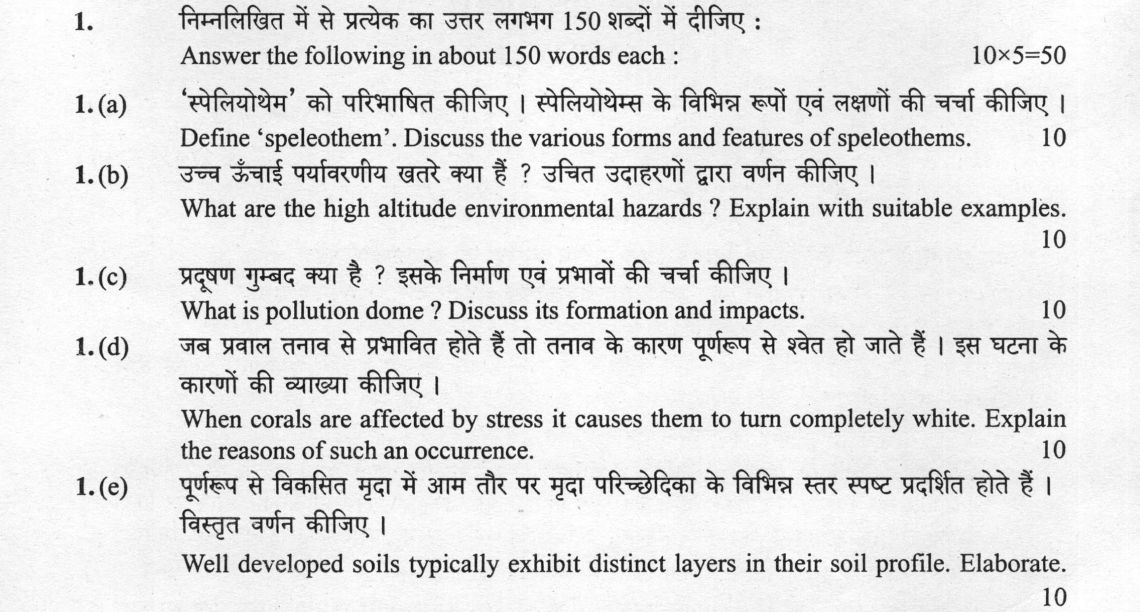
Answer the following in about 150 words each: (a) Define 'speleothem'. Discuss the various forms and features of speleothems. (10…
Answer the following in about 150 words each: Define 'speleothem'. Discuss the various forms and features of speleothems. 10 marks
What are the high altitude environmental hazards? Explain with suitable examples. 10 marks
What is pollution dome? Discuss its formation and impacts. 10 marks
When corals are affected by stress it causes them to turn completely white. Explain the reasons of such an occurrence. 10 marks
Well developed soils typically exhibit distinct layers in their soil profile. Elaborate. 10 marks
हिंदी में प्रश्न पढ़ें
निम्नलिखित में से प्रत्येक का उत्तर लगभग 150 शब्दों में दीजिए : 'स्पेलियोथेम' को परिभाषित कीजिए । स्पेलियोथेम्स के विभिन्न रूपों एवं लक्षणों की चर्चा कीजिए । (10 अंक)
उच्च ऊँचाई पर्यावरणीय खतरे क्या हैं ? उचित उदाहरणों द्वारा वर्णन कीजिए । (10 अंक)
प्रदूषण गुंबद क्या है ? इसके निर्माण एवं प्रभावों की चर्चा कीजिए । (10 अंक)
जब प्रवाल तनाव से प्रभावित होते हैं तो तनाव के कारण पूर्णतः से श्वेत हो जाते हैं । इस घटना के कारणों की व्याख्या कीजिए । (10 अंक)
पूर्णतः से विकसित मृदा में आम तौर पर मृदा परिछेदिका के विभिन्न स्तर स्पष्ट प्रदर्शित होते हैं । विस्तृत वर्णन कीजिए । (10 अंक)
Model answer
Written by UPSC Answer Check against this question's marking rubric, to the 150-word length. UPSC does not publish answers for Mains — this is one way to score well, not an official key.
(a) Speleothems Speleothems are secondary mineral deposits formed in caves by precipitation from water, mainly calcium carbonate (calcite/aragonite) from limestone dissolution, sometimes gypsum or silica. Dripping water loses CO2, raising pH, so CaCO3 precipitates. Stalactites hang from ceilings as icicle-like formations, formed by dripping water; stalagmites rise from floors where drops splash; when they meet they form columns. Flowstones are sheet-like draperies on walls/floors from thin films; helictites are twisted, gravity-defying forms due to capillary forces and crystal growth. Features include concentric growth bands, calcite crystals, and paleoclimate proxies. In India, Sonbhadra and Meghalaya caves show such deposits. Their morphology records past rainfall, temperature, and hydrology; speleothem oxygen isotopes help reconstruct monsoon variability. Speleothems can be fragile, affected by tourism, acid rain, and microclimate changes. They also form in aragonite caves and gypsum caves, showing different textures and colours. Their preservation depends on stable cave humidity and low disturbance.
(b) High-altitude hazards High-altitude environmental hazards are physical and physiological risks above roughly 2,500–3,000 m, where lower barometric pressure, thin air, intense radiation, cold, and unstable terrain combine. Hypoxia causes acute mountain sickness, high-altitude pulmonary/cerebral oedema; Everest and K2 expeditions record deaths from AMS and exhaustion. Strong UV increases snow blindness and skin damage. Cold injuries include frostbite and hypothermia, especially in Siachen Glacier’s extreme winds and sub-zero temperatures. Avalanches, seracs, crevasses, rockfall, and wind-scoured ridges create terrain instability; Ladakh tourism incidents show risks from sudden weather and unprepared trekkers. Altitude also reduces oxygen availability, impairs judgement, and increases fatigue. Remote terrain delays rescue, making IMD forecasts, early warning, satellite tracking, and community-based mountain weather services essential, with trained guides for safe mountaineering and emergency evacuation planning and rescue.
(c) Pollution dome A pollution dome is a visible or invisible blanket of pollutants trapped near the ground by a thermal inversion, often under a high-pressure subsidence inversion. Stable air, weak winds, and topography prevent vertical mixing, so vehicular, industrial, biomass, and dust emissions accumulate. In Delhi, winter inversion, crop-residue burning, and cold stable air create smog domes; Mexico City’s basin topography and subsidence produce persistent ozone and particulate layers. Impacts include respiratory and cardiovascular illness, especially for children and elderly, reduced visibility, school closures, and worsened urban heat island. It can persist for days, especially in winter, under stable high pressure, when cold air pools in valleys and plains. Public health systems must monitor AQI, restrict high-emission sources, promote clean energy and public transport, and protect vulnerable groups from harm during critical episodes. Regional coordination is needed because pollutants cross city and state boundaries for effective control and public-health protection.
(d) Coral bleaching Coral bleaching occurs when stressed corals expel or lose their symbiotic zooxanthellae, the dinoflagellates that provide colour and most of their energy through photosynthesis. The main trigger is thermal stress: even 1–2°C above summer maxima for weeks can damage the symbiosis, exposing the white skeleton. Nutrient pollution, sedimentation, low light, disease, and ocean acidification weaken corals and reduce recovery. Mass bleaching in the Great Barrier Reef in 2016 and 2020 showed climate-driven mortality; in India, Gulf of Mannar and Palk Bay reefs have experienced bleaching and degradation. Bleached corals survive if stress ends, but repeated events cause mortality, loss of fish habitat, reduced coastal protection, and biodiversity decline. Mitigation requires climate action, marine protected areas, reduced runoff, and restoration. Local management cannot offset global warming, but it can improve resilience, reduce fishing pressure, and support larval recruitment and community monitoring for long-term recovery of reef ecosystems and fisheries livelihoods in coastal India.
(e) Soil horizons Well-developed soils show distinct horizons formed by weathering, organic accumulation, and translocation. The O horizon is organic litter and humus; A is topsoil with mixed mineral and organic matter, high biological activity. E is an eluvial horizon where fine clay, iron, and organic matter are leached out, leaving paler sandy material. B is illuvial, receiving clay, sesquioxides, or organic matter; in Podzols it is a spodic horizon with illuvial Fe/Al and organic matter, while in Alfisols/Ultisols it may be argillic. C is weathered parent material; R is bedrock. In India, laterite soils show thick red B horizons rich in iron/aluminium, alluvial soils have young A-C profiles, and black soils develop deep clayey B horizons. These profiles reveal climate, vegetation, and time. Their thickness and colour also indicate drainage, fertility, and erosion history, guiding land use, conservation, and sustainable agriculture in different regions of India.
Thus, integrated monitoring, local case studies, and preventive management of caves, mountains, cities, reefs, and soils support sustainable development and resilience in these environments.
What "Discuss" is asking you to do
Lay the issue out from more than one side — how it arose, what is claimed for it, what is held against it, and where it now stands. UPSC attaches discuss to broad topics with several live dimensions, so coverage of the dimensions earns more than the strength of your opinion.
Structure that answers it
Set the issue up → the case as it is made → the case against → the dimension both sides leave out → where the balance now lies
Where marks are lost
Listing facts with no thread between them, or arguing one side throughout and calling it a discussion.
How this answer will be evaluated
Approach
Framework: Concept > Mechanism > Diagram > Example. (a) define: precise definition > the distinguishing feature > one example | (b) explain: definition/context > points in order > small example > short close | (c) discuss: intro > 3-4 dimensions > example > balanced close | (d) explain: definition/context > points in order > small example > short close | (e) explain: definition/context > points in order > small example > short close Full marks: Precise definitions, clear mechanisms, labelled diagrams, and specific regional examples for all parts.
Key points expected
- Precise definition of speleothem
- Identification of stalactites and stalagmites
- Explanation of formation mechanism (dripstone)
- Mention of other forms (flowstone, columns)
- Identification of key hazards (e.g., AMS, UV, cold)
- Explanation of physiological impact (hypoxia)
- Suitable examples of high altitude regions
- Link between altitude and specific hazard
Evaluation rubric
Each sub-part is marked on its own, against the marks and word limit printed on the paper.
- (a) Definition of speleothem and discussion of its forms and features. 10 marks · 150 words
define— precise definition → the distinguishing feature → one example
Must cover
- Precise definition of speleothem
- Identification of stalactites and stalagmites
- Explanation of formation mechanism (dripstone)
- Mention of other forms (flowstone, columns)
Loses marks
- Confusing speleothems with exogenetic features
- Listing forms without explaining formation
Earns more
- Reference to calcite deposition
- Mention of stalactite-stalagmite connection
- Note on cave paintings or age dating
Extra mark
- Labelled diagram of cave formations
- Specific example (e.g., Son Doong cave)
- (b) Explanation of high altitude environmental hazards with examples. 10 marks · 150 words
explain— definition/context → points in order → small example → short close
Must cover
- Identification of key hazards (e.g., AMS, UV, cold)
- Explanation of physiological impact (hypoxia)
- Suitable examples of high altitude regions
- Link between altitude and specific hazard
Loses marks
- Vague description without specific hazards
- Ignoring the 'high altitude' context
Earns more
- Mention of Acute Mountain Sickness (AMS)
- Reference to UV radiation intensity
- Example of Himalayan or Andean regions
Extra mark
- Diagram of atmospheric pressure vs altitude
- Specific data on oxygen levels
- (c) Discussion of pollution dome formation and its impacts. 10 marks · 150 words
discuss— intro → 3-4 dimensions → example → balanced close
Must cover
- Definition of pollution dome
- Explanation of formation (inversion/trapping)
- Discussion of health impacts
- Mention of urban context
Loses marks
- Confusing with general air pollution
- Failing to explain the 'dome' mechanism
Earns more
- Reference to temperature inversion
- Mention of smog or particulate matter
- Example of a specific city (e.g., Delhi, Beijing)
Extra mark
- Sketch of inversion layer trapping pollutants
- Reference to specific pollution index
- (d) Explanation of reasons for coral bleaching due to stress. 10 marks · 150 words
explain— definition/context → points in order → small example → short close
Must cover
- Identification of stress factors (heat, pollution)
- Explanation of symbiotic relationship (zooxanthellae)
- Mechanism of bleaching (expulsion of algae)
- Consequence of loss of color/nutrients
Loses marks
- Describing bleaching without explaining the cause
- Ignoring the role of zooxanthellae
Earns more
- Mention of thermal stress specifically
- Reference to photosynthesis disruption
- Link to ocean acidification
Extra mark
- Diagram of coral-algae relationship
- Specific example of a bleaching event
- (e) Elaboration on distinct layers in a well-developed soil profile. 10 marks · 150 words
explain— definition/context → points in order → small example → short close
Must cover
- Identification of O, A, B, C, R horizons
- Description of topsoil (A horizon) features
- Explanation of subsoil (B horizon) accumulation
- Mention of parent material (C horizon)
Loses marks
- Listing layers without describing their characteristics
- Confusing soil horizons with rock strata
Earns more
- Reference to humus in O horizon
- Mention of leaching in A horizon
- Note on bedrock (R horizon)
Extra mark
- Labelled diagram of soil profile
- Reference to specific soil type (e.g., Mollisol)
Practice this exact question
Write your answer and it is marked point by point against the model answer above — what you covered, what you missed, what you got wrong.
Evaluate my answer →More from Geography 2022 Paper I
- Q1 Answer the following in about 150 words each: (a) Define 'speleothem'. Discuss the variou…
- Q2 (a) Sequential changes in land use and land cover have brought global and regional ecolog…
- Q3 (a) Plants and animals that exist in a particular ecosystem are those that have been succ…
- Q4 (a) Rise of surface temperature brings severe consequences. Elaborate the potential chang…