Paper I — Q5
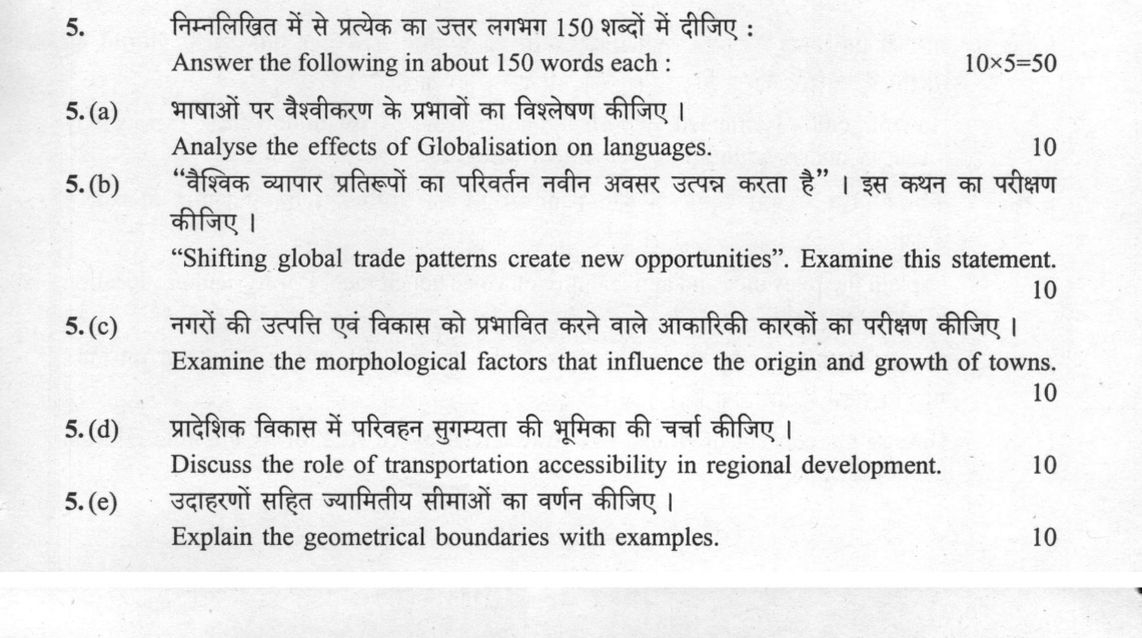
Answer the following in about 150 words each: (a) Analyse the effects of Globalisation on languages. (10 marks) (b) "Shifting…
Answer the following in about 150 words each: Analyse the effects of Globalisation on languages. 10 marks
"Shifting global trade patterns create new opportunities". Examine this statement. 10 marks
Examine the morphological factors that influence the origin and growth of towns. 10 marks
Discuss the role of transportation accessibility in regional development. 10 marks
Explain the geometrical boundaries with examples. 10 marks
हिंदी में प्रश्न पढ़ें
निम्नलिखित में से प्रत्येक का उत्तर लगभग 150 शब्दों में दीजिए : भाषाओं पर वैश्वीकरण के प्रभावों का विश्लेषण कीजिए । (10 अंक)
"वैश्विक व्यापार प्रतिरूपों का परिवर्तन नवीन अवसर उत्पन्न करता है" । इस कथन का परीक्षण कीजिए । (10 अंक)
नगरों की उत्पत्ति एवं विकास को प्रभावित करने वाले आकारिकी कारकों का परीक्षण कीजिए । (10 अंक)
प्रादेशिक विकास में परिवहन सुगमता की भूमिका की चर्चा कीजिए । (10 अंक)
उदाहरणों सहित ज्यामितीय सीमाओं का वर्णन कीजिए । (10 अंक)
Model answer
Written by UPSC Answer Check against this question's marking rubric, to the 150-word length. UPSC does not publish answers for Mains — this is one way to score well, not an official key.
(a) Globalisation and languages. Globalisation acts on languages through market, media, migration and digital networks. Its first effect is homogenisation: English and a few lingua francas gain prestige in education, business and science, while smaller languages lose domains of use. This can accelerate endangerment and extinction, especially when mother-tongue schooling is weak and urban migration pulls speakers toward dominant languages. At the same time, contact produces hybridisation and creolisation, as loanwords, code-switching and new urban dialects emerge; in India, Hinglish and regional-English mixes show this. These effects interact: dominance weakens transmission, while hybridisation and digital use can create new vitality. Digital platforms can spread minority languages through apps, social media and online archives, but they also expose them to algorithmic dominance of major languages. Policy can cushion or intensify these effects. Thus globalisation is not simply destructive; it restructures linguistic hierarchy, making preservation a policy issue rather than a natural outcome.
(b) Shifting global trade patterns. The statement is valid because trade is no longer confined to North-South flows. South-South trade, China’s Belt and Road Initiative, and re-routing of supply chains have opened new markets, corridors and investment channels. Nearshoring and friendshoring, accelerated by geopolitical tensions and pandemic shocks, encourage firms to diversify production bases, which can benefit countries with reliable power, ports, skilled labour and policy. India’s opportunities lie in services, electronics, pharmaceuticals, defence and manufacturing, supported by production-linked incentive schemes, while its ports, SEZs and trade agreements can capture re-routed cargo. For landlocked or smaller economies, access to new corridors can reduce dependence on a single market. They may also encourage technology transfer and higher value addition. Yet opportunities are uneven: they require logistics, skilled workforce and institutional trust. Hence shifting trade patterns create opportunities, but only where domestic capabilities convert access into sustained growth.
(c) Morphological factors in towns. Town origins and growth are shaped by morphology, meaning the physical setting and spatial form of settlement. Site factors such as water supply, drainage, defensible ground, soil fertility and mineral wealth determine where a town can first emerge; river confluences, hill passes and coastal inlets often produce early towns. Situation, or relative location, matters equally: towns on trade routes, ports, rail junctions or administrative boundaries grow because they connect places rather than merely occupy a good site. Over time, urban form evolves through models such as concentric zones, sector growth and multiple nuclei, showing how land use, transport and social groups organise space. In India, Varanasi’s river site, Mumbai’s harbour situation and Delhi’s planned radial sectors illustrate these forces. Site and situation interact, so a good location may still fail without connectivity. Morphology therefore explains both the birth of a town and the pattern of its later expansion.
(d) Transportation accessibility and regional development. Transportation accessibility is a core mechanism of regional development because it changes the cost of moving goods, people, capital and information. Improved connectivity can reduce core-periphery gaps by bringing hinterlands closer to markets, ports and airports, enabling local specialisation and higher incomes. Corridor development, such as India’s Golden Quadrilateral and the Delhi-Mumbai Industrial Corridor, shows how highways, railways and industrial nodes can create linear growth poles, attract investment and generate employment. Logistics hubs, inland container depots and port-led development under Sagarmala further reduce transaction costs and integrate agriculture, manufacturing and services. In India, airport connectivity, expressways and inland waterways can link agricultural belts to urban markets, raising farm incomes and reducing post-harvest losses. However, accessibility can also concentrate benefits in well-connected nodes, leaving bypassed regions behind if land, skills and institutions are weak. Thus transport is a catalyst, not an automatic guarantee; development depends on complementary planning.
(e) Geometrical boundaries. Geometrical boundaries are straight-line or arc boundaries drawn along parallels, meridians or surveyed lines, often for administrative convenience rather than physical or cultural logic. The Canada-USA boundary along the 49th parallel, the Egypt-Sudan boundary along the 22nd parallel, and the Chad-Libya boundary in the Sahara are classic examples. Such boundaries are easy to map and legally define, but they can cut across ethnic groups, pastoral routes, river basins and resource areas, producing disputes over identity, grazing, water or minerals. In the Chad-Libya case, the Aouzou Strip became a flashpoint because a straight-line boundary did not match local political claims. They may also ignore physiographic features, making border administration costly in deserts, mountains or river valleys and requiring periodic demarcation. Geometrical boundaries therefore simplify state sovereignty on paper, yet they may create long-term friction where communities, resources and physical geography do not align with the line.
What "Analyse" is asking you to do
Break the subject into its working parts and show how they act on each other. The marks are in the interconnections — which factor drives which, and what the resulting structure explains — not in the inventory of factors.
Structure that answers it
Define the whole → separate it into its parts → show which part drives which → what that interaction produces → what the structure implies
Where marks are lost
A flat list of causes with no account of which drives which. An answer of neatly separated headings, each self-contained, scores as description.
How this answer will be evaluated
Approach
Framework: Concept or mechanism > Diagram > Regional example > Application. (a) analyse: intro > causes > effects > stakeholders/linkages > way forward | (b) examine: intro > how/why with reasoning > evidence > conclusion | (c) examine: intro > how/why with reasoning > evidence > conclusion | (d) discuss: intro > 3-4 dimensions > example > balanced close | (e) explain: definition/context > points in order > small example > short close Full marks: Clear causal chain, specific examples, and a relevant diagram/sketch.
Key points expected
- Mechanism of English as global lingua franca
- Erosion of indigenous/local languages
- Linguistic homogenisation vs. hybridisation
- Linkage to economic/cultural power structures
- Mechanism of comparative advantage shifts
- Rise of new industrial hubs (e.g., SEZs)
- Integration into Global Value Chains (GVCs)
- Linkage to regional economic growth
Evaluation rubric
Each sub-part is marked on its own, against the marks and word limit printed on the paper.
- (a) Causal chain of globalisation's impact on linguistic diversity and dominance. 10 marks · 150 words
analyse— intro → causes → effects → stakeholders/linkages → way forward
Must cover
- Mechanism of English as global lingua franca
- Erosion of indigenous/local languages
- Linguistic homogenisation vs. hybridisation
- Linkage to economic/cultural power structures
Loses marks
- General description without causal mechanism
- Ignoring the 'loss' aspect of globalisation
Earns more
- Reference to 'linguicide' or language death
- Example of specific language decline (e.g., Adivasi)
- Role of digital media in language spread
Extra mark
- Citation of UNESCO language endangerment data
- Sketch of 'language hierarchy' or 'linguistic map'
- (b) Reasoning on how trade shifts generate new economic opportunities. 10 marks · 150 words
examine— intro → how/why with reasoning → evidence → conclusion
Must cover
- Mechanism of comparative advantage shifts
- Rise of new industrial hubs (e.g., SEZs)
- Integration into Global Value Chains (GVCs)
- Linkage to regional economic growth
Loses marks
- Vague statement without specific examples
- Ignoring the 'new' aspect of opportunities
Earns more
- Example of a specific trade shift (e.g., China to Vietnam)
- Mention of 'export-led growth' model
- Reference to specific Indian trade corridors
Extra mark
- Recent trade data or specific policy example
- Diagram of shifting trade flows
- (c) Morphological factors (physical features) influencing town origin/growth. 10 marks · 150 words
examine— intro → how/why with reasoning → evidence → conclusion
Must cover
- Role of river valleys and water sources
- Influence of topography (plains vs. mountains)
- Impact of natural resources (minerals)
- Defensive advantages of specific landforms
Loses marks
- Confusing morphology with administrative factors
- Listing factors without explaining the mechanism
Earns more
- Example of a riverine town (e.g., Varanasi)
- Example of a resource-based town (e.g., Jharia)
- Reference to 'morphology' as physical structure
Extra mark
- Sketch map showing town location relative to physical features
- Specific example of a mountain pass town
- (d) Role of transport accessibility in regional development. 10 marks · 150 words
discuss— intro → 3-4 dimensions → example → balanced close
Must cover
- Reduction of transport costs and time
- Market integration and expansion
- Industrial location and agglomeration
- Linkage to rural-urban connectivity
Loses marks
- General description without specific examples
- Ignoring the 'regional' aspect of development
Earns more
- Example of a specific transport project (e.g., Golden Quadrilateral)
- Mention of 'accessibility' as a key concept
- Reference to 'regional disparity' reduction
Extra mark
- Diagram of transport network and regional growth
- Specific data on transport cost reduction
- (e) Definition and examples of geometrical boundaries. 10 marks · 150 words
explain— definition/context → points in order → small example → short close
Must cover
- Definition of geometrical boundaries (straight lines)
- Examples of latitude/longitude boundaries
- Examples of straight-line boundaries (e.g., US-Canada)
- Reasons for their creation (treaties, surveys)
Loses marks
- Confusing geometrical with natural boundaries
- Lack of specific examples
Earns more
- Example of a specific geometrical boundary (e.g., 49th parallel)
- Mention of 'artificial' nature of these boundaries
- Reference to 'treaty boundaries'
Extra mark
- Sketch map showing a geometrical boundary
- Specific example of a controversial geometrical boundary
Practice this exact question
Write your answer and it is marked point by point against the model answer above — what you covered, what you missed, what you got wrong.
Evaluate my answer →More from Geography 2022 Paper I
- Q2 (a) Sequential changes in land use and land cover have brought global and regional ecolog…
- Q3 (a) Plants and animals that exist in a particular ecosystem are those that have been succ…
- Q4 (a) Rise of surface temperature brings severe consequences. Elaborate the potential chang…
- Q5 Answer the following in about 150 words each: (a) Analyse the effects of Globalisation on…
- Q6 (a) "Culture is a dynamic concept". Elucidate with examples. (20 marks) (b) "Automation i…
- Q7 (a) "Climate change is a serious problem to global food security and poverty eradication"…
- Q8 (a) How migration is affected by push and pull factors? Explain how these factors play a…