Paper I — Q2
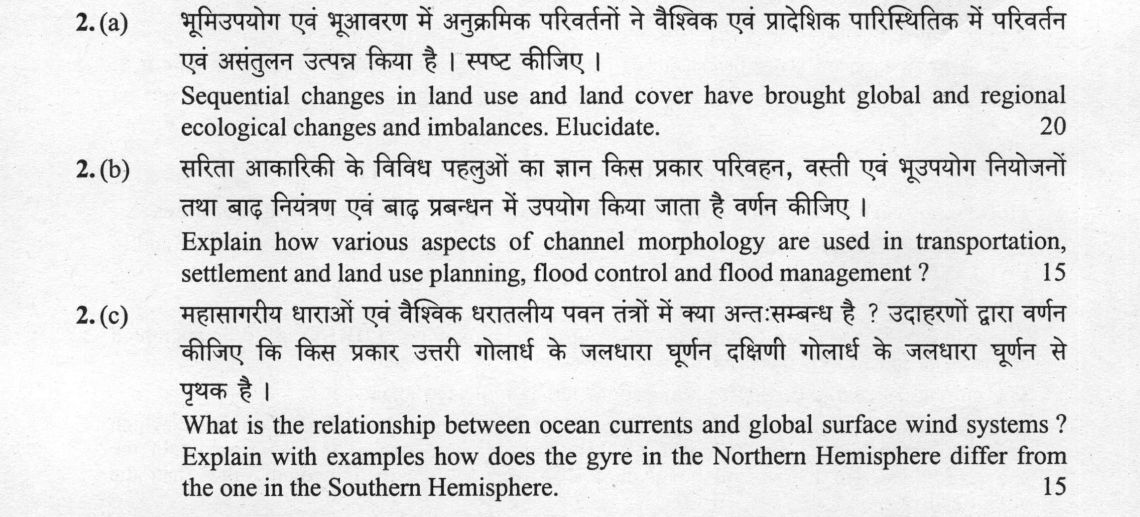
(a) Sequential changes in land use and land cover have brought global and regional ecological changes and imbalances. Elucidate…
Sequential changes in land use and land cover have brought global and regional ecological changes and imbalances. Elucidate. 20 marks
Explain how various aspects of channel morphology are used in transportation, settlement and land use planning, flood control and flood management? 15 marks
What is the relationship between ocean currents and global surface wind systems? Explain with examples how does the gyre in the Northern Hemisphere differ from the one in the Southern Hemisphere. 15 marks
हिंदी में प्रश्न पढ़ें
भूमिप्रयोग एवं भूआवरण में अनुक्रमिक परिवर्तनों ने वैश्विक एवं प्रादेशिक पारिस्थितिक में परिवर्तन एवं असंतुलन उत्पन्न किया है । स्पष्ट कीजिए । (20 अंक)
सरिता आकारिकी के विविध पहलुओं का ज्ञान किस प्रकार परिवहन, बस्ती एवं भूप्रयोग नियोजनों तथा बाढ़ नियंत्रण एवं बाढ़ प्रबंधन में उपयोग किया जाता है वर्णन कीजिए । (15 अंक)
महासागरीय धाराओं एवं वैश्विक धरातलीय पवन तंत्रों में क्या अन्तःसम्बन्ध है ? उदाहरणों द्वारा वर्णन कीजिए कि किस प्रकार उत्तरी गोलार्ध के जलधारा घूर्णन दक्षिणी गोलार्ध के जलधारा घूर्णन से पृथक है । (15 अंक)
Model answer
Written by UPSC Answer Check against this question's marking rubric, to the expected length. UPSC does not publish answers for Mains — this is one way to score well, not an official key.
Sequential land-use and land-cover change usually moves from forest or grassland clearance to agriculture, then to urbanisation, and in some regions to reforestation or land abandonment, as forest transition theory describes. Each stage alters biophysical processes. Deforestation in the Amazon reduces evapotranspiration, lowers local rainfall, releases stored carbon, fragments habitats and increases fire risk, while Sahel desertification shows how overgrazing, cropping and reduced vegetation cover can push drylands toward irreversible thresholds. In India, Green Revolution expansion in Punjab changed water tables, soil salinity and cropping patterns, while Delhi NCR sprawl has replaced green cover with impervious surfaces, raising runoff, heat-island effects and air pollution. These changes disrupt the carbon cycle by converting living biomass and soils into CO2 sources, reduce biodiversity through habitat loss and fragmentation, and alter hydrology by changing infiltration, baseflow and flood peaks. Feedbacks compound the imbalance: lower evapotranspiration reduces moisture recycling, albedo changes affect local energy balance, and soil degradation lowers productivity and increases erosion. Indicators such as declining vegetation cover, waterlogging, salinisation, siltation, altered streamflow and species loss show that land systems can cross tipping points, making ecological recovery difficult.
Channel morphology in planning and flood management. Channel morphology—width-depth ratio, sinuosity, gradient, bank strength and discharge patterns—directly shapes engineering and planning decisions. A wide, shallow, braided channel such as the Kosi, which is avulsion-prone rather than simply meandering, requires broad floodplain zoning, flexible embankment alignment and avoidance of permanent settlements in active braid belts. The Brahmaputra’s variable sinuosity and wide, shallow reaches influence bridge span design, approach embankments and the siting of towns away from cut-bank erosion. In the Narmada, a comparatively straight, incised channel with lower floodplain width allows different settlement patterns and controlled embankments, but steep valley sides still constrain transport corridors. For transportation, sinuosity and gradient determine bridge length, navigation channels and road alignment; for flood control and management, channel capacity and bankfull discharge guide embankment height, spillway locations and drainage design; for land use planning, floodplain zoning uses historical channel migration, avulsion frequency and inundation depth to separate residential, agricultural and industrial uses.
Ocean currents, winds and gyres. Surface ocean currents are mainly wind-driven. Trade winds push equatorial waters westward, while mid-latitude westerlies drive eastward currents; the Coriolis effect deflects moving water to the right in the Northern Hemisphere and to the left in the Southern Hemisphere. In the surface layer, wind stress and Coriolis balance produce a surface current at about 45 degrees to the wind, while the integrated Ekman transport is directed about 90 degrees to the right of the wind in the Northern Hemisphere and to the left in the Southern Hemisphere. This transport piles water into subtropical gyres, creating pressure gradients that generate geostrophic flow. In the Northern Hemisphere, subtropical gyres rotate clockwise and subpolar gyres rotate counter-clockwise; western boundary currents such as the Gulf Stream and Kuroshio are intensified, narrow and fast. In the Southern Hemisphere, subtropical gyres rotate counter-clockwise, and subpolar gyres such as the Weddell and Ross gyres are less confined by land and strongly modified by the Antarctic Circumpolar Current. Western-boundary intensification is generally weaker and more open to the ACC than in the Northern Hemisphere; within the Southern Hemisphere, the Brazil Current, flowing south along South America, is stronger and more continuous than the East Australian Current, which is weaker and more seasonal, showing how basin shape and wind stress create hemispheric asymmetry.
Thus, land-cover change, river form and ocean circulation are linked: terrestrial disturbance alters runoff and carbon fluxes, channel morphology mediates how societies live with rivers, and wind-driven currents redistribute heat, connecting regional imbalances to global climate.
What "Elucidate" is asking you to do
Make a stated proposition plain and then prove it with instances. Elucidate stems almost always carry a claim or a named concept, and very often the words “with examples” or “with suitable diagrams” — the illustration is part of the directive, not decoration.
Structure that answers it
Plain-language statement of what the proposition means → the part that is obscure, resolved → first illustration → second illustration → why the proposition holds
Where marks are lost
Adding terminology; elucidate rewards removing it. The commoner loss is a clean explanation with no example, when the stem asked for examples.
How this answer will be evaluated
Approach
Framework: Concept or mechanism > Diagram > Regional example > Application. (a) discuss: intro > 3-4 dimensions > example > balanced close | (b) explain: definition/context > points in order > small example > short close | (c) compare: paired headings or table > key differences > significance > conclusion Full marks: Clear causal chains, precise terminology, and relevant diagrams for all parts.
Key points expected
- Define land use vs land cover distinction
- Explain mechanism of ecological imbalance (e.g., albedo, carbon)
- Provide global and regional examples of change
- Include a diagram of land use change cycle
- Define channel morphology (width, depth, sinuosity)
- Link morphology to transportation (navigability)
- Link morphology to settlement/land use planning
- Explain role in flood control/management
Evaluation rubric
Each sub-part is marked on its own, against the marks and word limit printed on the paper.
- (a) Elucidate how sequential land use/cover changes cause global/regional ecological imbalances. 20 marks
discuss— intro → 3-4 dimensions → example → balanced close
Must cover
- Define land use vs land cover distinction
- Explain mechanism of ecological imbalance (e.g., albedo, carbon)
- Provide global and regional examples of change
- Include a diagram of land use change cycle
Loses marks
- Descriptive answer without causal mechanism
- Confusing land use with land cover
- No diagram or visual aid
Earns more
- Mention specific deforestation or urbanization data
- Link to climate change feedback loops
- Reference specific regional case studies (e.g., Amazon, Sahel)
Extra mark
- Cite specific IPCC report findings
- Include a labelled map of major land use shifts
- (b) Explain application of channel morphology in transport, settlement, and flood management. 15 marks
explain— definition/context → points in order → small example → short close
Must cover
- Define channel morphology (width, depth, sinuosity)
- Link morphology to transportation (navigability)
- Link morphology to settlement/land use planning
- Explain role in flood control/management
Loses marks
- General description without specific morphological features
- Ignoring the link to human planning
- No diagram of channel features
Earns more
- Mention specific river engineering techniques
- Reference specific flood management projects
- Discuss impact on riparian settlements
Extra mark
- Include a cross-section diagram of a river channel
- Cite specific flood control statistics
- (c) Compare Northern and Southern Hemisphere ocean gyres and their wind drivers. 15 marks
compare— paired headings or table → key differences → significance → conclusion
Must cover
- Explain relationship between wind systems and currents
- Describe Northern Hemisphere gyre (clockwise)
- Describe Southern Hemisphere gyre (counter-clockwise)
- Explain the Coriolis effect difference
Loses marks
- Confusing the direction of rotation
- Failing to link to wind systems
- No diagram of gyre circulation
Earns more
- Name specific currents (e.g., Gulf Stream, Kuroshio)
- Mention impact on regional climate
- Discuss the role of trade winds and westerlies
Extra mark
- Include a global map of ocean gyres
- Mention specific temperature differences
Practice this exact question
Write your answer and it is marked point by point against the model answer above — what you covered, what you missed, what you got wrong.
Evaluate my answer →More from Geography 2022 Paper I
- Q1 Answer the following in about 150 words each: (a) Define 'speleothem'. Discuss the variou…
- Q2 (a) Sequential changes in land use and land cover have brought global and regional ecolog…
- Q3 (a) Plants and animals that exist in a particular ecosystem are those that have been succ…
- Q4 (a) Rise of surface temperature brings severe consequences. Elaborate the potential chang…
- Q5 Answer the following in about 150 words each: (a) Analyse the effects of Globalisation on…