Paper I — Q3
(a) Plants and animals that exist in a particular ecosystem are those that have been successful in adjusting to their habitat and…
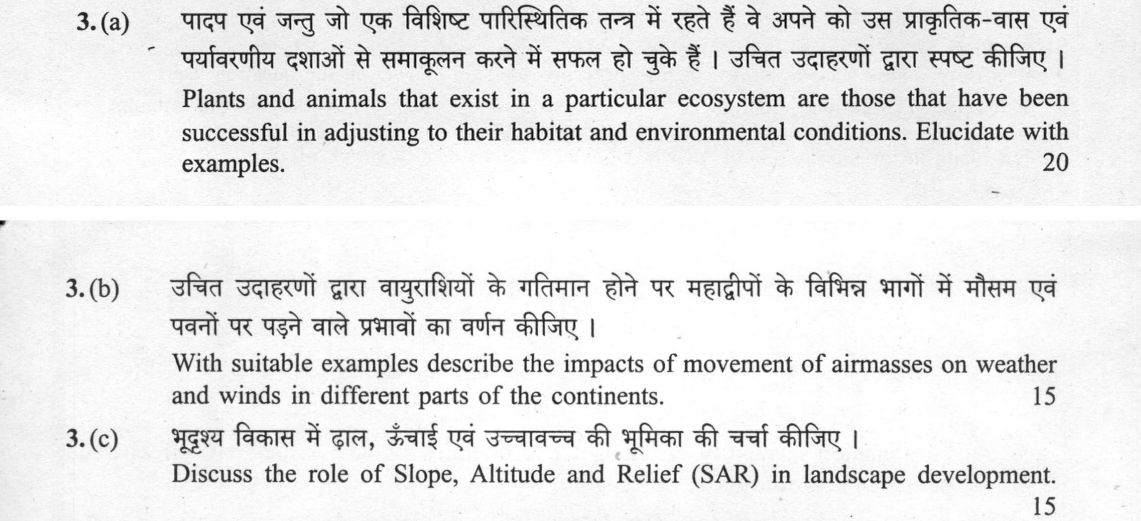
Plants and animals that exist in a particular ecosystem are those that have been successful in adjusting to their habitat and environmental conditions. Elucidate with examples. 20 marks
With suitable examples describe the impacts of movement of airmasses on weather and winds in different parts of the continents. 15 marks
Discuss the role of Slope, Altitude and Relief (SAR) in landscape development. 15 marks
हिंदी में प्रश्न पढ़ें
पादप एवं जन्तु जो एक विशिष्ट पारिस्थितिक तंत्र में रहते हैं वे अपने को उस प्राकृतिक-वास एवं पर्यावरणीय दशाओं से समाकूलन करने में सफल हो चुके हैं । उचित उदाहरणों द्वारा स्पष्ट कीजिए । (20 अंक)
उचित उदाहरणों द्वारा वायुराशियों के गतिमान होने पर महाद्वीपों के विभिन्न भागों में मौसम एवं पवनों पर पड़ने वाले प्रभावों का वर्णन कीजिए । (15 अंक)
भूदृश्य विकास में ढाल, ऊँचाई एवं उच्चावच की भूमिका की चर्चा कीजिए । (15 अंक)
Model answer
Written by UPSC Answer Check against this question's marking rubric, to the expected length. UPSC does not publish answers for Mains — this is one way to score well, not an official key.
The terrestrial landscape represents an integrated biogeomorphic system where geomorphic forms, atmospheric circulation, and ecological processes continually interact to shape global biomes.
Ecological Adaptation and Ecosystem Dynamics
Plants and animals survive in distinct ecosystems through natural selection and niche specialization, developing morphological, physiological, and behavioral adaptations in response to abiotic (climate, soil, water) and biotic factors.
Morphologically and physiologically, xerophytic vegetation in the Thar Desert (such as Prosopis cineraria and Acacia) displays deep taproots, succulent stems, sunken stomata, and CAM photosynthesis to minimize evapotranspiration and resist severe moisture deficits. In contrast, flora in the Arctic tundra remains low-stature and cushion-formed to withstand persistent winds and frost.
Faunal adaptations follow well-established eco-geographical principles. Bergmann’s rule explains the larger body mass of high-latitude endotherms like the polar bear to minimize heat loss through lower surface-area-to-volume ratios, whereas tropical relatives remain smaller. Allen’s rule explains the shortened extremities and ears of Arctic foxes compared to the elongated appendages of hot-desert foxes that facilitate heat dissipation.
Behaviorally, amphibians in the Western Ghats, such as the subterranean purple frog (Nasikabatrachus sahyadrensis), burrow underground for most of the year, emerging only during monsoon downpours for breeding. Through such functional adaptations, diverse biomes achieve ecological equilibrium: tropical rainforests optimize vertical stratification to capture sunlight under intense resource competition, while tundra species endure freezing regimes through metabolic dormancy and anti-freeze proteins.
Impact of Airmass Movement on Continental Weather
Airmasses are broad bodies of air classified by source characteristics into Continental Polar (cP), Continental Tropical (cT), Maritime Polar (mP), and Maritime Tropical (mT). As these systems migrate, thermal and moisture exchanges with the underlying terrain, alongside orographic lifting, dynamically alter continental weather.
Outbreaks of dense, dry Siberian cP airmasses dominate Eurasian interiors during winter, producing extreme cold waves; their southern penetration into northern India triggers sharp winter temperature drops, though largely mitigated by the Himalayan barrier. Conversely, Maritime Tropical (mT) airmasses originating over the Indian Ocean migrate inland during summer, undergoing intense orographic lifting along the Western Ghats and northeastern ranges to unleash the southwest monsoon burst.
Boundary interactions between contrasting airmasses yield sharp weather transitions. The clash of dry continental air with warm, moist maritime air in eastern and southern India spawns severe pre-monsoon convective systems, such as Nor’westers (Kalbaishakhi) in Bengal and Mango Showers along the peninsular coast. Across North America, the eastward migration of maritime air forced over the Rocky Mountains produces the dry, snow-melting Chinook wind through adiabatic compression on the leeward slopes, while high-pressure continental air funneling seaward generates the hot, desiccating Santa Ana winds of southern California.
Role of Slope, Altitude, and Relief (SAR) in Landscape Development
Slope, altitude, and relief serve as the primary structural and morphogenetic drivers of landscape evolution by regulating gravitational energy, denudational rates, and microclimates.
Slope dictates shear stress, controlling runoff velocity and the magnitude of mass wasting. Steep gradients accelerate slope failure, landslides, and debris flows, whereas gentle gradients facilitate pedogenesis, lateral planation, and alluvial deposition.
Altitude governs thermal lapse rates and atmospheric density, creating distinct altitudinal weathering zones. High altitudes foster mechanical frost shattering, gelifluction, and glacial abrasion, whereas basal elevations are dominated by deep chemical weathering and dense vegetation belts.
Relief defines the available potential energy for stream discharge; high relative relief accelerates vertical fluvial incision and increases drainage density, whereas subdued relief promotes meandering and peneplanation.
In India, the Himalayas exhibit active tectonic relief with profound altitudinal zonation, transitioning from humid subtropical foothills to alpine scree and periglacial peaks prone to rapid mass wasting. The Western Ghats form an asymmetrical escarpment where high relief drives headward scarp retreat on the windward side and creates an arid, planated rain-shadow landscape to the east. Across the Deccan Plateau, low-to-moderate relief and differential erosion of horizontal basaltic layers have produced distinct stepped mesas, buttes, and polycyclic pediments.
Landscape evolution is thus an ongoing synthesis wherein morphogenetic terrain conditions established by SAR guide the spatial impact of airmasses, in turn dictating the ecological niches to which biotic communities must adapt.
What "Elucidate" is asking you to do
Make a stated proposition plain and then prove it with instances. Elucidate stems almost always carry a claim or a named concept, and very often the words “with examples” or “with suitable diagrams” — the illustration is part of the directive, not decoration.
Structure that answers it
Plain-language statement of what the proposition means → the part that is obscure, resolved → first illustration → second illustration → why the proposition holds
Where marks are lost
Adding terminology; elucidate rewards removing it. The commoner loss is a clean explanation with no example, when the stem asked for examples.
How this answer will be evaluated
Approach
Framework: Concept or mechanism > Diagram > Regional example > Application. (a) explain: definition/context > points in order > small example > short close | (b) describe: define > structure or process in order > labelled diagram > significance | (c) discuss: intro > 3-4 dimensions > example > balanced close Full marks: Clear causal chains, specific examples, and diagrams.
Key points expected
- Define adaptation (morphological/physiological/behavioral)
- Explain causal link between environment and trait
- Provide specific plant example (e.g., xerophytes)
- Provide specific animal example (e.g., camels)
- Define airmass and its properties
- Explain frontal interaction (warm/cold)
- Link airmass to specific weather (rain/storm)
- Provide continental example (e.g., Monsoon)
Evaluation rubric
Each sub-part is marked on its own, against the marks and word limit printed on the paper.
- (a) Mechanism of biotic adjustment to abiotic factors with specific examples. 20 marks
explain— definition/context → points in order → small example → short close
Must cover
- Define adaptation (morphological/physiological/behavioral)
- Explain causal link between environment and trait
- Provide specific plant example (e.g., xerophytes)
- Provide specific animal example (e.g., camels)
Loses marks
- Listing traits without explaining mechanism
- Generalities without specific examples
Earns more
- Mention specific biome (e.g., Tundra, Desert)
- Discuss co-evolution or niche partitioning
- Reference specific species names
Extra mark
- Labelled diagram of a specific adaptation
- Reference to specific Indian ecosystem
- (b) Impact of airmass movement on continental weather and winds. 15 marks
describe— define → structure or process in order → labelled diagram → significance
Must cover
- Define airmass and its properties
- Explain frontal interaction (warm/cold)
- Link airmass to specific weather (rain/storm)
- Provide continental example (e.g., Monsoon)
Loses marks
- Describing weather without airmass cause
- Ignoring the 'movement' aspect
Earns more
- Mention specific airmass types (mT, cP)
- Reference specific wind patterns (Westerlies)
- Discuss seasonal variation
Extra mark
- Sketch map of airmass movement
- Reference to specific cyclone or event
- (c) Role of Slope, Altitude, and Relief in landscape development. 15 marks
discuss— intro → 3-4 dimensions → example → balanced close
Must cover
- Define SAR (Slope, Altitude, Relief)
- Explain impact of slope on erosion
- Explain impact of altitude on climate/vegetation
- Explain impact of relief on drainage
Loses marks
- Treating SAR as separate unrelated factors
- Ignoring the 'development' aspect
Earns more
- Link to geomorphic processes (weathering)
- Reference specific landforms (e.g., V-valleys)
- Discuss human impact (settlement)
Extra mark
- Profile diagram of relief
- Reference to specific mountain range
Practice this exact question
Write your answer and it is marked point by point against the model answer above — what you covered, what you missed, what you got wrong.
Evaluate my answer →More from Geography 2022 Paper I
- Q1 Answer the following in about 150 words each: (a) Define 'speleothem'. Discuss the variou…
- Q2 (a) Sequential changes in land use and land cover have brought global and regional ecolog…
- Q3 (a) Plants and animals that exist in a particular ecosystem are those that have been succ…
- Q4 (a) Rise of surface temperature brings severe consequences. Elaborate the potential chang…
- Q5 Answer the following in about 150 words each: (a) Analyse the effects of Globalisation on…
- Q6 (a) "Culture is a dynamic concept". Elucidate with examples. (20 marks) (b) "Automation i…