Paper I — Q6
(a) "Culture is a dynamic concept". Elucidate with examples. (20 marks) (b) "Automation is rapidly changing the economies of…
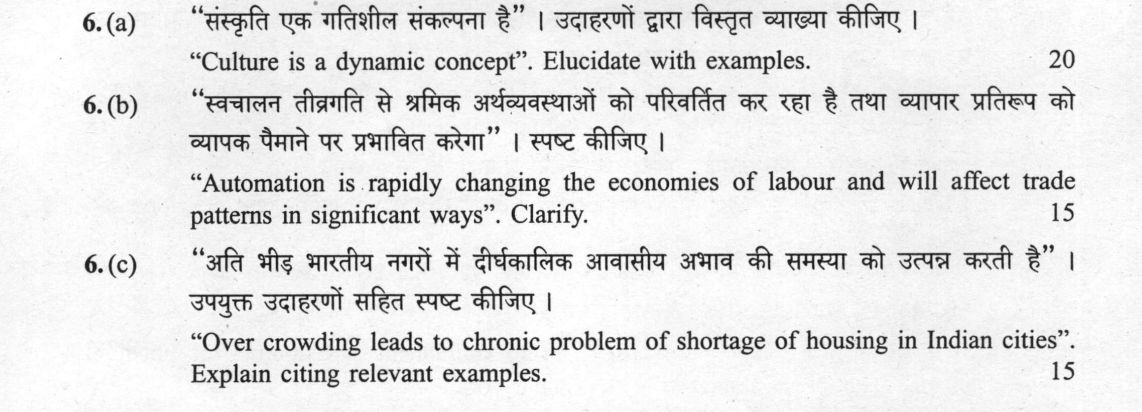
"Culture is a dynamic concept". Elucidate with examples. 20 marks
"Automation is rapidly changing the economies of labour and will affect trade patterns in significant ways". Clarify. 15 marks
"Over crowding leads to chronic problem of shortage of housing in Indian cities". Explain citing relevant examples. 15 marks
हिंदी में प्रश्न पढ़ें
"संस्कृति एक गतिशील संकल्पना है" | उदाहरणों द्वारा विस्तृत व्याख्या कीजिए | (20 अंक)
"स्वचालन तीव्रगति से श्रमिक अर्थव्यवस्थाओं को परिवर्तित कर रहा है तथा व्यापार प्रतिरूप को व्यापक पैमाने पर प्रभावित करेगा" | स्पष्ट कीजिए | (15 अंक)
"अति भीड़ भारतीय नगरों में दीर्घकालिक आवासीय अभाव की समस्या को उत्पन्न करती है" | उपयुक्त उदाहरणों सहित स्पष्ट कीजिए | (15 अंक)
Model answer
Written by UPSC Answer Check against this question's marking rubric, to the expected length. UPSC does not publish answers for Mains — this is one way to score well, not an official key.
Human geography studies the spatial dynamics of society, where cultural systems evolve through spatial interactions, economic production reorganizes through technological shifts like automation, and spatial agglomeration manifests as urban housing stress.
Culture as a Dynamic Concept
Culture is not an immutable, static artifact; it is an evolving spatial process shaped continuously by innovation, diffusion, and acculturation. Friedrich Ratzel’s anthropogeography framed culture as dynamically linked to geographical space, while Carl Sauer’s cultural landscape morphology demonstrated how human groups continuously reshape their physical environment over time into ever-changing cultural landscapes. In contemporary cultural geography, theories of hybridity and transnationalism further explain how cultural identities fluidly cross boundaries and recombine.
This dynamism operates through distinct geographical and historical mechanisms. Endogenously, cultural systems evolve through social adaptations, as conceptualized in M.N. Srinivas’s Sanskritization, where lower castes adopt dominant rituals and cultural practices to alter the social structure. Exogenously, spatial diffusion along historical trade routes dynamically altered Indian cuisine, integrating New World crops like potatoes and chilies via the Columbian Exchange and Central Asian culinary styles into Mughlai traditions. Conversely, rapid external exposure introduces profound cultural disruption, as observed in the lifestyle and linguistic shifts of the Jarawa tribe in the Andaman Islands due to road infrastructure and modern contact. Thus, culture continuously mutates through spatial interaction and social mobility.
Automation, Labour Economies, and Global Trade Patterns
Automation, driven by robotics, Artificial Intelligence, and Industry 4.0, is fundamentally restructuring the economies of labour. By decoupling output from sheer manpower, it increases capital intensity, polarizes labour markets into high-skill cognitive and low-skill service sectors, and compresses the labour share of income. Consequently, the traditional wage-arbitrage model is weakened, encouraging "reshoring" or "nearshoring" of production to advanced economies situated closer to consumer markets.
This restructuring alters global trade patterns significantly. Developing nations face premature deindustrialization as their comparative advantage in cheap, labour-intensive manufacturing exports—such as textiles and basic assembly—diminishes. Concurrently, international commerce is pivoting toward digitally deliverable services, automated logistics, and trade in advanced intellectual property. For India to maintain its footing in Global Value Chains (GVCs), it must transition from low-skill Business Process Outsourcing (BPO) to high-end engineering research, AI development, and specialized manufacturing.
Overcrowding and Chronic Housing Shortage in Indian Cities
Urban overcrowding in India is driven by persistent rural-to-urban distress migration (push factors of agrarian stagnation) combined with spatial concentration of economic opportunities in urban cores (pull factors). This influx creates an acute housing demand-supply mismatch, resulting in hyper-dense informal settlements. Prototypical examples include Mumbai’s Dharavi, where informal spatial packing strains basic civic infrastructure, Delhi’s proliferating unauthorized colonies like Sangam Vihar, and Bengaluru’s peripheral growth corridors where housing supply lags behind IT-driven workforce influx.
Institutional bottlenecks exacerbate this shortage. Historically, restrictive Rent Control Acts disincentivized private rental housing, locking potential urban land. While the Pradhan Mantri Awas Yojana (Urban) addresses physical deficits through credit-linked subsidies and in-situ slum redevelopment, challenges regarding peripheral relocation, lack of livelihood linkages, and clear land titling persist. Furthermore, the Smart Cities Mission has largely concentrated investments on area-based developments rather than rectifying the structural deficits in mass affordable social housing.
To conclude, contemporary India lies at the intersection of cultural transformation through globalization, structural trade shifts induced by automation, and acute urban spatial pressures. Addressing these interconnected challenges requires progressive spatial planning, upgrading human capital for automated value chains, and fostering inclusive, affordable urban habitats.
What "Elucidate" is asking you to do
Make a stated proposition plain and then prove it with instances. Elucidate stems almost always carry a claim or a named concept, and very often the words “with examples” or “with suitable diagrams” — the illustration is part of the directive, not decoration.
Structure that answers it
Plain-language statement of what the proposition means → the part that is obscure, resolved → first illustration → second illustration → why the proposition holds
Where marks are lost
Adding terminology; elucidate rewards removing it. The commoner loss is a clean explanation with no example, when the stem asked for examples.
How this answer will be evaluated
Approach
Framework: Concept or mechanism > Diagram > Regional example > Application. (a) discuss: intro > 3-4 dimensions > example > balanced close | (b) examine: intro > how/why with reasoning > evidence > conclusion | (c) explain: definition/context > points in order > small example > short close Full marks: Comprehensive mechanism with precise examples and diagrams
Key points expected
- Define culture as a dynamic concept
- Explain the mechanism of cultural change
- Provide examples of cultural evolution
- Link physical cause to human consequence
- Explain the process of automation
- Locate its impact on labour economies
- Show effect on trade patterns
- Define overcrowding and housing shortage
Evaluation rubric
Each sub-part is marked on its own, against the marks and word limit printed on the paper.
- (a) Define culture as dynamic and illustrate its evolution with examples. 20 marks
discuss— intro → 3-4 dimensions → example → balanced close
Must cover
- Define culture as a dynamic concept
- Explain the mechanism of cultural change
- Provide examples of cultural evolution
- Link physical cause to human consequence
Loses marks
- Description without mechanism
- Answers with no diagram
- Lack of specific examples
Earns more
- Mention specific cultural shifts
- Reference relevant theories
- Use contemporary examples
- Show regional variations
Extra mark
- Labelled sketch map of cultural diffusion
- Recent census data on cultural practices
- (b) Explain how automation changes labour economies and trade patterns. 15 marks
examine— intro → how/why with reasoning → evidence → conclusion
Must cover
- Explain the process of automation
- Locate its impact on labour economies
- Show effect on trade patterns
- Link physical cause to human consequence
Loses marks
- Description without mechanism
- Answers with no diagram
- Lack of specific examples
Earns more
- Mention specific industries
- Reference recent technological shifts
- Use data on employment changes
- Show regional impacts
Extra mark
- Labelled sketch map of automation hubs
- Recent disaster or census data
- (c) Explain how overcrowding causes housing shortage in Indian cities. 15 marks
explain— definition/context → points in order → small example → short close
Must cover
- Define overcrowding and housing shortage
- Explain the causal mechanism
- Provide relevant examples
- Link physical cause to human consequence
Loses marks
- Description without mechanism
- Answers with no diagram
- Lack of specific examples
Earns more
- Mention specific Indian cities
- Reference urban planning policies
- Use data on population density
- Show regional variations
Extra mark
- Labelled sketch map of urban sprawl
- Recent disaster or census data
Practice this exact question
Write your answer and it is marked point by point against the model answer above — what you covered, what you missed, what you got wrong.
Evaluate my answer →More from Geography 2022 Paper I
- Q3 (a) Plants and animals that exist in a particular ecosystem are those that have been succ…
- Q4 (a) Rise of surface temperature brings severe consequences. Elaborate the potential chang…
- Q5 Answer the following in about 150 words each: (a) Analyse the effects of Globalisation on…
- Q6 (a) "Culture is a dynamic concept". Elucidate with examples. (20 marks) (b) "Automation i…
- Q7 (a) "Climate change is a serious problem to global food security and poverty eradication"…
- Q8 (a) How migration is affected by push and pull factors? Explain how these factors play a…