Paper I — Q4
(a) Rise of surface temperature brings severe consequences. Elaborate the potential changes and threats associated with it in the…
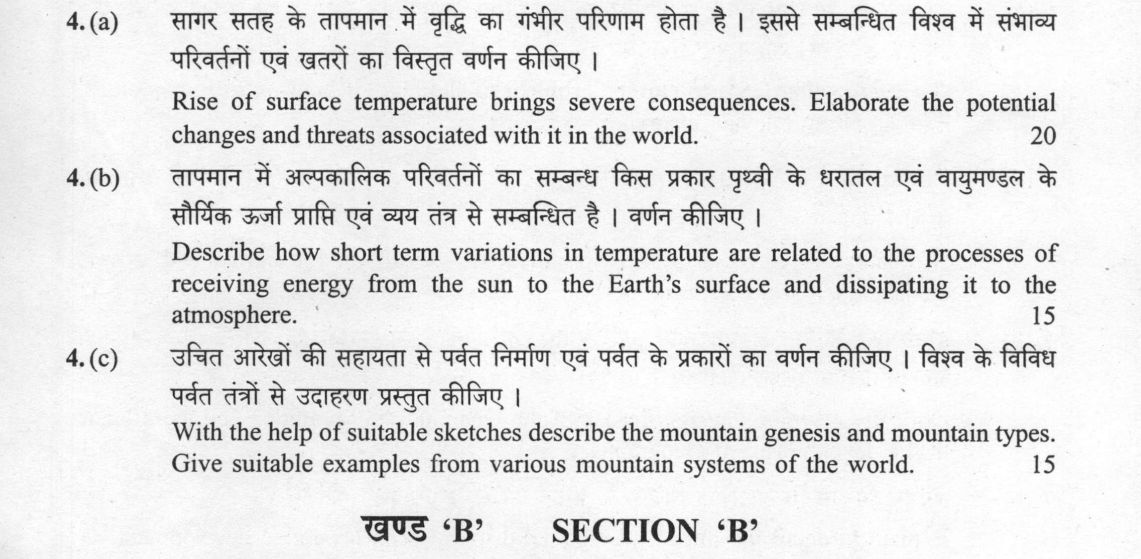
Rise of surface temperature brings severe consequences. Elaborate the potential changes and threats associated with it in the world. 20 marks
Describe how short term variations in temperature are related to the processes of receiving energy from the sun to the Earth's surface and dissipating it to the atmosphere. 15 marks
With the help of suitable sketches describe the mountain genesis and mountain types. Give suitable examples from various mountain systems of the world. 15 marks
हिंदी में प्रश्न पढ़ें
सागर सतह के तापमान में वृद्धि का गंभीर परिणाम होता है । इससे सम्बन्धित विश्व में संभाव्य परिवर्तनों एवं खतरों का विस्तृत वर्णन कीजिए । (20 अंक)
तापमान में अल्पकालिक परिवर्तनों का सम्बन्ध किस प्रकार पृथ्वी के धरातल एवं वायुमण्डल के सौरिक ऊर्जा प्राप्ति एवं व्यय तंत्र से सम्बन्धित है । वर्णन कीजिए । (15 अंक)
उचित आरेखों की सहायता से पर्वत निर्माण एवं पर्वत के प्रकारों का वर्णन कीजिए । विश्व के विविध पर्वत तंत्रों से उदाहरण प्रस्तुत कीजिए । (15 अंक)
Model answer
Written by UPSC Answer Check against this question's marking rubric, to the expected length. UPSC does not publish answers for Mains — this is one way to score well, not an official key.
The Earth's climate and surface morphology operate as an interconnected thermodynamic system, where incoming solar energy, atmospheric heat retention, and endogenic tectonic forces constantly interact.
Consequences of Global Surface Temperature Rise
Anthropogenic enhancement of the greenhouse effect alters planetary energy equilibrium, producing multi-sectoral crises. Thermal expansion of ocean water combined with the melting of continental ice sheets and mountain glaciers drives eustatic sea-level rise, threatening low-lying coastal tracts and deltaic ecosystems like the Sundarbans.
Thermodynamic intensification of the hydrological cycle amplifies extreme weather events, yielding erratic monsoonal pulses, prolonged droughts, and intense tropical cyclones. In agriculture, tropical and subtropical regions face declining crop yields due to heat stress and shifting agro-climatic zones, compromising food security across South Asia and Sub-Saharan Africa.
Ecosystem disruptions manifest in widespread coral bleaching, biodiversity loss, and phenological mismatch. Public health vulnerabilities escalate through heightened incidence of lethal heatwaves, urban heat island effects, and the poleward and altitudinal expansion of vector-borne diseases such as dengue and malaria. In fragile zones like the Indian Himalayan Region (IHR), rising temperatures destabilize slope mechanics and induce glacial lake outburst floods (GLOFs).
Short-Term Temperature Variations and Radiative Processes
Short-term temperature fluctuations operate on diurnal and seasonal scales, governed by the balance between incoming shortwave solar radiation and outgoing longwave terrestrial radiation.
Diurnal variations arise from Earth's rotation, which continuously alters the solar angle of incidence and beam concentration. Surface warming peaks not at solar noon, but in the early afternoon when incoming shortwave absorption still exceeds outgoing terrestrial emission (lag effect). Nocturnal cooling occurs through continuous longwave radiative dissipation into space. This cooling is retarded by the atmospheric greenhouse effect and cloud cover, which absorb and re-radiate infrared energy back to the surface.
Seasonal variations depend on Earth's axial tilt and revolution, dictating solar declination and photoperiod duration. These variations are locally modulated by differential specific heat capacity—land surfaces heat and cool roughly five times faster than water bodies—and variable surface albedo, where fresh snow reflects up to 85% of insolation compared to darker land surfaces.
Mountain Genesis and Structural Types
Mountain building (orogenesis) occurs through distinct tectonic and denudational mechanisms:
``` Fold Mountains (Compression) Fault-Block Mountains (Tension) / / / | Horst | / \/ \/ ______| |______ --->[ Fold Strata ]<--- <---[ Graben ]---> (Faults)
Volcanic Mountains (Magmatism) Dome/Residual (Denudation) / (Crater) _₋--__ / (Cone) / (Dome) \ ====[ || ]==== (Magma) ~~~~~[ Ancient Core ]~~~~~ ```
Fold mountains develop along convergent plate boundaries where intense horizontal compressional forces deform sedimentary and crustal strata into anticlines and synclines. Examples include the young fold Himalayas (Indian-Eurasian collision), the Alps, and the Rockies.
Fault-block mountains result from tensional or rifting forces that fracture the crust along fault lines, causing differential displacement. The central upthrown block forms a horst (block mountain) flanked by downthrown grabens (rift valleys). Examples include the Vosges, the Sierra Nevada, and the block-faulted scarp of the Western Ghats.
Volcanic mountains are constructed by the subduction of oceanic plates, magma ascent, and cumulative extrusion of lava and pyroclasts. Examples include the Andes (ocean-continent subduction) and the Cascade Range.
Dome and residual mountains arise from vertical plutonic upwarping of magma without surface eruption, or the differential erosion of ancient orogens. Examples include the Black Hills of South Dakota and the relict, denuded Aravalli Range.
Anthropogenic warming directly destabilizes mountain geomorphology: accelerated cryospheric retreat in the Himalayas and Alps degrades permafrost, triggers mass wasting, and alters downstream orographic hydrology, demanding integrated climate adaptation strategies.
What "Elaborate" is asking you to do
Give the full detailed account the question has compressed into a line — every dimension of it, with specifics. Elaborate rewards completeness and detail rather than clarification or argument: the examiner is checking whether you can fill out a topic without being told what its parts are.
Structure that answers it
State the proposition → first dimension in detail → second dimension in detail → the part the statement leaves implicit → the consolidated picture
Where marks are lost
Repeating the statement at greater length instead of adding substance. Elaborate also punishes narrowness: omitting a whole dimension costs more here than anywhere else in this family.
How this answer will be evaluated
Approach
Framework: Concept or mechanism > Diagram > Regional example > Application. (a) discuss: intro > 3-4 dimensions > example > balanced close | (b) explain: definition/context > points in order > small example > short close | (c) describe: define > structure or process in order > labelled diagram > significance Full marks: Comprehensive, well-structured, with clear diagrams and specific examples.
Key points expected
- Mechanism of surface temperature rise (e.g., greenhouse effect)
- Physical changes: sea-level rise, glacial melt, extreme weather
- Human threats: food security, health, displacement
- Link physical cause to human consequence
- Process of receiving energy from the sun
- Process of dissipating energy to the atmosphere
- Link between these processes and short-term variations
- Causal chain in order
Evaluation rubric
Each sub-part is marked on its own, against the marks and word limit printed on the paper.
- (a) Elaborate potential changes and threats associated with the rise of surface temperature. 20 marks
discuss— intro → 3-4 dimensions → example → balanced close
Must cover
- Mechanism of surface temperature rise (e.g., greenhouse effect)
- Physical changes: sea-level rise, glacial melt, extreme weather
- Human threats: food security, health, displacement
- Link physical cause to human consequence
Loses marks
- Description without mechanism
- Answers with no diagram
- Generic statements without specific examples
Earns more
- Labelled sketch map of global warming impacts
- Recent disaster or census data (e.g., 2023 heatwave)
- Specific regional examples (e.g., Arctic, South Asia)
Extra mark
- Reference to specific IPCC report or committee
- Precise statistic on temperature anomaly
- (b) Describe how short-term temperature variations relate to solar energy receipt and atmospheric dissipation. 15 marks
explain— definition/context → points in order → small example → short close
Must cover
- Process of receiving energy from the sun
- Process of dissipating energy to the atmosphere
- Link between these processes and short-term variations
- Causal chain in order
Loses marks
- Description without mechanism
- Answers with no diagram
- Confusing short-term with long-term variations
Earns more
- Labelled diagram of energy balance
- Specific examples of short-term variations (e.g., diurnal cycle)
- Mention of specific atmospheric processes (e.g., convection, radiation)
Extra mark
- Reference to specific scientific study or data
- Precise figure for energy balance components
- (c) Describe mountain genesis and types with sketches and examples. 15 marks
describe— define → structure or process in order → labelled diagram → significance
Must cover
- Definition of mountain genesis
- Types of mountains (e.g., fold, block, volcanic)
- Suitable sketches for each type
- Examples from various mountain systems
Loses marks
- Description without mechanism
- Answers with no diagram
- Confusing different types of mountains
Earns more
- Labelled sketches of different mountain types
- Specific examples (e.g., Himalayas, Andes, Rockies)
- Explanation of tectonic processes involved
Extra mark
- Reference to specific geological study or map
- Precise figure for mountain height or age
Practice this exact question
Write your answer and it is marked point by point against the model answer above — what you covered, what you missed, what you got wrong.
Evaluate my answer →More from Geography 2022 Paper I
- Q1 Answer the following in about 150 words each: (a) Define 'speleothem'. Discuss the variou…
- Q2 (a) Sequential changes in land use and land cover have brought global and regional ecolog…
- Q3 (a) Plants and animals that exist in a particular ecosystem are those that have been succ…
- Q4 (a) Rise of surface temperature brings severe consequences. Elaborate the potential chang…
- Q5 Answer the following in about 150 words each: (a) Analyse the effects of Globalisation on…
- Q6 (a) "Culture is a dynamic concept". Elucidate with examples. (20 marks) (b) "Automation i…
- Q7 (a) "Climate change is a serious problem to global food security and poverty eradication"…