Paper I — Q7
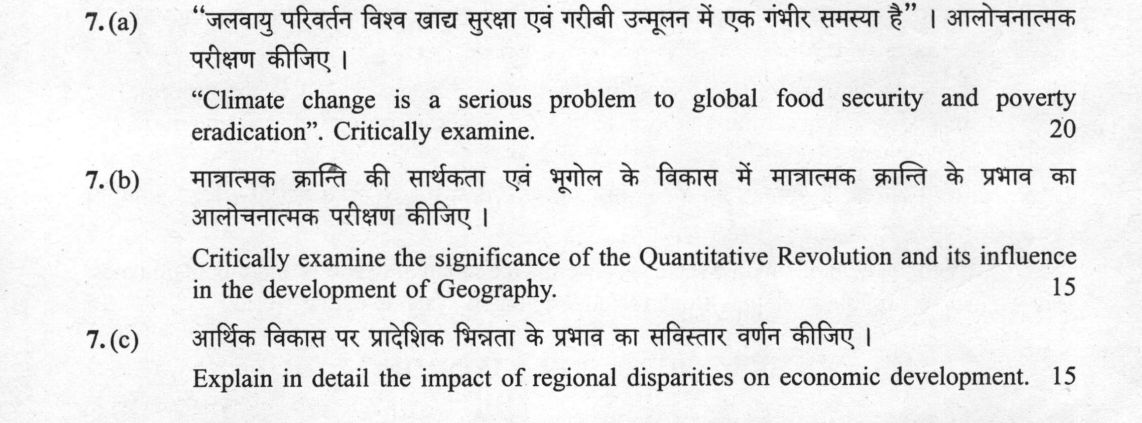
(a) "Climate change is a serious problem to global food security and poverty eradication". Critically examine. (20 marks) (b)…
"Climate change is a serious problem to global food security and poverty eradication". Critically examine. 20 marks
Critically examine the significance of the Quantitative Revolution and its influence in the development of Geography. 15 marks
Explain in detail the impact of regional disparities on economic development. 15 marks
हिंदी में प्रश्न पढ़ें
"जलवायु परिवर्तन विश्व खाद्य सुरक्षा एवं गरीबी उन्मूलन में एक गंभीर समस्या है" | आलोचनात्मक परीक्षण कीजिए | (20 अंक)
मात्रात्मक क्रांति की सार्थकता एवं भूगोल के विकास में मात्रात्मक क्रांति के प्रभाव का आलोचनात्मक परीक्षण कीजिए | (15 अंक)
आर्थिक विकास पर प्रादेशिक विषमता के प्रभाव का सविस्तार वर्णन कीजिए | (15 अंक)
Model answer
Written by UPSC Answer Check against this question's marking rubric, to the expected length. UPSC does not publish answers for Mains — this is one way to score well, not an official key.
Climate Change, Food Security, and Poverty Eradication
Anthropogenic climate change poses systemic risks to the global agrifood system through rising temperatures, altered precipitation regimes, and intensified extreme weather events. These dynamics depress crop yields—particularly staple cereals like wheat and rice—exacerbate agricultural water stress, and amplify global food price volatility. The burden falls disproportionately on tropical smallholder farmers in the Global South, where low baseline productivity and institutional deficits create a regressive feedback loop: climate shocks erode asset bases, which depresses adaptive capacity and deepens structural poverty traps.
However, a critical evaluation reveals uneven spatial outcomes. Elevated atmospheric carbon induces a localized CO2 fertilization effect, while warming temperatures expand arable frontiers in high-latitude temperate regions (e.g., parts of Canada and Russia). Furthermore, technological adaptation—such as drought-resilient crop breeding, micro-irrigation, and institutional safety nets like India’s National Adaptation Fund for Climate Change (NAFCC) and PM-KISAN—can offset localized production shortfalls. Nevertheless, because ecological tipping points and tropical yield declines outpace the gains of high-latitude regions, climate change remains an acute net threat to global food security and poverty eradication.
Significance and Evolution of the Quantitative Revolution
During the 1950s and 1960s, the Quantitative Revolution (QR) transformed geography from an idiographic, descriptive craft into a nomothetic spatial science grounded in positivist epistemology. Pioneered by Fred K. Schaefer’s critique of exceptionalism, William Bunge’s theoretical geometric formulations, and Richard Chorley’s application of systems analysis and statistical modeling, the QR introduced rigorous quantification, hypothesis testing, and spatial law-formulation to geographic inquiry.
Despite establishing geography as a rigorous spatial discipline, the QR suffered from marked reductionism. By prioritizing geometric patterns and treating humans as isotropic homo economicus, it abstracted away power structures, historical context, and social processes. This technocratic bias sparked the Humanistic counter-revolution (emphasizing human agency, place, and lived experience) and the Radical-Marxist critique (focusing on spatial justice and capital accumulation), ultimately transitioning geography into a mature era of methodological and paradigm pluralism.
Impact of Regional Disparities on Economic Development
Regional disparities exert a dual, contradictory impact on economic development. Gunnar Myrdal’s model of cumulative causation explains how market forces unleash severe polarization and "backwash effects"—drawing capital, skilled labour, and resources from lagging peripheries toward dominant cores. Over time, persistent disparities obstruct national market integration, fragment human capital formation, and depress aggregate domestic demand, acting as a severe structural drag on long-term growth.
Conversely, spatial concentration is often an unavoidable driver of early-stage economic efficiency. Unbalanced growth generates agglomeration economies, localized supply chains, and innovation spillovers. India’s development policy illustrates this tension: while Special Economic Zones (SEZs) and industrial corridors intentionally harness agglomeration efficiencies to drive export-led growth, compensatory instruments like the Backward Regions Grant Fund and the Aspirational Districts Programme aim to mitigate peripheral stagnation and restore spatial equity.
Synthesis and Conclusion
The analytical techniques pioneered by the Quantitative Revolution—including spatial modeling, GIS-based climate vulnerability mapping, and regional inequality indices—provide the essential empirical tools to navigate these interconnected challenges. Sustainable economic development requires moving beyond purely market-driven agglomeration toward place-based regional planning. Integrating targeted climate adaptation, redistributive infrastructure investment, and spatial planning is imperative to overcome regional disparities and secure lasting global food and livelihood security.
What "Critically examine" is asking you to do
Test the proposition the question puts to you and return a finding on how far it holds. Examine stems carry a claim, or ask whether something has happened, and expect evidence weighed both ways before the extent is stated — often with remedial measures attached. “Critically” is not a section added at the end: name the yardstick you are judging by — the evidence, the stated objective, a constitutional principle, a rival explanation — and let a verdict close each part of the body. Where the question quotes a claim, that verdict must land on the claim itself, accepted, qualified or rejected, and not on the theme in general.
Structure that answers it
Restate the claim as the question frames it → evidence that supports it → evidence that undercuts it → the conditions under which it holds → verdict on how far it stands
Where marks are lost
Merits in one paragraph, demerits in the next, and a conclusion calling for a balanced and holistic approach. That is a survey with the judgement left out and it holds the answer in the middle band. The opposite error is reading “critically” as permission to attack — and with the odd pairings, critically describe or critically explain, the exposition still carries most of the marks, the judgement being a layer on it rather than a substitute for it.
How this answer will be evaluated
Approach
Framework: Concept > Diagram > Regional Example > Application. (a) examine: intro > how/why with reasoning > evidence > conclusion | (b) examine: intro > how/why with reasoning > evidence > conclusion | (c) explain: definition/context > points in order > small example > short close Full marks: Precise mechanisms, specific examples, and critical depth.
Key points expected
- Mechanism: Temperature/rainfall shifts affecting crop yields
- Link: Food price volatility to poverty traps
- Evidence: Regional case study (e.g., Sahel, South Asia)
- Critical view: Vulnerability of smallholder farmers
- Definition: Shift to statistical/mathematical methods
- Key figures: Haggett, Berry, Chorley
- Influence: Spatial analysis and modeling
- Critique: Limitations of positivism
Evaluation rubric
Each sub-part is marked on its own, against the marks and word limit printed on the paper.
- (a) Critical analysis of climate change's impact on food security and poverty. 20 marks
examine— intro → how/why with reasoning → evidence → conclusion
Must cover
- Mechanism: Temperature/rainfall shifts affecting crop yields
- Link: Food price volatility to poverty traps
- Evidence: Regional case study (e.g., Sahel, South Asia)
- Critical view: Vulnerability of smallholder farmers
Loses marks
- Generic description of climate change without food link
- Ignoring the poverty eradication aspect
Earns more
- Mention of specific crops (rice, wheat) sensitivity
- Reference to IPCC or FAO data
- Discussion of adaptation strategies
Extra mark
- Labelled map of vulnerable regions
- Specific statistic on yield loss per degree
- (b) Significance of Quantitative Revolution and its influence on Geography. 15 marks
examine— intro → how/why with reasoning → evidence → conclusion
Must cover
- Definition: Shift to statistical/mathematical methods
- Key figures: Haggett, Berry, Chorley
- Influence: Spatial analysis and modeling
- Critique: Limitations of positivism
Loses marks
- Confusing with Green Revolution
- Failing to link to development of the discipline
Earns more
- Mention of specific models (Gravity, Central Place)
- Comparison with traditional descriptive geography
Extra mark
- Diagram of a spatial model
- Reference to specific journals (Annals of AAPG)
- (c) Detailed impact of regional disparities on economic development. 15 marks
explain— definition/context → points in order → small example → short close
Must cover
- Definition: Uneven spatial distribution of resources
- Mechanism: Brain drain and capital flight
- Effect: Widening income gaps (Gini coefficient)
- Policy: Regional planning and infrastructure
Loses marks
- Describing disparity without explaining the impact
- Ignoring the feedback loop of development
Earns more
- Example: Coastal vs Inland India
- Mention of trickle-down theory failure
Extra mark
- Map showing disparity (e.g., HDI map)
- Reference to specific policy (e.g., NEP)
Practice this exact question
Write your answer and it is marked point by point against the model answer above — what you covered, what you missed, what you got wrong.
Evaluate my answer →More from Geography 2022 Paper I
- Q4 (a) Rise of surface temperature brings severe consequences. Elaborate the potential chang…
- Q5 Answer the following in about 150 words each: (a) Analyse the effects of Globalisation on…
- Q6 (a) "Culture is a dynamic concept". Elucidate with examples. (20 marks) (b) "Automation i…
- Q7 (a) "Climate change is a serious problem to global food security and poverty eradication"…
- Q8 (a) How migration is affected by push and pull factors? Explain how these factors play a…