Paper I — Q8
(a) How migration is affected by push and pull factors? Explain how these factors play a role in understanding new settlement…
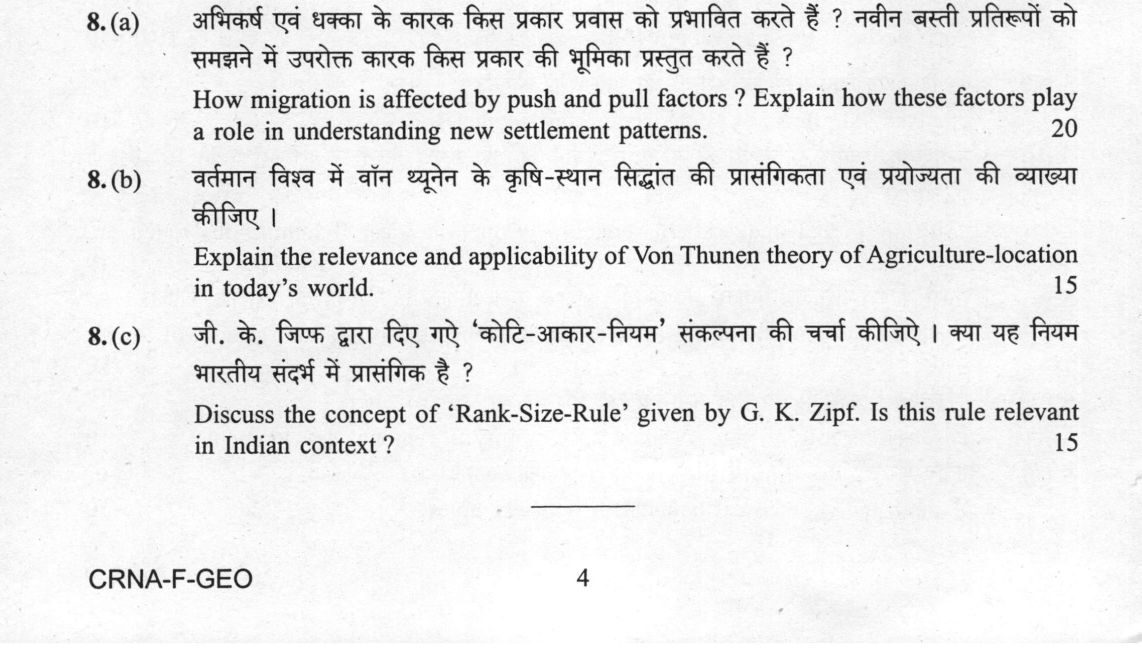
How migration is affected by push and pull factors? Explain how these factors play a role in understanding new settlement patterns. 20 marks
Explain the relevance and applicability of Von Thunen theory of Agriculture-location in today's world. 15 marks
Discuss the concept of 'Rank-Size-Rule' given by G. K. Zipf. Is this rule relevant in Indian context? 15 marks
हिंदी में प्रश्न पढ़ें
अभिकर्ष एवं धक्का के कारक किस प्रकार प्रवास को प्रभावित करते हैं ? नवीन बस्ती प्रतिरूपों को समझने में उपरोक्त कारक किस प्रकार की भूमिका प्रस्तुत करते हैं ? (20 अंक)
वर्तमान विश्व में वॉन थ्यूनन के कृषि-स्थान सिद्धांत की प्रासंगिकता एवं प्रयोज्यता की व्याख्या कीजिए | (15 अंक)
जी. के. जिप्फ द्वारा दिए गए 'कोटि-आकार-नियम' संकल्पना की चर्चा कीजिए | क्या यह नियम भारतीय संदर्भ में प्रासंगिक है ? (15 अंक)
Model answer
Written by UPSC Answer Check against this question's marking rubric, to the expected length. UPSC does not publish answers for Mains — this is one way to score well, not an official key.
Push–Pull and Settlements Migration is a spatial response to differential opportunities. Push factors—environmental degradation, conflict, unemployment, and poor rural livelihoods—make origin areas less attractive; pull factors—jobs, education, health, urban amenities, and social networks—draw migrants to destinations. E. G. Lee’s model adds intervening obstacles such as distance, cost, legal barriers, and information gaps, and intermediate opportunities that can divert or stop movement. The causal sequence is therefore: a deteriorating origin, a promising destination, and a feasible route. The result is not merely movement but new settlement patterns: rural–urban migrants concentrate in informal settlements and satellite towns around Mumbai and Delhi; climate-induced migration from Bundelkhand creates seasonal labour camps and remittance-dependent villages; Northeast ethnic migration produces transnational ethnic enclaves and diaspora networks. Where pull is strong but housing and services lag, peri-urban growth and counter-urbanization appear: some migrants settle on city fringes, while others move to smaller cities or return home with savings, reshaping local economies. These mechanisms explain why migration does not simply empty villages; it creates new urban peripheries, transit settlements, and diaspora-linked hometowns.
Von Thunen Today Von Thunen assumed a single market, uniform land, and transport cost rising with distance. In his concentric zone model, land rent falls outward, so farmers locate the most bulky, perishable, or high-value products nearest the market: intensive horticulture and dairy, then field crops, then forestry and extensive grazing. Distance decay and transport cost are therefore the causal mechanism: higher value per unit distance can pay higher rent near the city. The model remains relevant where perishables dominate, as in peri-urban vegetable farming around Delhi, Mumbai, and Bengaluru. But modern modifications matter: irrigation decouples location from rainfall; refrigeration and highways reduce distance decay; industrial agriculture and global commodity chains allow distant farms to serve urban markets. In India, Punjab–Haryana’s wheat belt reflects scale, mechanization, and market access more than pure distance, while Kerala’s commercial crops respond to climate, land, and export demand. Contract farming and agri-businesses also deviate from the simple ring model. Its limitations are clear: MSP and government pricing, fragmented landholdings, tenancy, and infrastructure gaps alter locational choices. Yet the theory still explains why high-value horticulture clusters near cities and why extensive activities move outward. Thus, while the model is simplified, it remains a useful baseline for understanding agri-food spatial organization.
Rank–Size Rule in India G. K. Zipf’s Rank–Size Rule states that the population of the r-th ranked city, Pr, is approximately K/r, so Pr × r = K. It is an empirical regularity, not a direct derivation from Christaller’s Central Place Theory, though both describe hierarchical settlement systems. In a perfectly rank-size system, the largest city is twice the second, three times the third, and so on. Deviations include primate-city distributions, where one city is disproportionately larger than the next; binary distributions, where two cities dominate; and log-normal distributions, where many mid-sized cities break the simple inverse relationship. In India, the rule is only partially relevant. At the national level, Mumbai, Delhi, and Kolkata show strong primate-city tendencies, yet their dominance distorts the ideal curve. State-level patterns vary: Maharashtra and Karnataka show stronger primate tendencies around Mumbai and Bengaluru, while Uttar Pradesh and Bihar show more dispersed or binary systems, and West Bengal combines Kolkata’s primacy with a dense secondary network. The growth of million-plus cities, the NCR, and the Mumbai–Pune corridor challenges rank-size regularity by creating polycentric regions. Compared with the USA, where rank-size conformity is closer, India’s urban hierarchy is shaped by colonial legacies, industrial location, and regional capitals. Smart City Mission and regional planning must therefore use rank-size as a diagnostic, not a law: it reveals concentration, but policy must address secondary cities, corridors, and inter-city linkages.
What "Explain" is asking you to do
Make the working of something clear — what sets it off, what follows from what, and what it produces. Explain is the Commission's mechanism word: it dominates the technical papers and the “explain why” stems, where the marks sit in the causal chain and not in the label.
Structure that answers it
State what it is → the initiating condition → the chain of cause, step by step → an instance where it plays out → what the chain produces
Where marks are lost
Describing what something looks like instead of why it works that way. Naming the stages without linking them reads as description too.
How this answer will be evaluated
Approach
Framework: UPSC Geography Paper 1 Rubric. (a) explain: definition/context > points in order > small example > short close | (b) explain: definition/context > points in order > small example > short close | (c) discuss: intro > 3-4 dimensions > example > balanced close Full marks: Comprehensive mechanism, precise examples, clear diagrams, and strong application.
Key points expected
- Define push and pull factors
- Explain the causal mechanism of migration
- Link factors to new settlement patterns
- Include a diagram of migration flow
- State Von Thunen's core assumptions
- Describe the concentric ring model
- Explain modern applicability (transport, markets)
- Include a diagram of the rings
Evaluation rubric
Each sub-part is marked on its own, against the marks and word limit printed on the paper.
- (a) Mechanism of push/pull factors and their role in settlement patterns. 20 marks
explain— definition/context → points in order → small example → short close
Must cover
- Define push and pull factors
- Explain the causal mechanism of migration
- Link factors to new settlement patterns
- Include a diagram of migration flow
Loses marks
- Description without causal mechanism
- Answer with no diagram
- Confusing push and pull factors
Earns more
- Mention Lee's model of migration
- Cite specific regional examples
- Discuss intermediate places of destination
- Reference recent census data
Extra mark
- Labelled sketch map of migration routes
- Specific statistic on migration volume
- (b) Relevance and applicability of Von Thunen's theory in the modern world. 15 marks
explain— definition/context → points in order → small example → short close
Must cover
- State Von Thunen's core assumptions
- Describe the concentric ring model
- Explain modern applicability (transport, markets)
- Include a diagram of the rings
Loses marks
- Description without mechanism
- Answer with no diagram
- Ignoring modern context
Earns more
- Mention limitations of the theory
- Cite modern agricultural examples
- Discuss the role of technology
- Reference specific crops in rings
Extra mark
- Labelled sketch map of rings
- Specific example of modern application
- (c) Concept of Rank-Size-Rule and its relevance in the Indian context. 15 marks
discuss— intro → 3-4 dimensions → example → balanced close
Must cover
- Define Rank-Size-Rule (Zipf's law)
- Explain the mathematical relationship
- Discuss relevance in Indian context
- Include a diagram of the distribution
Loses marks
- Description without mechanism
- Answer with no diagram
- Ignoring the Indian context
Earns more
- Mention deviations in India
- Cite specific Indian cities
- Discuss the role of primate cities
- Reference census data on city sizes
Extra mark
- Labelled sketch map of Indian cities
- Specific statistic on city population
Practice this exact question
Write your answer and it is marked point by point against the model answer above — what you covered, what you missed, what you got wrong.
Evaluate my answer →More from Geography 2022 Paper I
- Q5 Answer the following in about 150 words each: (a) Analyse the effects of Globalisation on…
- Q6 (a) "Culture is a dynamic concept". Elucidate with examples. (20 marks) (b) "Automation i…
- Q7 (a) "Climate change is a serious problem to global food security and poverty eradication"…
- Q8 (a) How migration is affected by push and pull factors? Explain how these factors play a…