Paper II — Q1
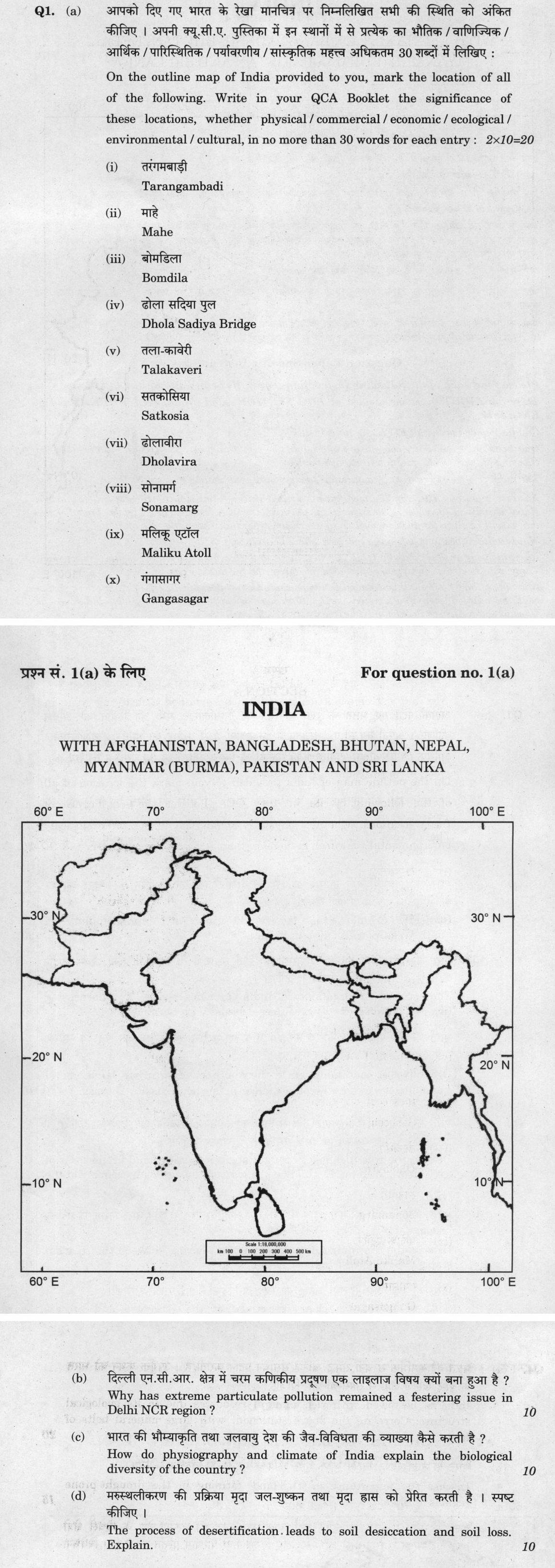
On the outline map of India provided to you, mark the location of all of the following. Write in your QCA Booklet the…
On the outline map of India provided to you, mark the location of all of the following. Write in your QCA Booklet the significance of these locations, whether physical / commercial / economic / ecological / environmental / cultural, in no more than 30 words for each entry : 2×10=20
Tarangambadi
Mahe
Bomdila
Dhola Sadiya Bridge
Talakaveri
Satkosia
Dholavira
Sonamarg
Maliku Atoll
Gangasagar
Why has extreme particulate pollution remained a festering issue in Delhi NCR region ? 10 marks
How do physiography and climate of India explain the biological diversity of the country ? 10 marks
The process of desertification leads to soil desiccation and soil loss. Explain. 10 marks
हिंदी में प्रश्न पढ़ें
आपको दिए गए भारत के रेखा मानचित्र पर निम्नलिखित सभी की स्थिति को अंकित कीजिए । अपनी क्यू.सी.ए. पुस्तिका में इन स्थानों में से प्रत्येक का भौतिक / वाणिज्यिक / आर्थिक / पारिस्थितिक / पर्यावरणीय / सांस्कृतिक महत्व अधिकतम 30 शब्दों में लिखिए : 2×10=20
तरंगमबाड़ी
माहे
बोमडिला
ढोला सदिया पुल
तला-कावेरी
सतकोसिया
ढोलावीरा
सोनमर्ग
मलिकु एटोल
गंगासागर
दिल्ली एन.सी.आर. क्षेत्र में चरम कणिकीय प्रदूषण एक लाइलाज विषय क्यों बना हुआ है ? 10 marks
भारत की भौम्याकृति तथा जलवायु देश की जैव-विविधता की व्याख्या कैसे करती है ? 10 marks
मरुस्थलीकरण की प्रक्रिया मृदा जल-शुष्कन तथा मृदा ह्रास को प्रेरित करती है । स्पष्ट कीजिए । 10
The figure this question refers to, in words
The question paper is a scan and the diagram did not survive as text. This is the figure as read from the original page — every component, value and label — so the question can be worked from the text below.
(a) A black and white outline map of India and its neighboring countries (Afghanistan, Bangladesh, Bhutan, Nepal, Myanmar, Pakistan, Sri Lanka). The map is titled 'INDIA' and includes a header 'For question no. 1(a)'. The map is bounded by a grid with latitude lines marked at 10° N, 20° N, and 30° N, and longitude lines marked at 60° E, 70° E, 80° E, 90° E, and 100° E. The outlines of the Indian subcontinent, including the island of Sri Lanka and the Andaman and Nicobar Islands, are drawn with solid black lines. A scale bar at the bottom indicates a scale of 1:18,000,000 with a graphical bar showing distances in kilometers (0 to 500 km). The page number '3' is at the bottom center, and the code 'CRNA-S-GEO' is at the bottom left.
Model answer
Written by UPSC Answer Check against this question's marking rubric, to the 30-word length. UPSC does not publish answers for Mains — this is one way to score well, not an official key.
Tarangambadi, Nagapattinam district, Tamil Nadu, lies on the Bay of Bengal, approximately 10.8° N, 79.8° E. It is a Chola port and temple town, significant for heritage and maritime culture.
Mahe is a coastal district of Puducherry in Kerala, approximately 11.8° N, 75.0° E, on the Arabian Sea. It is a union-territory district, significant for political status and coastal trade.
Bomdila, West Kameng district, Arunachal Pradesh, lies approximately 28.1° N, 94.8° E, near the Bhutan border. It is a transit town to Tawang, significant for border access and ecology.
Dhola Sadiya Bridge crosses the Lohit, linking Dhola and Sadiya in Assam, approximately 27.6° N, 92.7° E. It is strategic for border security and access to Arunachal Pradesh.
Talakaveri, Shivamogga district, Karnataka, lies approximately 13.6° N, 75.7° E, at the source of the Kaveri River. It is a pilgrimage and river-origin site, significant for ecology and water resources.
Satkosia is a gorge and national park on the Mahanadi, Dhenkanal district, Odisha, approximately 20.5° N, 84.1° E. It is significant for river ecology, wildlife, and the Mahanadi basin.
Dholavira is a Harappan site in the Rann of Kutch, Gujarat, approximately 23.9° N, 70.2° E. It is an Indus Valley city, significant for archaeology, water management, and cultural heritage.
Sonamarg is a valley in Leh district, Ladakh, approximately 34.1° N, 76.2° E, on the Srinagar-Leh highway. It is a glacial valley, significant for physical geography, border access, and tourism.
Maliku Atoll is an atoll in Lakshadweep, Arabian Sea, approximately 10.5° N, 72.5° E. It is a coral reef group, significant for marine ecology, maritime security, and climate vulnerability.
Gangasagar, South 24 Parganas, West Bengal, lies approximately 21.7° N, 88.1° E, where the Ganges meets the Bay of Bengal. It is significant for estuarine ecology, pilgrimage, and coastal environment.
Delhi NCR’s extreme particulate pollution persists because the region’s flat, enclosed topography and winter temperature inversions trap fine particles, while low wind speeds reduce dispersion. Emissions are high and continuous: vehicular traffic, construction dust, industrial activity, brick kilns, domestic biomass, and seasonal crop-residue burning in Punjab, Haryana, and Uttar Pradesh. Transboundary smoke, inadequate enforcement, rapid urbanisation, and limited green cover compound the problem. The combination of meteorological stagnation, multiple local sources, and weak long-term mitigation makes PM2.5 episodes recurrent and health-threatening. It also affects schools, hospitals, and outdoor workers, raising public-health costs. This makes air-quality management a persistent public-health and governance challenge.
India’s biological diversity is explained by its varied physiography and climate. The Himalayas, Western and Eastern Ghats, Deccan Plateau, Indo-Gangetic plains, coasts, and islands create distinct habitats, altitudinal zones, and ecological barriers. Latitude and monsoon rainfall produce gradients from arid Thar to wet Western Ghats and tropical northeast, while temperature and seasonality shape forests, grasslands, deserts, and wetlands. These physical and climatic variations support different biomes, species assemblages, and high endemism, especially in mountain and coastal regions. The resulting mosaic of niches, from alpine meadows to mangroves, explains India’s rich flora and fauna. It also explains seasonal migration, crop diversity, and ecosystem services.
Desertification reduces vegetation cover and organic matter, exposing soil to direct sun and wind. With less plant transpiration and shade, soil moisture evaporates faster, causing desiccation and loss of soil structure. Wind and water erosion then remove the dried, loose topsoil, while salinisation and crusting may follow. Reduced infiltration increases runoff, and nutrient loss lowers fertility. The process becomes self-reinforcing: drier, bare soil supports fewer plants, which further weakens soil binding and accelerates land degradation. Over time, productive land in semi-arid regions becomes less capable of sustaining crops, pasture, or livestock. This reduces resilience to drought and climate variability.
What "Explain" is asking you to do
Make the working of something clear — what sets it off, what follows from what, and what it produces. Explain is the Commission's mechanism word: it dominates the technical papers and the “explain why” stems, where the marks sit in the causal chain and not in the label.
Structure that answers it
State what it is → the initiating condition → the chain of cause, step by step → an instance where it plays out → what the chain produces
Where marks are lost
Describing what something looks like instead of why it works that way. Naming the stages without linking them reads as description too.
How this answer will be evaluated
Approach
Framework: null. (a) enumerate: Map marking > Significance statement | (b) explain: Definition/Context > Points in order > Small example > Short close | (c) explain: Definition/Context > Points in order > Small example > Short close | (d) explain: Definition/Context > Points in order > Small example > Short close Full marks: Precise map marking, clear causal chains, specific examples, good structure.
Key points expected
- Tarangambadi: Wind energy
- Mahe: SEZ/Port
- Bomdila: Border/Tea
- Dhola Sadiya: Border bridge
- Talakaveri: River source
- Satkosia: Dam/Geology
- Dholavira: Indus Valley
- Sonamarg: Tourism/Geology
- Maliku Atoll: Coral reef
- Gangasagar: River mouth
- Delhi pollution: Inversion, stubble, traffic
- Biodiversity: Physiography, climate, isolation
- Desertification: Water loss, erosion, vegetation
Evaluation rubric
Each sub-part is marked on its own, against the marks and word limit printed on the paper.
- (a) Mark 10 locations on map and write 30-word significance for each. 20 marks · 30 words
enumerate— Map marking → Significance statement
Must cover
- Correct map location for all 10 places
- Significance type identified (physical/commercial/etc)
- Specific reason for significance (e.g. wind energy, border)
- Adherence to word limit per entry
Loses marks
- Vague significance (e.g. 'important place')
- Exceeding word limit significantly
Earns more
- Precise state/region mentioned
- Specific feature named (e.g. Brahmaputra for Dhola Sadiya)
Extra mark
- Mention of specific project or treaty
- Reference to recent news or data
- (b) Explain causes of persistent particulate pollution in Delhi NCR. 10 marks · 30 words
explain— Definition/Context → Points in order → Small example → Short close
Must cover
- Geographical factors (inversion, topography)
- Anthropogenic sources (vehicles, industry, stubble)
- Transboundary pollution (neighboring states)
- Inadequate mitigation measures
Loses marks
- Focusing only on one source
- Ignoring geographical factors
Earns more
- Mention of specific pollutants (PM2.5, PM10)
- Reference to specific events (e.g. 2019-20 smog)
Extra mark
- Citing specific AQI data
- Mentioning specific policy failures
- (c) Explain how physiography and climate drive India's biodiversity. 10 marks · 30 words
explain— Definition/Context → Points in order → Small example → Short close
Must cover
- Physiographic diversity (Himalayas, Plateaus, Coast)
- Climatic variation (monsoon, temperature zones)
- Habitat fragmentation and isolation
- Link to specific biomes
Loses marks
- Listing biomes without explaining causes
- Ignoring climate's role
Earns more
- Mention of specific biomes (e.g. Western Ghats)
- Reference to endemism
Extra mark
- Mentioning specific species
- Reference to biodiversity hotspots
- (d) Explain how desertification causes soil desiccation and loss. 10 marks · 30 words
explain— Definition/Context → Points in order → Small example → Short close
Must cover
- Mechanism of soil desiccation (water loss)
- Mechanism of soil loss (erosion)
- Role of vegetation loss
- Feedback loop (degradation)
Loses marks
- Confusing desertification with drought
- Ignoring the link between desiccation and loss
Earns more
- Mention of specific processes (wind/water erosion)
- Reference to specific regions (e.g. Thar)
Extra mark
- Mentioning specific data on land degradation
- Reference to specific mitigation techniques
Practice this exact question
Write your answer and it is marked point by point against the model answer above — what you covered, what you missed, what you got wrong.
Evaluate my answer →More from Geography 2022 Paper II
- Q1 On the outline map of India provided to you, mark the location of all of the following. W…
- Q2 (a) Critically examine the factors affecting the unpredictability of South-West Monsoon s…
- Q3 (a) Discuss the recent changes brought about in institutional frameworks of agriculture i…
- Q4 (a) India is bestowed with rich mineral resources due to its geological structure. Correl…