Paper II — Q5
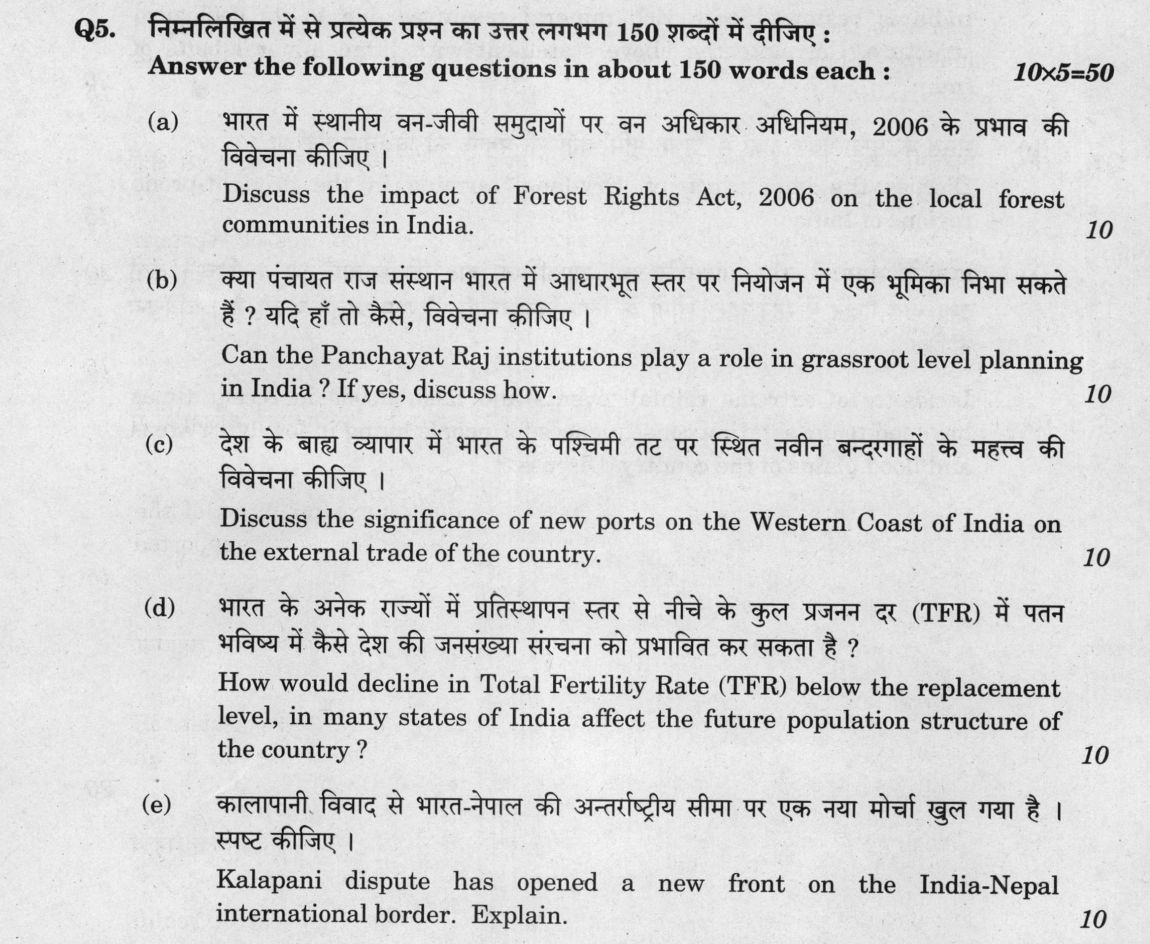
Answer the following questions in about 150 words each : 10×5=50 (a) Discuss the impact of Forest Rights Act, 2006 on the local…
Answer the following questions in about 150 words each : 10×5=50
Discuss the impact of Forest Rights Act, 2006 on the local forest communities in India. 10 marks
Can the Panchayat Raj institutions play a role in grassroot level planning in India ? If yes, discuss how. 10 marks
Discuss the significance of new ports on the Western Coast of India on the external trade of the country. 10 marks
How would decline in Total Fertility Rate (TFR) below the replacement level, in many states of India affect the future population structure of the country ? 10 marks
Kalapani dispute has opened a new front on the India-Nepal international border. Explain. 10 marks
हिंदी में प्रश्न पढ़ें
निम्नलिखित में से प्रत्येक प्रश्न का उत्तर लगभग 150 शब्दों में दीजिए : 10×5=50
भारत में स्थानीय वन-जीवी समुदायों पर वन अधिकार अधिनियम, 2006 के प्रभाव की विवेचना कीजिए । 10
क्या पंचायत राज संस्थान भारत में आधारभूत स्तर पर नियोजन में एक भूमिका निभा सकते हैं ? यदि हाँ तो कैसे, विवेचना कीजिए । 10
देश के बाह्य व्यापार में भारत के पश्चिमी तट पर स्थित नवीन बंदरगाहों के महत्व की विवेचना कीजिए । 10
भारत के अनेक राज्यों में प्रतिस्थापन स्तर से नीचे के कुल प्रजनन दर (TFR) में पतन भविष्य में कैसे देश की जनसंख्या संरचना को प्रभावित कर सकता है ? 10 marks
कालापानी विवाद से भारत-नेपाल की अंतर्राष्ट्रीय सीमा पर एक नया मोर्चा खुल गया है । स्पष्ट कीजिए । 10
Model answer
Written by UPSC Answer Check against this question's marking rubric, to the 150-word length. UPSC does not publish answers for Mains — this is one way to score well, not an official key.
(a) Forest Rights Act, 2006. The Forest Rights Act, 2006, transformed local forest communities from objects of protection into rights-holders by recognising individual forest rights and community forest rights over forest land, resources and produce. It empowered Scheduled Tribes and Other Traditional Forest Dwellers by giving Gram Sabhas a role in verification, enabling access to minor forest produce, grazing, fishing and forest produce, and providing a legal basis for community management. This has strengthened livelihood security, reduced displacement fears, and encouraged conservation through local stewardship. It also regularises traditional access, reducing illegal encroachment and strengthening community-based conservation and biodiversity protection in forest areas. However, implementation has been uneven: many claims were rejected due to procedural hurdles, lack of records, weak forest administration, and overlap with protected areas. Conflicts with conservation goals and forest department control have limited benefits. A way forward is faster claim resolution, demarcation, and participatory forest management.
(b) PRIs in planning. Panchayat Raj institutions can play a decisive role in grassroot planning because the 73rd Constitutional Amendment made Gram Panchayats, Panchayat Samitis and Zilla Panchayats constitutional bodies with elected representatives and devolved functions. The 11th Schedule assigns agriculture, minor irrigation, rural roads, drinking water, health, education and poverty alleviation, enabling local needs to be translated into plans. Gram Sabha provides participatory legitimacy, and District Planning Committees integrate panchayat plans into district plans, while State Planning Committees align them with state and national priorities, including SDGs. In PESA areas, autonomous district and village councils strengthen tribal self-governance. Yet planning is constrained by fiscal dependence, capacity gaps, and top-down schemes. Strengthening fund flows, training, and data systems can make PRIs genuine planning units. They can also monitor MGNREGA, PMAY-G, and rural sanitation, ensuring convergence of central schemes with local priorities, and local audit by Gram Sabhas can improve accountability.
(c) Western Coast ports. New ports on the Western Coast are significant for external trade because they expand India’s container handling capacity at a time when JNPT and Mundra face congestion and capacity limits. Vadhavan near JNPT, Vizhinjam in Kerala, and Enayam in Tamil Nadu provide additional deep-water berths, shorter turnaround, and better access to hinterlands. By dispersing cargo, they reduce pressure on existing ports and improve supply-chain resilience. Their location on the Western Coast shortens sea routes to West Asia, Africa and Europe, helping India capture more transshipment and value-added trade. Vizhinjam, with its natural deep harbour and proposed free trade zone, can develop as a transshipment hub, while Vadhavan strengthens the Mumbai port cluster. However, benefits depend on rail, road and inland waterway connectivity, customs facilitation, and investment in port-city development. If integrated with logistics corridors, these ports can raise India’s trade competitiveness and lower logistics costs nationally.
(d) TFR below replacement. Decline in Total Fertility Rate below replacement level in many states will reshape India’s future population structure. When TFR falls below 2.1, births decline, the working-age population eventually shrinks, and the demographic dividend window narrows. States such as Kerala, Tamil Nadu, Punjab and West Bengal, where NFHS-5 shows TFR around 1.8 or lower, will experience faster ageing than the national average. This will raise the old-age dependency ratio, increase demand for pensions, healthcare, long-term care and geriatric services, and put pressure on public finances. It may also alter labour supply, migration patterns and regional development, as younger states send workers to ageing states. The challenge is not only population decline but preparedness: social security, skill formation, productivity growth and inter-state fiscal transfers must adapt. A balanced approach is needed to convert the remaining demographic dividend into economic growth before ageing becomes a fiscal and care burden.
(e) Kalapani dispute. The Kalapani dispute has opened a front on the India-Nepal border because it combines territorial, strategic, hydrological and diplomatic dimensions. Kalapani, near the source of the Kali River, is claimed by Nepal on the basis of the 1816 Sugauli Treaty, while India has administered it and incorporated it in its maps. Its strategic importance is heightened by the Lipulekh Pass, a route to Tibet used for the Kailash-Mansarovar yatra, making it sensitive for border security and trade. The dispute also touches water resources, as the Kali is a transboundary river. It has strained India-Nepal relations, with Nepal protesting India’s map and India asserting historical control. The concern is that border instability may create space for external influence, such as Chinese engagement in Nepal. A way forward requires diplomacy, demarcation, confidence-building and joint management of the Kali basin, so that a dispute does not undermine the India-Nepal partnership.
What "Discuss" is asking you to do
Lay the issue out from more than one side — how it arose, what is claimed for it, what is held against it, and where it now stands. UPSC attaches discuss to broad topics with several live dimensions, so coverage of the dimensions earns more than the strength of your opinion.
Structure that answers it
Set the issue up → the case as it is made → the case against → the dimension both sides leave out → where the balance now lies
Where marks are lost
Listing facts with no thread between them, or arguing one side throughout and calling it a discussion.
How this answer will be evaluated
Approach
Framework: Concept or mechanism > Diagram > Regional example > Application. (a) discuss: intro > 3-4 dimensions > example > balanced close | (b) discuss: intro > 3-4 dimensions > example > balanced close | (c) discuss: intro > 3-4 dimensions > example > balanced close | (d) explain: definition/context > points in order > small example > short close | (e) explain: definition/context > points in order > small example > short close Full marks: All musts met, 3+ credits, 1+ bonus, precise Indian places, clear mechanism
Key points expected
- Define Forest Rights Act, 2006 (FRA) purpose
- Explain mechanism of Forest Rights Committee (FRC)
- Link physical forest access to human livelihood
- Name specific Indian tribal community or state
- Define Panchayat Raj Institutions (PRI) structure
- Explain mechanism of grassroots planning
- Link local resource to development outcome
- Name specific Indian state or district
Evaluation rubric
Each sub-part is marked on its own, against the marks and word limit printed on the paper.
- (a) Intro > 3-4 dimensions of impact > example > balanced close 10 marks · 150 words
discuss— intro → 3-4 dimensions → example → balanced close
Must cover
- Define Forest Rights Act, 2006 (FRA) purpose
- Explain mechanism of Forest Rights Committee (FRC)
- Link physical forest access to human livelihood
- Name specific Indian tribal community or state
Loses marks
- Description without mechanism of rights
- No specific Indian place named
- No link to human consequence
Earns more
- Mention individual vs community rights distinction
- Reference specific forest produce (NTFPs)
- Discuss impact on forest conservation
- Mention Gram Sabha role in FRA
Extra mark
- Labelled sketch map of a forest region
- Cite specific census or forest survey data
- (b) Intro > 3-4 dimensions of role > example > balanced close 10 marks · 150 words
discuss— intro → 3-4 dimensions → example → balanced close
Must cover
- Define Panchayat Raj Institutions (PRI) structure
- Explain mechanism of grassroots planning
- Link local resource to development outcome
- Name specific Indian state or district
Loses marks
- Description without mechanism of planning
- No specific Indian place named
- No link to human consequence
Earns more
- Mention 11th/12th/13th Finance Commission
- Reference specific scheme (e.g., MGNREGA)
- Discuss role of Gram Sabha
- Mention specific development indicator
Extra mark
- Labelled sketch map of a Panchayat
- Cite specific development data
- (c) Intro > 3-4 dimensions of significance > example > balanced close 10 marks · 150 words
discuss— intro → 3-4 dimensions → example → balanced close
Must cover
- Define Western Coast ports' location
- Explain mechanism of trade facilitation
- Link port infrastructure to economic growth
- Name specific Western Coast port
Loses marks
- Description without mechanism of trade
- No specific Indian place named
- No link to economic consequence
Earns more
- Mention specific trade route (e.g., Suez)
- Reference specific commodity (e.g., oil)
- Discuss impact on regional economy
- Mention specific port authority
Extra mark
- Labelled sketch map of Western Coast
- Cite specific trade volume data
- (d) Definition/context > points in order > small example > short close 10 marks · 150 words
explain— definition/context → points in order → small example → short close
Must cover
- Define Total Fertility Rate (TFR)
- Explain mechanism of population structure change
- Link demographic shift to economic impact
- Name specific Indian state with low TFR
Loses marks
- Description without mechanism of change
- No specific Indian place named
- No link to economic consequence
Earns more
- Mention replacement level (2.1)
- Reference specific demographic dividend
- Discuss impact on labor force
- Mention specific age structure change
Extra mark
- Labelled sketch map of population distribution
- Cite specific census data
- (e) Definition/context > points in order > small example > short close 10 marks · 150 words
explain— definition/context → points in order → small example → short close
Must cover
- Define Kalapani dispute context
- Explain mechanism of border conflict
- Link geographical feature to political tension
- Name specific border location
Loses marks
- Description without mechanism of conflict
- No specific Indian place named
- No link to political consequence
Earns more
- Mention specific treaty (e.g., 1950)
- Reference specific geographical feature (e.g., Lipu Lekh)
- Discuss impact on bilateral relations
- Mention specific diplomatic response
Extra mark
- Labelled sketch map of border area
- Cite specific diplomatic statement
Practice this exact question
Write your answer and it is marked point by point against the model answer above — what you covered, what you missed, what you got wrong.
Evaluate my answer →More from Geography 2022 Paper II
- Q2 (a) Critically examine the factors affecting the unpredictability of South-West Monsoon s…
- Q3 (a) Discuss the recent changes brought about in institutional frameworks of agriculture i…
- Q4 (a) India is bestowed with rich mineral resources due to its geological structure. Correl…
- Q5 Answer the following questions in about 150 words each : 10×5=50 (a) Discuss the impact o…
- Q6 (a) Why do disparities in development and incomes between regions persist in large countr…
- Q7 (a) Discuss the salient characteristics of industrial complexes of Western India. Examine…
- Q8 (a) How do agro-climatic and land capability indicators assist in macro-agricultural regi…