Paper II — Q4
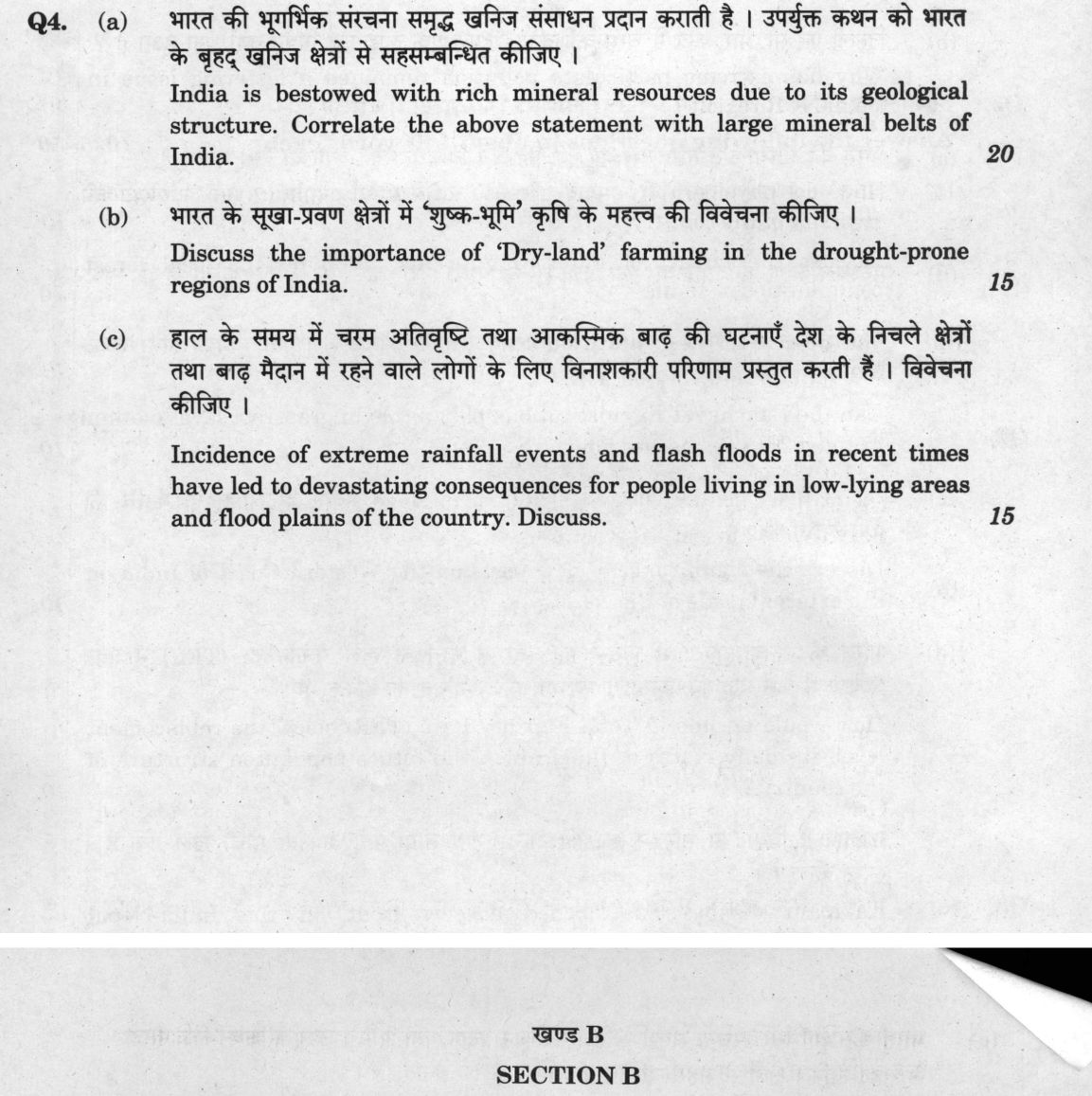
(a) India is bestowed with rich mineral resources due to its geological structure. Correlate the above statement with large…
India is bestowed with rich mineral resources due to its geological structure. Correlate the above statement with large mineral belts of India. 20 marks
Discuss the importance of 'Dry-land' farming in the drought-prone regions of India. 15 marks
Incidence of extreme rainfall events and flash floods in recent times have led to devastating consequences for people living in low-lying areas and flood plains of the country. Discuss. 15 marks
हिंदी में प्रश्न पढ़ें
भारत की भूगर्भिक संरचना समृद्ध खनिज संसाधन प्रदान करती है । उपर्युक्त कथन को भारत के बृहद् खनिज क्षेत्रों से सहसंबद्धित कीजिए । 20
भारत के सूखा-प्रवण क्षेत्रों में 'शुष्क-भूमि' कृषि के महत्व की विवेचना कीजिए । 15
हाल के समय में चरम अतिवृष्टि तथा आकस्मिक बाढ़ की घटनाएँ देश के निचले क्षेत्रों तथा बाढ़ मैदान में रहने वाले लोगों के लिए विनाशकारी परिणाम प्रस्तुत करती हैं । विवेचना कीजिए । 15
Model answer
Written by UPSC Answer Check against this question's marking rubric, to the expected length. UPSC does not publish answers for Mains — this is one way to score well, not an official key.
Geological Structure and Mineral Belts
India’s geological evolution directly governs the spatial distribution of its mineral reserves. The stable, ancient Peninsular shield, shaped by cratonic stability and long metamorphic cycles, concentrates the vast majority of metallic, non-metallic, and fossil fuel deposits, whereas the tectonically active extra-Peninsular region primarily contains tertiary sediments, young coal, and petroleum reserves.
The Archaean crystalline complex and the Dharwar system form the primary repository of metallic minerals. These metalliferous rocks host major iron ore, manganese, and mica belts across the Singhbhum craton, the Bailadila region, and Karnataka's Sandur and Kudremukh belts. The Cuddapah and Vindhyan sedimentary basins are rich in non-metallic minerals, limestone, dolomite, and building stones. In contrast, late Paleozoic-Mesozoic rift basins and grabens facilitated the preservation of the Gondwana formation, which contains over ninety percent of India’s commercial coal reserves along the Damodar, Mahanadi, Godavari, and Wardha river valleys. Intensive tropical weathering of the Deccan basaltic traps and Eastern Ghats granulites produced significant lateritic bauxite belts across Odisha and Gujarat.
Significance of Dry-Land Farming
Dry-land farming is vital for sustaining the agrarian economy of drought-prone tracts in the rain-shadow Deccan plateau, western Rajasthan, Gujarat, and interior Karnataka. Accounting for over half of India’s net sown area, it ensures national food and nutritional security by contributing the majority of coarse cereals (millets like jowar, bajra, and ragi), pulses, and oilseeds.
Sustainable dry-land farming depends on moisture conservation and scientific water management. Integrated watershed management under schemes like PMKSY aids groundwater recharge and surface storage. In-situ soil moisture conservation techniques, including contour bunding, ridge-and-furrow cultivation, and organic mulching, retard runoff and enhance soil-water retention. The adoption of micro-irrigation systems, specifically drip and sprinkler networks, optimizes water-use efficiency. Concurrently, deploying drought-resistant and short-duration high-yielding varieties (HYVs) developed by ICAR-CRIDA, along with agroforestry systems, stabilizes rural incomes, protects topsoil, and builds ecological resilience against recurrent monsoon deficits.
Extreme Rainfall and Flash Floods
The increasing incidence of extreme rainfall events is closely linked to climate change, characterized by accelerated atmospheric warming, anomalous Arabian Sea heating, erratic monsoon low-pressure systems, and the intensification of Western Disturbances interacting with the monsoon trough. These dynamics trigger localized cloudbursts and intense precipitation over short durations, resulting in flash floods and severe inundation.
Devastation is most acute in low-lying areas and river floodplains, exacerbated by unplanned urbanization, destruction of urban wetlands, and encroachment onto natural drainage channels. Catastrophes such as the 2013 Uttarakhand flash floods, the 2015 Chennai urban inundation, and the 2018 Kerala floods demonstrated the vulnerability of low-lying settlements, resulting in severe infrastructural destruction, economic dislocation, and loss of life.
Managing these hydro-meteorological hazards requires strict adherence to National Disaster Management Authority (NDMA) guidelines on flood management. Crucial interventions include modernizing Central Water Commission (CWC) flood forecasting networks with Doppler weather radars, operationalizing impact-based Early Warning Systems, and strictly enforcing river floodplain zoning acts to halt encroachment. Ultimately, adopting integrated, basin-wide river management and nature-based climate adaptation strategies is essential to mitigate flash flood vulnerabilities across vulnerable plains.
What "Discuss" is asking you to do
Lay the issue out from more than one side — how it arose, what is claimed for it, what is held against it, and where it now stands. UPSC attaches discuss to broad topics with several live dimensions, so coverage of the dimensions earns more than the strength of your opinion.
Structure that answers it
Set the issue up → the case as it is made → the case against → the dimension both sides leave out → where the balance now lies
Where marks are lost
Listing facts with no thread between them, or arguing one side throughout and calling it a discussion.
How this answer will be evaluated
Approach
Framework: Concept or mechanism > Diagram > Regional example > Application. (a) explain: definition/context > points in order > small example > short close | (b) discuss: intro > 3-4 dimensions > example > balanced close | (c) discuss: intro > 3-4 dimensions > example > balanced close Full marks: Precise geographical names, clear causal chains, and labelled diagrams.
Key points expected
- Identify Aravalli and Chotanagpur mineral belts
- Link geological age (Precambrian) to mineral concentration
- Explain the mechanism of mineral formation
- Provide a labelled sketch map of belts
- Define dry-land farming (rainfed agriculture)
- Identify specific drought-prone regions (e.g., Deccan)
- Explain soil moisture conservation techniques
- Link physical cause (low rain) to human consequence
Evaluation rubric
Each sub-part is marked on its own, against the marks and word limit printed on the paper.
- (a) Correlate India's geological structure with its major mineral belts. 20 marks
explain— definition/context → points in order → small example → short close
Must cover
- Identify Aravalli and Chotanagpur mineral belts
- Link geological age (Precambrian) to mineral concentration
- Explain the mechanism of mineral formation
- Provide a labelled sketch map of belts
Loses marks
- Listing minerals without geological context
- Omitting the required sketch map
- Confusing sedimentary and igneous origins
Earns more
- Mention specific minerals (iron, manganese) per belt
- Reference the Eastern Ghats belt
- Discuss the role of the Deccan Trap
Extra mark
- Cite specific geological formations (e.g., Dharwar)
- Reference recent mining data or policy
- (b) Discuss the importance of dry-land farming in drought-prone regions. 15 marks
discuss— intro → 3-4 dimensions → example → balanced close
Must cover
- Define dry-land farming (rainfed agriculture)
- Identify specific drought-prone regions (e.g., Deccan)
- Explain soil moisture conservation techniques
- Link physical cause (low rain) to human consequence
Loses marks
- General description without specific techniques
- Ignoring the 'drought-prone' context
- No link to human livelihoods
Earns more
- Mention specific crops (millets, pulses)
- Discuss government schemes (e.g., PMKSY)
- Reference specific states (Rajasthan, Maharashtra)
Extra mark
- Cite specific drought statistics or census data
- Mention a specific recent disaster or failure
- (c) Discuss the consequences of extreme rainfall and flash floods in low-lying areas. 15 marks
discuss— intro → 3-4 dimensions → example → balanced close
Must cover
- Identify specific low-lying areas (e.g., Mumbai, Assam)
- Explain the mechanism of flash floods
- Detail human consequences (displacement, loss)
- Link physical cause to human impact
Loses marks
- General description without specific locations
- Ignoring the 'flash flood' mechanism
- No link to human consequences
Earns more
- Mention specific recent events (e.g., 2023 floods)
- Discuss urbanization's role in exacerbation
- Reference specific river basins (Brahmaputra, Godavari)
Extra mark
- Cite specific disaster data or loss figures
- Mention a specific government response or policy
Practice this exact question
Write your answer and it is marked point by point against the model answer above — what you covered, what you missed, what you got wrong.
Evaluate my answer →More from Geography 2022 Paper II
- Q1 On the outline map of India provided to you, mark the location of all of the following. W…
- Q2 (a) Critically examine the factors affecting the unpredictability of South-West Monsoon s…
- Q3 (a) Discuss the recent changes brought about in institutional frameworks of agriculture i…
- Q4 (a) India is bestowed with rich mineral resources due to its geological structure. Correl…
- Q5 Answer the following questions in about 150 words each : 10×5=50 (a) Discuss the impact o…
- Q6 (a) Why do disparities in development and incomes between regions persist in large countr…
- Q7 (a) Discuss the salient characteristics of industrial complexes of Western India. Examine…